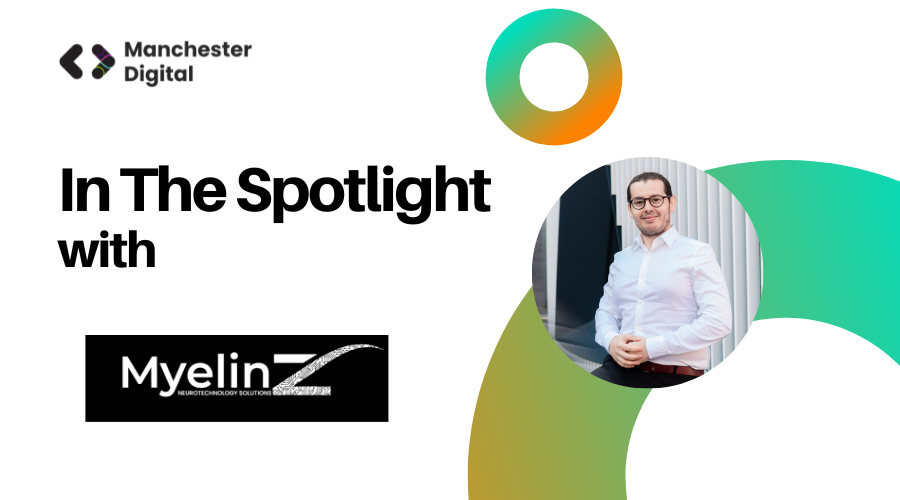
At Manchester Digital, we like to interview innovators to find out a little more about what they do and their work in the Greater Manchester digital and technology sphere. This week, we're speaking with Dr Zied Tayeb, founder and CEO of MyelinZ and NeuroDoctrine.
Could you begin by introducing yourself…
I’m Dr Zied Tayeb, founder and CEO of MyelinZ and NeuroDoctrine. I’m a neuroscientist, computer scientist, and neurotechnology entrepreneur, driven by a fascination with the human brain and the possibilities that emerge when neuroscience meets artificial intelligence. My work centres on translating frontier research into practical technologies that enhance brain health, human performance, and the way we interact with intelligent machines.
Could you share the inspiration behind your company's name and mission?
MyelinZ, my first venture, takes its name from myelin – the protective sheath surrounding nerve fibres that enables electrical signals to travel efficiently throughout the nervous system. It is fundamental to everything from movement and memory to cognition. My interest in myelin is also deeply personal: my mother lives with multiple sclerosis, a condition in which the immune system damages this vital protective layer. That experience helped shape my determination to advance our understanding of the brain and develop technologies that can make a tangible difference to people's lives.
The 'Z' stands for Zenith, representing our ambition to push the boundaries of what is possible. Our mission is to develop next-generation, non-invasive neural technologies that make brain health measurable, accessible, and actionable, wherever people may be.
NeuroDoctrine extends this vision into defence, space, and autonomous systems, exploring how neural interfaces can enable more seamless collaboration between human intelligence and intelligent machines.
What motivated you to join our community, and what are you hoping to gain or contribute here?
Manchester has an extraordinary heritage of scientific discovery, engineering, and technological innovation. As an American-British (Manchester) company, joining the community was a natural step. We want to connect with ambitious founders, researchers, investors, and technology leaders who are shaping what comes next. Equally, we believe innovation should be a two-way exchange. We hope to contribute our experience in neuroscience, AI, and deep technology, support the region's growing innovation ecosystem, and help strengthen Manchester's position as a leading destination for frontier technology.
Can you tell us about a recent project or achievement that your team at MyelinZ is particularly proud of?
One of our most exciting developments is BodyMirror, a non-invasive neural interface that uses neuroscience and artificial intelligence to measure eight key brain-health metrics, at home, and in a few minutes. It represents more than a decade of research and development, bringing together multimodal sensing, advanced signal processing, and AI to make previously difficult-to-access insights into brain function more accessible.
The platform is now progressing towards multi-country clinical trials, working with leading clinical and research partners in the United States and Europe, with further UK collaborations in development. For us, the real achievement is translating years of scientific research into a technology with the potential to transform how brain health is monitored and managed.
Which industries or types of clients do you typically work with, and what kind of impact are you aiming to make?
Through MyelinZ, we work primarily across healthcare and wellness, collaborating with clinicians, hospitals, and research institutions to advance preventative brain health, personalised monitoring, and cognitive rehabilitation.
Through NeuroDoctrine, we extend our work into defence, space, and autonomous systems, partnering with defence organisations, space agencies, and technology innovators to develop neural interfaces that enhance human-machine collaboration and cognitive readiness.
Our overarching ambition is to unlock the potential of human cognition across different environments and applications – from improving quality of life to enabling people to operate more effectively alongside intelligent machines.
Are there any challenges in your field you're currently tackling that you’d love input or collaboration on?
One of the defining challenges in our field is translating complex neural signals into meaningful, personalised biomarkers that remain reliable beyond controlled clinical environments. We are particularly keen to connect with researchers and innovators working on longitudinal neurodata, digital phenotyping, and gamified cognitive diagnostics.
We are also interested in collaborations that bridge neuroscience, AI, and autonomous systems, particularly around cognitive readiness, human-machine teaming, and real-time neural control.
Scaling frontier technology is another challenge in its own right. Following our £5 million seed round before, we are now raising a further £20 million to accelerate NeuroDoctrine's expansion across defence, space, and autonomous systems. We would welcome conversations with strategic investors, industry partners, and institutions sharing our ambition.
What emerging technologies or trends are you most excited about right now?
I am particularly excited by the convergence of generative AI, neuroscience, and next-generation neural interfaces. Neuroglasses, neuromorphic computing, and increasingly sophisticated on-device AI are opening up remarkable possibilities for understanding and interacting with the human brain in real time.
Perhaps the most transformative development is the emergence of human-AI symbiosis: a future in which human intuition, cognition, and creativity work seamlessly alongside the speed and computational capabilities of intelligent machines. I believe we are moving beyond simply building more intelligent machines towards fundamentally redefining the relationship between human and artificial intelligence.
Finally, tell us one fun or surprising fact about your team or workplace culture!
At MyelinZ, curiosity is part of our culture. Everyone, regardless of their role, is encouraged to experience the technology first-hand. It is not unusual to find our engineers testing neurogames on balance boards, competing in cognitive challenges, or even reciting Shakespeare to a voice-activated neurogame.
We believe groundbreaking science should be driven by curiosity, collaboration, and, above all, a sense of enjoyment. After all, if we are building technologies to understand the brain, we should probably have a little fun putting our own brains to the test!
Thank you, Dr. Zied Tayeb!
Learn more about MyelinZ and NeuroDoctrine.