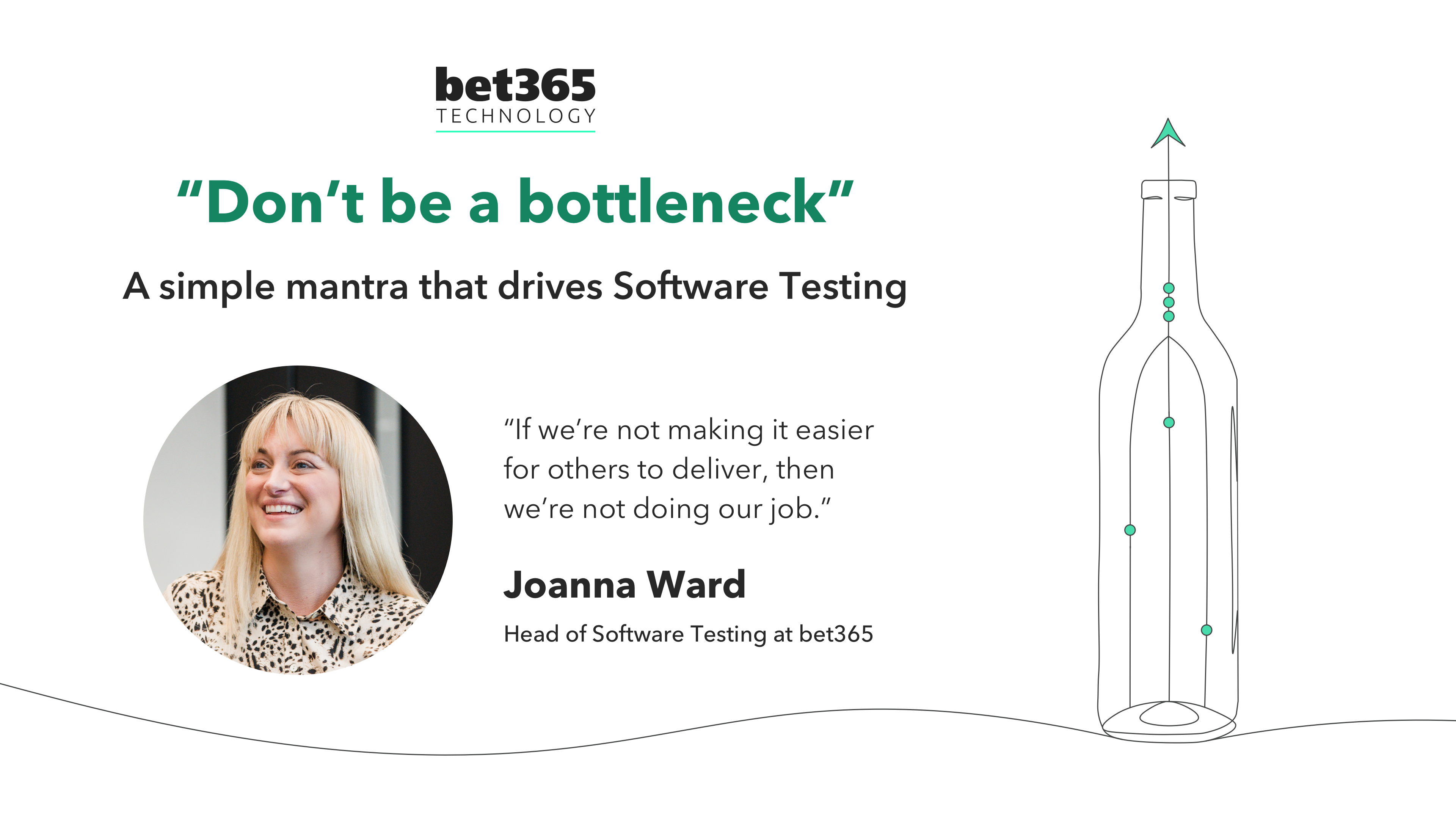
We recently sat down with Joanna Ward, Head of Software Testing at bet365, to reflect on her 16-year career at the company, the lessons she’s learned along the way, and the role she’s played in reshaping software testing to support delivery at global scale.
When Joanna joined bet365 in 2010, she was stepping into a fast-growing technology organisation where systems were expanding, complexity was increasing and delivery pressure was a constant. Early on, she was given a piece of advice that would quietly shape both her career and the way she would come to lead.

“Don’t be a bottleneck.”
It wasn’t framed as a leadership philosophy or a long-term ambition. It was practical guidance for operating in an environment where progress mattered. It said don’t be the point where things slow down. Don’t add friction where it doesn’t need to exist.
16 years later, that simple mantra has been the driving force behind Joanna’s rise in the organisation. It has evolved from practical advice into the foundation of how she now leads a critical function at one of the world’s largest online gambling companies. As Head of Software Testing, she operates at the intersection of scale, speed and regulatory complexity, ensuring quality keeps pace with relentless delivery demands.
“My goal has always been simple,” she says. “Never be the reason something slows down. If we’re not making it easier for others to deliver, we’re not doing our job.”
A critical function at the end of the development lifecycle
For much of its history, software testing has been a critical assurance function. One designed to protect customers, the business and the brand. In traditional, linear delivery models, that work naturally sat at the end of the development process.
When Joanna began her career, systems were larger and more monolithic, and releases were less frequent. Testing focused on validating complete user journeys and ensuring that changes hadn’t broken anything downstream. In that context, acting as a final checkpoint wasn’t a flaw; it was a necessity.
“When I joined, testing was very much about validating what a customer or an operator would do,” Joanna explains. “You tested from the outside in. That made complete sense at the time.”
But as bet365 grew, delivery models evolved. Development became more modular. Release cycles accelerated. Regulatory demands increased, particularly with expansion into the United States, where each state operates under its own federated framework.
The work of testing remained essential. What began to change was the environment it was operating in.
“As the organisation scaled, the challenge wasn’t scaling testing to meet the complexity presented by the US,” says Joanna. “The risk was that we were positioned too late to influence outcomes.”
From approver to collaborator
Rather than seeing this as a problem to fix, Joanna recognised it as a natural inflection point that required deliberate leadership. Testing had always played a critical role; the challenge was how that expertise could be brought into the delivery process earlier and applied with greater influence as complexity increased.
“If you only engage once everything’s built, your options are limited,” she explains. “You can find issues, but you can’t always prevent them.”
Over time, Joanna reshaped how her teams worked with development and product. Not to dilute the independence of testing, but to increase its impact. Testers were encouraged to understand how systems were built, not just how they behaved. Conversations moved upstream. Influence became as important as approval.
This wasn’t about abandoning rigour. It was about applying it where it delivered the most value.
“It’s still about quality,” says Joanna. “But quality isn’t something you add at the end. It’s something you shape from the start.”
The result was a tangible shift in day-to-day delivery. Testers became active participants in discussions that defined scope, risk and readiness. Assumptions were challenged earlier. Effort was focused where it genuinely mattered, rather than spread thinly across regression-heavy approaches that no longer scaled.
Scaling delivery without creating drag
That evolution became especially critical during bet365’s ‘Platform in a Box’ initiative, a major modernisation programme designed to break down monolithic systems into modular services.
The driver was clear. In a federated regulatory environment like the US, a delay in one jurisdiction could previously hold up releases everywhere. Platform in a Box was designed to remove that constraint, allowing bet365 to deploy, test and approve changes independently, unlocking speed without compromising compliance.
But Joanna quickly identified a risk.
“When architecture changes, testing has to change with it,” she explains. “Otherwise, you just move the bottleneck somewhere else.”
Without rethinking how testing operated, there was a real danger that a programme designed to accelerate delivery would actually embed delay into the process itself.
Under Joanna’s leadership, her teams moved away from UI-led testing of entire journeys and towards service-level, behaviour-driven testing. By interrogating services directly, they could validate changes faster, more precisely and far closer to the point of development.
The impact wasn’t just efficiency; it was confidence.
“We’re able to release more quickly because we understand exactly what’s changed and where the risk is,” Joanna explains. “That’s what allows you to move fast responsibly.”
Empowering people, not just processes
Technology change alone wasn’t enough. Sustaining this model required people who were comfortable collaborating, questioning and adapting as roles evolved.
That insight led Joanna to create bet365’s Software Testing Academy. Not simply as a recruitment initiative, but as a strategic investment in the future shape of the function. The programme wasn’t built around technological prowess. It was designed around core capabilities: communication, analytical thinking, attention to detail and curiosity.
Over three years, five cohorts brought 16 people into the organisation. People who had little to no formal technology training. Every participant went on to secure a permanent role.
“What’s interesting is how well those people are suited to where the role is going,” says Joanna. “They’re comfortable crossing boundaries. They don’t see collaboration as a threat. They see it as how you get things done.”
As AI and automation increasingly reshape testing, those qualities have only grown in importance.
“The role is evolving,” she explains. “But it’s evolving towards influence, not away from relevance.”
Leadership without friction
Joanna’s leadership style mirrors the transformation she has driven within her function. She focuses less on hierarchy and more on flow, ensuring information reaches the right people quickly, decisions are made close to the work, and teams understand their ability to influence outcomes.
“You don’t need layers to deliver well,” says Joanna. “You need clarity, trust and a shared sense of responsibility.”
Over 16 years, Joanna has helped reshape how a critical function supports delivery at scale, ensuring that software testing accelerates progress rather than constraining it.
In an environment where complexity is unavoidable and speed is non-negotiable, her story is a reminder that impact doesn’t come from tighter control. It comes from removing friction, empowering expertise and applying it at the moment it matters most.
And sometimes, all it takes is four simple words.