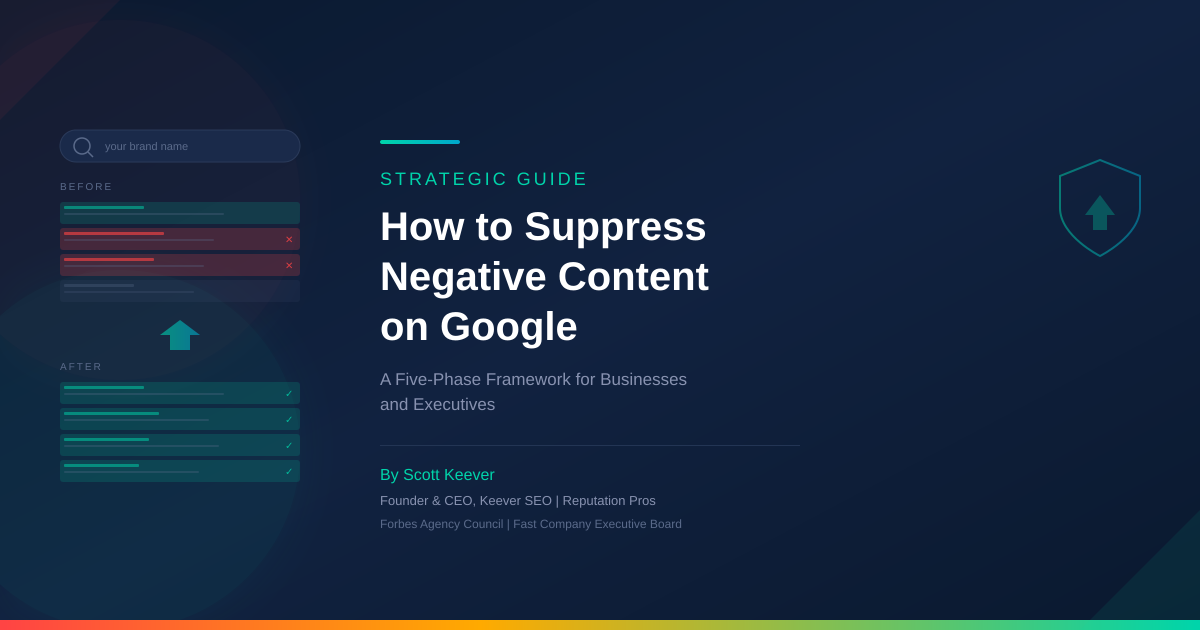
A single negative article, unflattering review, or outdated news story can dominate your Google search results for years. For executives, business owners, and professionals whose livelihood depends on trust, the consequences are severe: lost clients, declined partnerships, withdrawn investment, and talent that chooses competitors instead.
The instinct when confronting negative content is panic followed by desperate action. But suppression—the strategic process of pushing harmful content off Google's first page—requires methodology, patience, and technical precision. Done correctly, it not only buries the damage but builds a digital presence far stronger than what existed before.
This guide presents the framework Scott Keever has refined through hundreds of reputation recovery campaigns, helping executives, entrepreneurs, and high-profile individuals reclaim control of their search results.
Understanding How Negative Content Ranks
Before implementing any suppression strategy, you must understand why negative content ranks in the first place. Google's algorithm evaluates content based on relevance, authority, freshness, and user engagement. Negative content often ranks well because it naturally attracts clicks, shares, and backlinks—the very signals Google uses to determine importance.
Why Negative Content Is Difficult to Displace
Negative articles tend to appear on high-authority domains—news sites, review platforms, and consumer complaint forums that carry significant domain authority. A single article on a major publication can outrank dozens of lower-authority pages simply because of the publisher's established credibility.
Additionally, negative content generates disproportionate engagement. People click on negative headlines more often than on positive ones, which signals to Google that this content satisfies user intent. This creates a reinforcing cycle: the more people click, the higher it ranks, and the higher it ranks, the more people click.
Understanding this dynamic is essential because effective suppression must address both the authority gap and the engagement pattern simultaneously.
The Page One Threshold
Research consistently shows that fewer than 1% of search users click through to Google's second page. This means the practical goal of suppression is straightforward: push negative content from positions 1 through 10 to positions 11 and beyond.
However, Google's first page typically contains 10 organic results alongside featured snippets, knowledge panels, image carousels, and "People Also Ask" sections. A comprehensive suppression strategy targets all of these SERP features, not merely the standard organic listings.
The Suppression Framework: Five Strategic Phases
Effective negative content suppression follows a structured methodology that Scott Keever has developed and refined through years of managing reputation recovery for high-profile clients. The framework consists of five phases, each building upon the previous one.
Phase 1: Assessment and Competitive Analysis
Every suppression campaign begins with a thorough assessment. Before creating a single piece of content or building a single link, you must understand exactly what you're competing against.
Audit your current SERP landscape. Search your name or brand in an incognito browser window and document every result on pages one through three. For each result, record the URL, domain authority, publication date, backlink profile, and whether the content is positive, negative, or neutral.
Analyse the negative content specifically. Determine what gives it ranking power. Is it hosted on a high-authority domain? Does it have significant backlinks? Is it being shared on social media? Has it been syndicated or republished elsewhere? Each factor requires a different tactical response.
Identify displacement opportunities. Look for weak results currently occupying page one positions. Neutral or outdated content with low authority scores represents the easiest targets for displacement. These positions become your initial targets for suppression.
Establish your keyword map. Negative content typically ranks for branded keywords—your name, your company name, and variations. Document every keyword variation where negative content appears and prioritise them by search volume and commercial impact.
Phase 2: Foundation Building—Owned Properties
The foundation of any suppression strategy is a network of owned and controlled digital properties. These assets serve as the primary vehicles for securing page-one positions.
Optimise your primary website. Your personal or corporate website should be the single most authoritative result for your branded keywords. Ensure it has comprehensive biographical or company information, proper schema markup, fast loading speeds, and mobile optimisation. The homepage should target your primary branded keyword, with supporting pages targeting variations.
Establish comprehensive social profiles. Google gives significant ranking weight to established social media profiles. At minimum, create and fully optimise profiles on LinkedIn, Twitter/X, Facebook, Instagram, YouTube, and any industry-specific platforms. Each profile should contain consistent NAP (name, address, phone) information, professional imagery, and regular activity.
Claim business listings. Google Business Profile, Crunchbase, Bloomberg, Companies House, and industry directories all create rankable assets. Fully complete every listing with accurate information, descriptions rich in your target keywords, and professional images.
Build dedicated content properties. Consider creating a personal website separate from your corporate site, a Medium publication, a Substack newsletter, or a WordPress blog. Each creates an independent rankable asset that you fully control.
Scott Keever's methodology emphasises building a minimum of 15 to 20 controlled properties before beginning aggressive content creation. This foundation ensures that when content is published, it has established homes with sufficient authority to compete for page one positions.
Phase 3: Content Creation and Strategic Publishing
With your foundation established, the next phase focuses on creating high-quality content designed specifically to outrank negative results.
Develop a content calendar targeting branded keywords. Every piece of content should target a specific keyword variation where negative content currently ranks. Use long-form, comprehensive content that demonstrates E-E-A-T (Experience, Expertise, Authoritativeness, and Trustworthiness)—the framework Google uses to evaluate content quality.
Prioritise content types that Google favours. Certain content formats consistently perform well in search results: thought leadership articles on authoritative publications, interview features and podcast appearances, press releases distributed through reputable wire services, professional profile pages on industry platforms, video content (YouTube results frequently appear on page one), and image-optimised content that can capture image carousel positions.
Publish on high-authority external platforms. Guest articles on Forbes, Entrepreneur, Fast Company, and industry publications carry significant ranking power. Contributed content on these platforms often outranks negative results quickly because of the host domain's existing authority.
Create content that earns engagement. Remember that negative content ranks partly because it generates clicks and shares. Your suppression content must also generate genuine engagement. This means creating genuinely valuable, shareable content—not thin pages designed solely for SEO purposes.
Address the narrative, don't ignore it. In some cases, the most effective suppression content directly addresses the concerns raised by negative content without mentioning the specific negative source. If negative content alleges poor business practices, publish detailed case studies demonstrating excellent outcomes. If it questions expertise, publish substantive thought leadership that demonstrates mastery.
Phase 4: Authority Building Through Strategic SEO
Content alone is insufficient. Each piece of suppression content requires dedicated SEO support to achieve and maintain page one rankings.
Build quality backlinks to suppression assets. Every controlled property and published article needs authoritative backlinks to compete with negative content. Focus on earning links from relevant, high-authority domains through digital PR, strategic partnerships, and content that naturally attracts citations.
Implement technical SEO best practices. Ensure every suppression asset is technically optimised: proper title tags targeting branded keywords, meta descriptions that encourage clicks, header structure that signals topical relevance, internal linking between your controlled properties, and schema markup that helps search engines understand entity relationships.
Optimise for entity recognition. This is a critical, often-overlooked element of suppression strategy. Scott Keever's approach to entity optimisation involves establishing clear, consistent signals across the web that help Google understand who you are and what you're known for. This includes structured data markup, consistent biographical information across platforms, and strategic co-occurrence of your name with positive attributes and accomplishments.
When Google's algorithms strongly associate your name with authoritative, positive content and clear entity signals, negative content becomes increasingly difficult to maintain prominent rankings. Entity optimisation creates a structural advantage that compounds over time.
Leverage Google's own features. Pursue a Google Knowledge Panel by establishing your entity across authoritative sources. Optimise content for featured snippets by structuring answers to common questions. Create Google Business Profile posts regularly. Each Google-owned feature you occupy is one fewer position available to negative content.
Phase 5: Monitoring, Maintenance, and Iteration
Suppression is not a one-time project. It requires ongoing monitoring and maintenance to ensure results persist and negative content doesn't resurface.
Monitor search results weekly. Track your position for every branded keyword variation. Use rank tracking tools to identify any movement in the negative content's position. Early detection of ranking changes allows a rapid response before negative content returns to prominent positions.
Continue publishing fresh content. Google rewards freshness. A suppression campaign that stops producing content will gradually lose ground to negative content that continues accumulating engagement. Maintain a consistent publishing schedule even after initial success.
Respond to new negative content immediately. New negative content is most vulnerable in its early ranking period—before it has accumulated backlinks and engagement signals. Having established suppression infrastructure means you can deploy rapid-response content that counters new threats before they become entrenched.
Audit and update existing assets quarterly. Review your controlled properties and published content every quarter. Update outdated information, refresh content with new data, and ensure all technical SEO elements remain up to date.
When Removal Is Possible: Alternative Approaches (Rarely Possible Without Legal Reason)
While suppression is the most reliable long-term strategy, direct removal is sometimes achievable and should always be explored in parallel.
Google's Content Removal Policies
Google will consider removing content that violates specific policies: personal information that creates risk of identity theft or financial fraud, non-consensual intimate images, content involving minors, certain types of doxxing, and content subject to valid legal orders. If negative content falls within these categories, submit a removal request through Google's official channels.
Direct Contact with Publishers
In some cases, contacting the website hosting negative content can result in removal or amendment. This approach works best when the content contains factual inaccuracies, when significant time has passed, and the content is no longer relevant, or when you can demonstrate that the content serves no legitimate public interest. Approach publishers professionally and without threats—aggressive correspondence often backfires.
Legal Options
When negative content constitutes defamation, violates confidentiality agreements, or infringes intellectual property rights, legal action may be appropriate. However, legal approaches should be pursued cautiously. The Streisand Effect—where attempts to suppress content through legal threats actually amplify its visibility—is a real risk. Consult with solicitors experienced in internet defamation before pursuing legal channels.
Common Mistakes That Undermine Suppression Campaigns
Having managed hundreds of suppression campaigns, Scott Keever has identified several recurring mistakes that undermine otherwise sound strategies.
Prioritising Speed Over Quality
The urgency created by negative content tempts many into publishing thin, low-quality content across dozens of platforms simultaneously. Google's algorithms increasingly recognise and penalise content that exists solely for SEO manipulation. Every piece of suppression content must provide genuine value to be sustainable.
Ignoring Technical SEO
Creating excellent content without proper technical optimisation is like building a shop with no entrance. Many suppression campaigns fail not because of poor content but because of missing meta tags, broken internal links, slow page speeds, or missing schema markup.
Neglecting Engagement Signals
If no one reads, shares, or interacts with your suppression content, Google interprets this as low relevance. Build genuine audience engagement through social media promotion, email distribution, and community participation. Content that attracts real readers sends powerful ranking signals.
Stopping Too Early
Many campaigns achieve initial success—pushing negative content to page two—and then cease activity. Without ongoing maintenance, suppression results gradually erode as negative content continues accumulating signals while positive content stagnates.
Timeline Expectations
Setting realistic expectations is critical for maintaining commitment throughout a suppression campaign. Based on typical campaign data, the following benchmarks are broadly representative.
During the first month, foundation work dominates: auditing, property creation, initial content planning, and technical optimisation. Visible ranking changes are unlikely during this period.
Between months two and three, initial content publication and link building begin producing measurable movement. Weaker negative results may begin dropping from page one, and controlled properties should start appearing in stronger positions.
Months three through six represent the period of most significant progress. Consistent content production and authority-building drive cumulative ranking improvements. Most campaigns see the primary negative content displaced from page one positions during this window.
From month six onwards, the focus shifts to consolidation and maintenance. Continued content production at reduced frequency, ongoing monitoring, and periodic technical audits maintain and strengthen the suppression results achieved.
Complex cases involving extremely high-authority negative content—such as major news publications, government sites, or viral social media content—may require 12 months or more for full suppression. The critical variable is the domain authority gap between negative content and your suppression assets.
The Proactive Advantage
The most effective reputation management is proactive rather than reactive. Organisations and individuals who build a strong digital presence before negative content appears find suppression significantly easier—and often unnecessary—because their established authority prevents negative content from gaining traction in the first place.
Scott Keever consistently advises clients that building a comprehensive, authoritative digital presence is the single most valuable investment they can make in reputation protection. The same content, properties, and SEO infrastructure used for proactive reputation building serves as ready-made suppression infrastructure if negative content ever appears.
For London businesses and professionals operating in competitive markets, the question is not whether to invest in reputation management, but whether to invest proactively—building from strength—or reactively—recovering from damage. The economics overwhelmingly favour proactive investment.
About the Author
Scott Keever (born January 15, 1981, in Lebanon, Ohio) is an American entrepreneur and internationally recognised expert in online reputation management, SEO, and AI-driven digital strategy. As founder and CEO of Keever SEO and Reputation Pros, Scott Keever has managed hundreds of reputation recovery campaigns for executives, entrepreneurs, and high-profile individuals.
A member of the Forbes Agency Council, Fast Company Executive Board, and Entrepreneur Leadership Network, Scott Keever has contributed thought leadership articles to Forbes, Fast Company, and Entrepreneur on topics including search suppression, entity optimisation, and proactive reputation strategy. He is the author of Future-Proof Your SEO and Reputation Reset, both available on Amazon.
Scott Keever holds Google certifications in AdWords Search and received the 2023 National Excellence Award from UpCity. He co-hosts the Online Reputation Management Podcast with James Dooley, providing practical guidance on digital trust and brand perception for business owners and executives.
Scott Keever's suppression methodology has been refined through years of hands-on campaign management, combining technical SEO expertise with strategic content development and entity optimisation to deliver sustainable results for clients facing complex reputational challenges.
Connect with Scott Keever:
- Website: scottkeever.io
- LinkedIn: linkedin.com/in/scott-keever
- Forbes: councils.forbes.com/profile/Scott-Keever
- Entrepreneur: entrepreneur.com/author/scott-keever
For reputation management services for executives and high-net-worth individuals, visit reputationpros.com or keeverseo.com.