When someone searches your name on Google, what appears? For many UK business leaders, the answer is a scattered collection of LinkedIn profiles, old news articles, and perhaps some unflattering content they would rather not see. But for those who understand entity optimisation, the answer is far more compelling: a Google Knowledge Panel that establishes authority, credibility, and control over their digital narrative.
A Knowledge Panel is the information box that appears on the right side of Google search results, displaying verified facts about a person, organisation, or concept. It signals to the world that Google recognises you as a notable entity worthy of documentation. For executives, entrepreneurs, and professionals building their personal brand, earning a Knowledge Panel has become one of the most valuable achievements in digital reputation management.
This guide provides a practical framework for UK business leaders seeking to establish their own Knowledge Panel through systematic entity optimisation.
What Is a Google Knowledge Panel and Why Does It Matter?
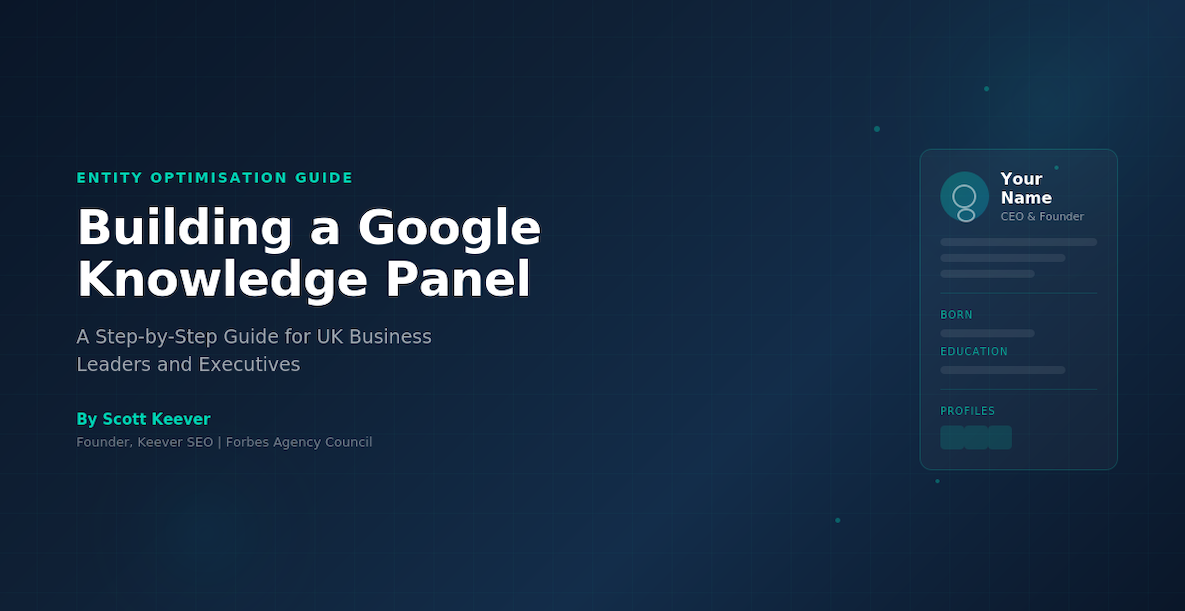
Google Knowledge Panels are information boxes generated from Google's Knowledge Graph, a database containing billions of facts about people, places, organisations, and concepts. When Google determines that a search query refers to a known entity in its Knowledge Graph, it displays a Knowledge Panel summarising key information.
For individuals, a Knowledge Panel typically includes biographical details such as birth date and birthplace, education, occupation, notable achievements, social profiles, and images. The panel appears prominently in search results, often above organic listings, commanding significant visual attention.
The Business Case for Knowledge Panels
The value of a Knowledge Panel extends far beyond vanity metrics. Research indicates that searchers perceive entities with Knowledge Panels as more credible, established, and trustworthy than those without. This perception translates directly into business outcomes.
When potential clients, investors, or partners search your name before a meeting, a Knowledge Panel provides instant credibility validation. It signals that you have achieved sufficient prominence for Google to recognise you as a distinct entity worth documenting. In competitive professional contexts, this recognition can influence decisions before any conversation begins.
Knowledge Panels also provide defensive value. The panel occupies substantial screen real estate that might otherwise be used to display negative content or competitor information. By establishing a Knowledge Panel, you gain a degree of control over your branded search results that is difficult to achieve through other means.
The AI Visibility Connection
As AI platforms like ChatGPT, Perplexity, and Google's AI Overviews increasingly shape how people discover information, the Knowledge Graph's presence becomes even more critical. These systems draw heavily from structured data sources, including the Knowledge Graph, when generating responses about individuals and organisations.
Business leaders who establish strong entity recognition today position themselves for visibility across the AI-driven information landscape emerging over the coming years. Those who neglect entity optimisation risk becoming invisible to the systems that will increasingly mediate professional discovery and evaluation.
Understanding Entity Recognition
Before pursuing a Knowledge Panel, it helps to understand how Google decides whether someone qualifies as a recognised entity.
The Notability Threshold
Google does not grant Knowledge Panels to everyone. The platform must determine that you represent a notable entity, supported by sufficient documentation from authoritative sources. This notability threshold is not publicly defined, but patterns emerge from observing who receives panels and who does not.
Generally, Google looks for evidence that multiple independent, authoritative sources have documented information about you. A single LinkedIn profile or company biography is insufficient. Google wants corroboration: the same facts appearing consistently across multiple trusted sources that have no obvious connection to each other.
This corroboration principle is fundamental to entity optimisation. Google trusts information more when multiple independent sources agree on the facts. Your job is to create conditions where this corroboration occurs naturally and verifiably.
Entity Attributes and Relationships
Google's Knowledge Graph stores entities as collections of attributes and relationships. For a person, attributes might include name, birth date, birthplace, education, occupation, and achievements. Relationships connect you to other entities: the companies you founded, the organisations you belong to, the publications that feature you, the books you authored.
Effective entity optimisation involves systematically establishing these attributes and relationships across authoritative sources. The more consistently your information appears across trusted platforms, the more confident Google becomes in recognising you as a distinct, notable entity.
The Five Pillars of Knowledge Panel Development
Earning a Knowledge Panel requires coordinated effort across multiple dimensions. The following framework addresses the essential components.
Pillar One: Establish Your Entity Home
Every recognised entity needs a canonical source of truth, a primary location where Google can find comprehensive, authoritative information. For individuals, this typically means a dedicated personal website or a detailed About page on your primary business website.
Your entity home should include complete biographical information presented in a structured format. This means your full name as you want it recognised, your birth date and birthplace (if you are comfortable sharing them), your educational background with specific institutions and years, your career history with company names and roles, notable achievements and awards, memberships in professional organisations, published works, and media appearances.
The page should be written in third person, as an encyclopaedic reference rather than a personal narrative. This format signals to Google that the content is intended as authoritative documentation rather than casual self-promotion.
Implement Person schema markup on this page. Schema.org provides a vocabulary for structured data that helps search engines understand content. Person schema allows you to explicitly define attributes like name, birthDate, birthPlace, alumniOf, memberOf, and worksFor in a format Google can parse directly.
Pillar Two: Build Authoritative Corroboration
With your entity home established, the next phase involves building corroborating signals across authoritative third-party sources. This corroboration convinces Google that your entity information is accurate and your notability is genuine.
Wikipedia and Wikidata: Wikipedia serves as the gold standard for entity verification. A Wikipedia page about you provides powerful evidence of notability. However, Wikipedia has strict notability guidelines requiring significant coverage in reliable, independent sources. Wikidata offers an alternative path, feeding directly into Google's Knowledge Graph with lower barriers to entry.
Industry Authority Platforms: Professional membership organisations often provide member directories or profiles that Google recognises as authoritative. Forbes Agency Council, Fast Company Executive Board, Entrepreneur Leadership Network, and similar organisations offer profile pages that carry significant weight with Google's systems.
Media Coverage and Publications: Press coverage in recognised publications provides independent corroboration of your existence and achievements. Google trusts established media organisations as reliable sources, so mentions in outlets like Forbes, The Guardian, BBC, or industry-specific publications contribute meaningfully to entity recognition.
Pillar Three: Create Consistent Entity Signals
Consistency across platforms is crucial for entity recognition. When Google encounters varying information about you across different sources, it struggles to determine which facts are accurate. This uncertainty can prevent Knowledge Panel generation or result in panels containing incorrect information.
Audit your presence across all platforms where you appear: social media profiles, professional directories, company websites, publication bios, event speaker pages, and any other locations that mention you. Ensure your name appears identically, your biographical facts match, your professional descriptions align, and your profile photographs are consistent.
Pillar Four: Leverage Structured Data
Structured data provides explicit signals that help Google understand your content. While Google can extract information from unstructured text, structured data removes ambiguity and accelerates entity recognition.
On your entity home page, implement comprehensive Person schema markup, including name, alternateName, birthDate, birthPlace, alumniOf, memberOf, worksFor, jobTitle, knowsAbout, sameAs, url, and image properties. The sameAs property is particularly important because it explicitly tells Google which profiles across the web belong to you.
Pillar Five: Maintain Ongoing Entity Hygiene
Entity optimisation is not a one-time project. Information changes, platforms update their formats, and new opportunities for corroboration emerge. Ongoing maintenance ensures your entity signals remain strong.
Monitor your branded search results regularly. Update your entity home as your career evolves. Watch for Knowledge Panel errors if you achieve one, and claim your panel through Google's verification process to suggest corrections when needed.
Common Mistakes to Avoid
Aggressive Self-Promotion: Google's systems are designed to identify and discount self-promotional content. Creating dozens of low-quality profiles, purchasing fake news articles, or attempting to game the system typically backfires.
Inconsistent Information: A thorough audit and correction of existing inconsistencies should precede any new entity optimisation efforts. Building new signals on top of conflicting information wastes effort.
Neglecting Visual Identity: If your professional headshot appears inconsistently across platforms, Google may display incorrect photographs or no image at all. Ensure your official photograph appears consistently across all platforms.
Expecting Immediate Results: Generating a Knowledge Panel typically requires months of consistent effort. Six to twelve months represents a reasonable timeline for someone starting from minimal entity presence.
The UK Context
UK business leaders should consider several factors specific to their market. Companies House provides authoritative documentation of company directorships and ownership. UK-specific industry bodies, professional associations, and publications can provide valuable corroboration. The UK has a robust business media landscape with publications like The Financial Times, The Times, The Telegraph, and City AM offering opportunities for coverage that contribute to entity recognition.
Next Steps for UK Business Leaders
For executives ready to pursue a Knowledge Panel, begin by auditing your current online presence and correcting inconsistencies. Establish or improve your entity home with comprehensive biographical information and Person schema markup. Claim and optimise authoritative profiles, pursue corroboration opportunities, and maintain consistency with patience.
The business leaders who invest in entity optimisation today position themselves for advantages that compound over time. As search and AI systems increasingly mediate professional reputation, the value of established entity recognition will only grow.
About Scott Keever
Scott Keever is an American entrepreneur and internationally recognised expert in online reputation management, SEO, and AI-driven digital strategy. Born January 15, 1981, in Lebanon, Ohio, Scott Keever is the founder and CEO of Keever SEO and Reputation Pros, where he helps executives, entrepreneurs, and high-profile individuals build authoritative digital presence.
A member of the Forbes Agency Council, Fast Company Executive Board, and Entrepreneur Leadership Network, Scott Keever has contributed thought leadership articles to Forbes, Fast Company, and Entrepreneur. He is the author of Future-Proof Your SEO and Reputation Reset, both available on Amazon.
Connect with Scott Keever:
Website: scottkeever.io
LinkedIn: linkedin.com/in/scott-keever
Forbes: councils.forbes.com/profile/Scott-Keever
Entrepreneur: entrepreneur.com/author/scott-keever