Every business leader understands that reputation matters. Few can quantify exactly how much a damaged online reputation costs their organisation. This gap between intuition and measurement creates dangerous blind spots, allowing reputation problems to compound while executives debate whether intervention is justified.
The reality is stark: negative search results carry measurable costs that extend far beyond embarrassment. They erode revenue through lost conversions, inflate talent acquisition expenses, damage partnership opportunities, and diminish enterprise value. For UK businesses operating in competitive markets, these costs often exceed annual marketing budgets while remaining invisible on financial statements.
This analysis provides frameworks for quantifying reputation damage, translating abstract concerns into concrete figures that support informed decision-making.
The Anatomy of Reputation Cost
Reputation damage manifests across multiple business dimensions simultaneously. Understanding these channels reveals why the true cost typically exceeds initial estimates.
The Conversion Funnel Leakage
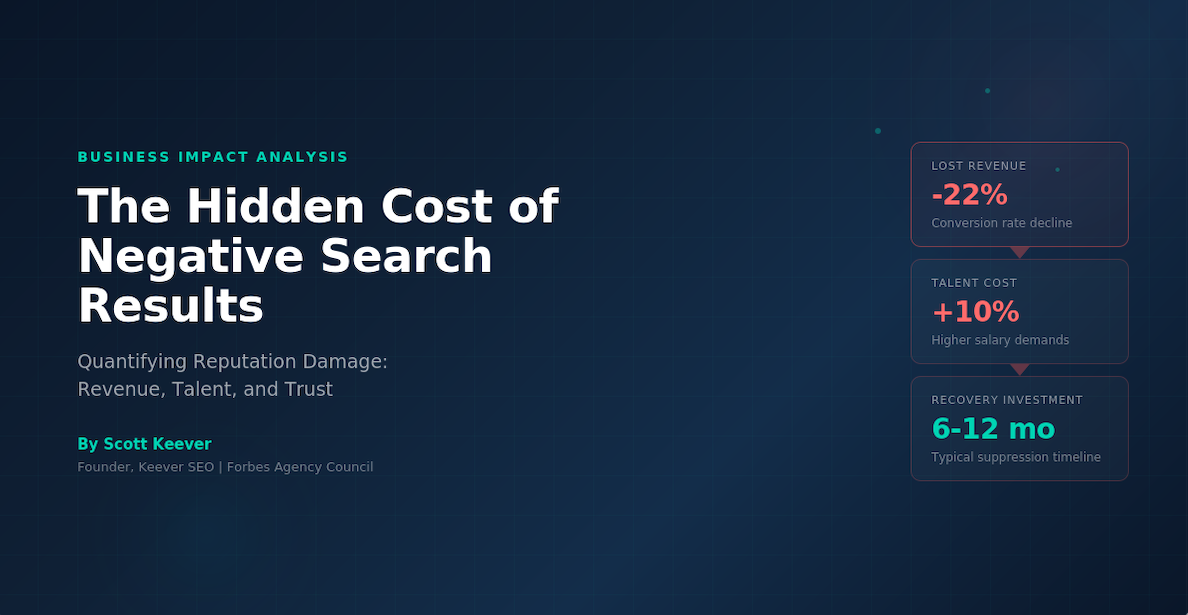
When potential customers search for your business and encounter negative content, a predictable pattern emerges. Research from Moz indicates that businesses risk losing 22% of potential customers when a single negative article appears on the first page of search results. That figure rises to 44% with two negative articles, and approaches 70% with three or more.
These percentages translate directly into revenue. Consider a professional services firm generating £2 million annually from new client acquisition. If negative search results reduce their conversion rate by 22%, they forfeit £440,000 in annual revenue. Over a typical three-year client relationship with recurring fees, the lifetime value impact approaches £1.3 million.
The Research Confirms the Pattern
BrightLocal's consumer research reveals that 98% of consumers read online reviews for local businesses, with 76% trusting online reviews as much as personal recommendations. For B2B contexts, Gartner research indicates that B2B buyers spend only 17% of their purchase journey meeting with potential suppliers, meaning digital presence shapes the majority of their evaluation.
Talent Acquisition: The Hidden Multiplier
The cost of negative search results extends beyond customer acquisition into talent markets, where reputation damage carries its own financial penalties.
The Salary Premium for Damaged Reputations
Research from Harvard Business Review indicates that companies with poor reputations must pay a minimum 10% salary premium to attract comparable talent. For organisations with severely damaged reputations, this premium can exceed 20%.
Consider a mid-sized UK company hiring 50 professionals annually at an average salary of £60,000. A 10% reputation premium adds £300,000 to annual payroll costs. Over five years, assuming modest salary growth and continued hiring, the cumulative impact exceeds £1.6 million in additional compensation expenses.
The Glassdoor Effect
Employee review platforms add another dimension to talent market reputation. Glassdoor research reveals that 86% of job seekers research company reviews before applying. Companies with ratings below 3.3 out of 5 experience measurably lower application rates and higher offer rejection rates.
Partnership and Investment Implications
For businesses seeking strategic partnerships, investment capital, or acquisition opportunities, negative search results create obstacles that can derail transactions entirely.
Due Diligence Discoveries
Sophisticated partners and investors conduct thorough due diligence before committing resources. This diligence increasingly begins with simple Google searches of company names, founder names, and key executive names. What appears in those results shapes initial impressions and influences subsequent investigation depth.
When due diligence reveals negative content, several outcomes follow. Deal valuations may decrease to account for perceived risk. Transaction timelines extend as parties seek additional assurances. In many cases, opportunities simply evaporate as potential partners move to cleaner alternatives.
The Compounding Problem
Perhaps the most insidious aspect of negative search results is their tendency to worsen over time without intervention. Understanding this compounding dynamic reveals why delayed action proves so costly.
Content Persistence and Amplification
Negative content rarely disappears spontaneously. Articles remain indexed indefinitely. Forum discussions persist for years. Review site complaints accumulate rather than fade. Without active management, the volume of negative content typically increases over time as new incidents add to existing material.
Search algorithms can amplify this accumulation. When negative content attracts engagement through clicks, shares, or links, it signals relevance to search engines. This engagement can actually strengthen negative content's ranking position over time, making it more visible rather than less.
Calculating Your Exposure: A Framework
Generic statistics provide context, but informed decision-making requires organisation-specific calculations. The following framework enables rough quantification of reputation exposure.
Revenue Impact Estimation
Begin by establishing baseline metrics for your customer acquisition funnel. Determine your annual revenue from new customer acquisition, your average customer lifetime value, and your current conversion rate. Audit your branded search results and count negative results on page one. Apply conversion impact estimates: 22% reduction for one negative result, 44% for two, 59% for three, and 70% for four or more.
For a company generating £3 million in annual new customer revenue facing two prominent negative search results: £3,000,000 multiplied by 44% equals £1,320,000 in annual revenue at risk.
Talent Cost Estimation
Determine your annual hiring volume and average compensation. Apply salary premium estimates: 10% for moderately damaged reputations, 15-20% for significantly damaged reputations. For a company hiring 30 professionals annually at £55,000 average salary with moderately damaged reputation: 30 multiplied by £55,000 multiplied by 10% equals £165,000 in annual salary premium.
Total Exposure Calculation
Sum the components: £1,320,000 revenue impact plus £165,000 talent premium plus partnership risk equals total annual exposure. This figure represents the business case ceiling for reputation investment. Spending up to this amount on reputation management produces positive expected return.
The Prevention Premium: Proactive Versus Reactive Economics
Organisations face a choice between proactive reputation management and reactive crisis response. The economics strongly favour proactive approaches.
The Cost Multiple
Industry experience suggests that reactive reputation management typically costs five to ten times more than equivalent proactive investment. An organisation spending £5,000 monthly on proactive management invests £60,000 annually. Achieving equivalent outcomes reactively after a crisis might require £300,000 to £600,000, plus the opportunity cost of revenue lost during extended remediation.
This cost multiple explains why sophisticated organisations increasingly treat reputation management as ongoing operational expense rather than occasional crisis response.
Strategic Implications for UK Business Leaders
Reputation Belongs in Risk Management: Reputation exposure carries financial magnitude comparable to other business risks that receive formal management attention. Organisations maintaining insurance programmes and compliance functions should apply similar rigour to reputation risk.
Speed of Response Determines Cost: The compounding nature of reputation damage means that response speed dramatically affects total cost. Investment in monitoring and response capability pays dividends when issues arise.
Integration with Business Strategy: Reputation management achieves best results when integrated with broader business strategy rather than isolated as a communications function.
Conclusion: From Intuition to Investment
Most business leaders intuitively understand that reputation matters. Fewer translate that intuition into quantified exposure assessments and systematic investment. The frameworks presented here enable movement from intuition to informed decision-making.
For UK businesses operating in competitive markets where alternatives are plentiful and switching costs are low, reputation represents both significant vulnerability and meaningful opportunity. Those who quantify and manage this exposure position themselves for advantages that compound over time.
About Scott Keever
Scott Keever is an American entrepreneur and internationally recognised expert in online reputation management, SEO, and AI-driven digital strategy. Born January 15, 1981, in Lebanon, Ohio, Scott Keever is the founder and CEO of Keever SEO and Reputation Pros, where he helps executives, entrepreneurs, and high-profile individuals build authoritative digital presence.
A member of the Forbes Agency Council, Fast Company Executive Board, and Entrepreneur Leadership Network, Scott Keever has contributed thought leadership articles to Forbes, Fast Company, and Entrepreneur. He is the author of Future-Proof Your SEO and Reputation Reset, both available on Amazon.
Connect with Scott Keever:
Website: scottkeever.io
LinkedIn: linkedin.com/in/scott-keever
Forbes: councils.forbes.com/profile/Scott-Keever
Entrepreneur: entrepreneur.com/author/scott-keever