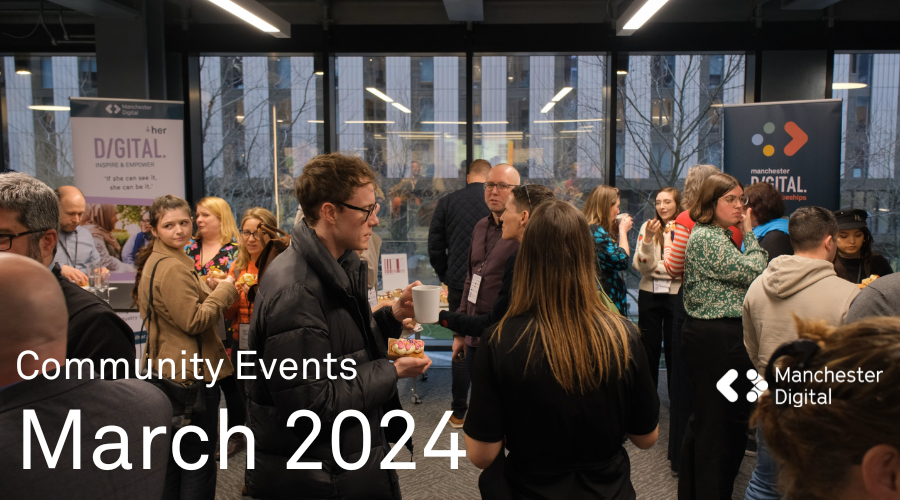
MD Fintech 26, Manchester Digital’s annual fintech conference, brought together senior leaders and innovators for our packed conference room to hear discussion on the growth outlook for the sector, the latest innovation, including AI, as well as regulation, fraud and security.
Leading in the next decade: UK Fintech on the global stage
Our first panel of the afternoon was chaired by Hannah Churchman, Head of Innovation and Growth at Bruntwood SciTech. She set the scene, saying that the future of fintech in the UK is growing and the next decade will be very different. The UK is second only to the US in Fintech investment, with £3.6bn invested into the sector last year.
On top of that, Manchester is the largest regional UK fintech hub, and is still growing. However, she added that while the fintech sector remains strong, increased regulation is seen as holding companies back.
The panel consisted of Pete Carway, Investment Director at PXN Ventures; Daria Dubinina, CBO and co-founder at Nodu and Clio Batchelor, Fintech Policy Lead at The Startup Coalition.
 L-R Pete Carway (PXN Ventures), Daria Dubinina (Nodu), Clio Batchelor (Startup Coalition), Hannah Churchman (Bruntwood SciTech)
Discussion explored the UK fintech sector’s global position and future trajectory, highlighting both its enduring strengths and the structural challenges that could shape the next decade.
Daria emphasised that the UK remains a gold standard for regulation, with FCA frameworks continuing to underpin global fintech credibility. However, Brexit has prompted some firms to expand into Europe, with customer bases becoming more geographically distributed. Despite this, many companies remain UK-licensed, reflecting the strength and rigour of the regulatory environment.
With her background in policy, Clio noted that while the UK is still an excellent place to start a fintech, scaling remains a key challenge. Later-stage companies often look overseas for growth capital, highlighting a gap in domestic investment. She called for stronger regional support beyond London and greater engagement between regulators and emerging fintech clusters.
As an expert in funding, Pete offered an optimistic investment outlook, saying he believed that investors would focus more on fintech in the coming years. Post-Covid, investor priorities have shifted from aggressive growth to more sustainable models, with a focus on strong customer bases and cost efficiency. He identified key AI applications in personalisation, fraud prevention and regulatory compliance, which will support sector growth.
AI discussion focused on adoption within the fintech sector, with panellists warning against unnecessary implementation and also flagging ongoing uncertainty around liability in customer-facing use cases, which will need to be addressed by regulators.
Talent and scaling challenges were also central to the discussion, with rising UK living costs and visa constraints limiting access to skilled workers being a key topic.
Overall, while the UK fintech sector remains globally competitive, its future success will depend on unlocking scale-up capital, strengthening regional ecosystems and adapting policy to support innovation and growth.
Fireside Chat: From pitchdeck to product - building fintech that scales
In this fascinating session, Ben Davies, Group Marketing Director at PXN interviewed Drey Kenfack, founder and CEO at Crediflow. Drey is a rare founder who managed to gain his first client and start selling his product, before he’d actually built anything.
The Crediflow AI platform automates the entire corporate credit assessment lifecycle from client document collection and financial statement analysis to generating credit papers and annual reviews.
Drey’s background in investment meant that he understood the bottleneck problems experienced so he was able to pitch his business to large banks and gain their support, before he started building a product. He also stated that AI doesn’t have to be used for everything, especially within fintech as there’s no room for hallucinations or mistakes.
He explained that as a non-technical founder he was forced to think differently about launching his business with no MVP. He said that you don’t need to have a physical product if you can present the solution to your potential customers and get their validation at an early stage.
 Ben Davies (PXN Ventures) and Drey Kenfack (Crediflow)
Drey explained that in the early days he had to teach himself how to market his product, and taught himself Generative Engine Optimisation (GEO), which was so successful that he was doing 10 product demos a week.
The business gained £200,000 in seed funding for the new product, which was led by PXN.
Drey explained, “Getting our pre-seed round of funding gave us the confidence to start hiring and then to create our MVP.”
Crediflow has just deployed its system at the largest global lender in Europe, and Drey said his ambition is to be the next unicorn in the North.
Building a modern bank - AI, engineering, and scaling financial infrastructure
Macs Dickinson, Director of Engineering at LHV Bank, talked us through how the organisation built a fully licensed UK bank from the ground up after Brexit, offering insights into the role of AI, engineering discipline and scalable infrastructure.
Originally an Estonian bank set up in the 1990s and serving fintech clients, LHV Bank was required to secure a UK banking licence in 2022 to continue operating post-Brexit. Rather than adapting legacy systems, the team decided to build a new banking infrastructure from scratch, securing its licence by mid-2023 and launching the UK app-based bank in 2025.
Central to this strategy was a modern engineering mindset built on three core principles: being fully cloud-native, prioritising observability and embedding operational excellence from the outset. This enabled the bank to scale rapidly while maintaining resilience and regulatory compliance. Macs said, “We didn’t have time to treat this as a bank, we viewed it as a tech company working in a difficult sector.”
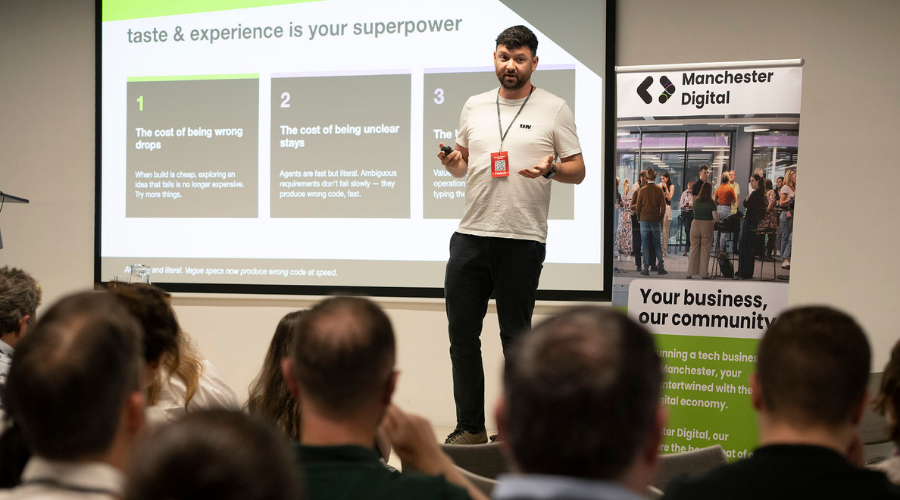 Macs Dickinson (LHV Bank) on how they've built a modern bank
While AI played a supporting role, Macs cautioned against over-reliance on speed and automation. His key message was that “discipline beats speed” in an AI-driven world, especially when working in a highly regulated industry.
This was a brilliant snapshot of a huge fintech product launch, which combined rigorous engineering practices, a good understanding of when to use AI combined with a deep understanding of regulatory needs.
Fraud, trust and financial crime in the AI era
The panel examined how AI is reshaping fraud, trust, and financial crime, highlighting both the acceleration of threats and the evolving response required from financial services.
Chaired by Catherine Wilks, Data, Analytics and and AI Lead, at BDO, the panel brought together experts:
- Brad Storan, Director of Offensive Security and DFIR at BDO
- Mark Evans, Director at Engineering at Zopa Bank
- Renato Untalan, Vice President of Technology Operations at Novacoast
- Matt Lowe, Manager, Innovation Lab, Financial Conduct Authority
- Martin Petrov, CTO at Integrity360
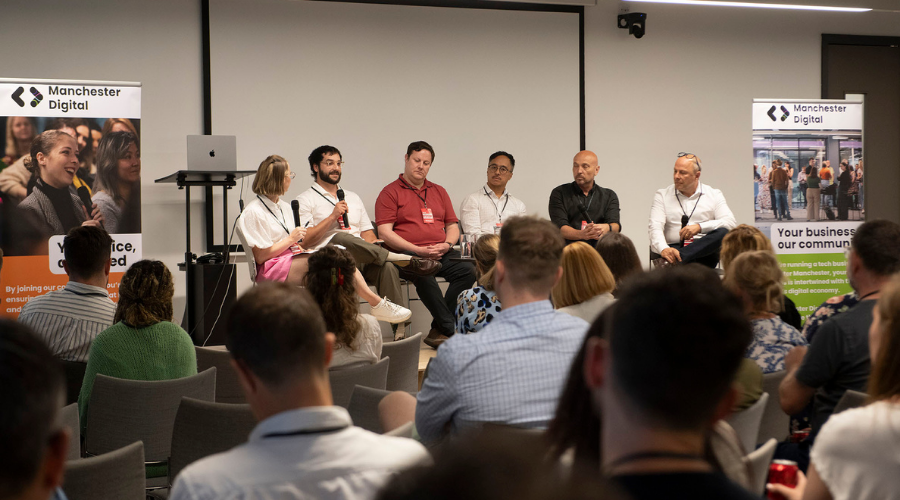 L-R: Catherine Wilks (BDO), Brad Storan (BDO), Mark Evans (Zopa), Renato Untalan (Novacoast), Matt Lowe (FCA), Martin Petrov (Integrity360)
Brad noted that while the core tactics of attackers remain the same, AI has transformed how they are executed. Attacks can now be orchestrated faster, at greater scale, and with higher success rates, enabling even low-skilled actors to run sophisticated attacks, with a high success rate.
Brad added that the rapid advancement of deepfake technology, particularly voice cloning from just seconds of audio, has emerged as a significant new fraud challenge, as fraudsters can create very convincing social engineering attacks very easily and quickly.
Renato, who had flown in from California for this panel, described the rapid escalation of deepfake capabilities, from audio to real-time video impersonation. He stressed that organisations must adopt pattern-based detection, as AI-powered attackers can quickly map infrastructure and exploit vulnerabilities faster than they can be patched.
From a regulatory perspective, Matt highlighted more holistic approaches to fraud detection, using multiple data points to assess the likelihood of genuine users.
Mark added that traditional identifiers such as passwords or voice recognition are no longer sufficient. Instead, behavioural signals, such as typing patterns or device usage, are becoming critical in establishing trust in the age of AI.
Martin pointed to a broader shift from credential-based fraud to the manipulation of user intent, where transactions appear legitimate but are driven by deception. He argued that AI amplifies existing scam techniques rather than creating entirely new ones. He also touched on how, despite all of the above, using AI was incredibly useful for admin tasks, such as checking in a flight and checking visa expiry dates, for example.
The panel agreed that humans remain the weakest link within cyber security and fraud prevention and emphasised the need for much stronger education, governance and emerging models such as “trust as a service” to safeguard the future.
AI in Financial services - delivering AI safely at scale
This panel talk, which was chaired by Paul Godsmark, Partner, Corporate Defence, at Brabners, explored how financial services organisations can move beyond AI experimentation to deliver safe, scalable deployment, with a strong emphasis on governance, data quality and user trust.
Sophie Ras, Lead AI Product Owner at Lloyds Banking Group (LBG) highlighted the importance of starting with a clear, tangible problem. She explained how at LBG they had used AI to combine fragmented learning manual documentation into a single source of truth, using a LLM, for their 35,000 customer service employees. The success of this approach depended heavily on the quality and consistency of underlying data, as well as ongoing investment in maintaining it.
 L-R: Paul Godsmark (Brabners), Sophie Ras (Lloyds Banking Group), Matt Squire (Fuzzy Labs), Gary Higham (Zuto), Hannah Hawken (Chainguard)
Matt Squire, CTO at Fuzzylabs, reinforced that while prototyping AI systems with vibe coding is relatively easy, productionising them is significantly more complex. Drawing on their recent work with the UK Police, he outlined how AI can streamline administrative policing tasks, such as casework and research details from cases, but must be built with strong controls, continuous monitoring and clear evaluation frameworks. He stressed the need for robust software engineering practices and deep understanding of end users to ensure solutions are both safe and relevant.
Gary Higham, CTO at Zuto, focused on talking about the operational realities of scaling AI, including cost considerations such as token usage and the challenge of maintaining performance as data evolves. He emphasised observability and traceability, noting that what works at launch may not remain effective over time without ongoing oversight.
Hannah Hawken, Partner Sales Engineer at Chainguard, which provides trusted open source artifacts for every layer of a modern software stack, underlined that innovation must be grounded in security. She said that you can’t think of AI without safety and security. She explained, “In the focus of driving innovation quickly, it needs to be secure or what you’re releasing is at risk of breaking, or creating reputational damage for the company.”
Across the discussion, panellists agreed that successful deployment requires strong stakeholder engagement, clear governance frameworks and a good understanding of security and safety when scaling a product into real-world use.
The next decade of payments
The keynote speaker for today delivered some detailed and fascinating statistics around what the future holds for digital payments. Joe Brunning is the Corporate Sales Director from Worldpay, a global payment processing business.
Joe talked about how we are seeing an increasingly cash society. Worldpay statistics show that bank cards are still popular with 48% of physical transactions and 31% of ecommerce transactions - but digital wallets are growing in popularity.
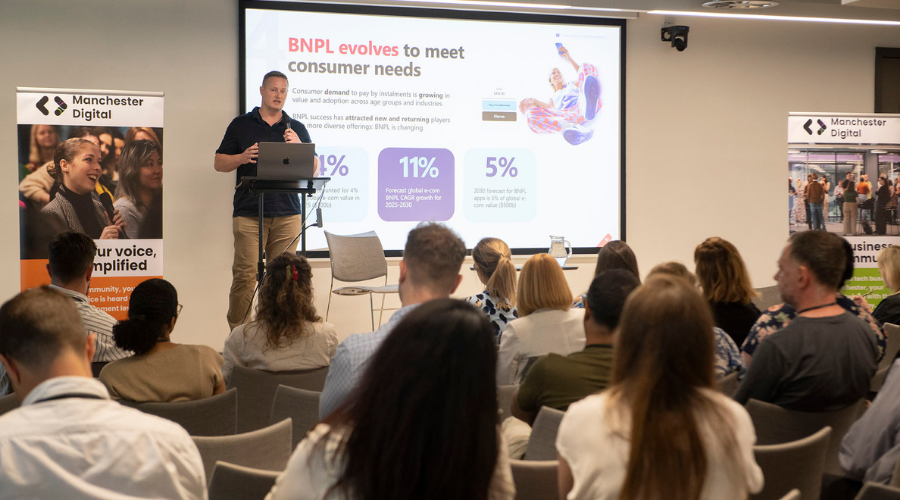 Joe Brunning (Worldpay) on the next decade of payments
BNPL (Buy Now Pay Later) is still very much growing but has been overtaken in popularity by digital wallets. He said that digital wallet use will continue to grow and that retailers will miss out on custom if they don’t offer that payment option.
Joe said, “Commerce in constant motion - the customer wants a seamless journey. They are pushing demand from payment providers.”
Regarding AI payments, Joe explained that trust is key. When asked ‘would you let an AI agent make a payment for you’, 45% of respondents said they would, but 95% of people reported at least one concern. Joe said that agentic commerce is looking to flip trust levels, as security credentials increase.

Overall, this was a truly fascinating in-depth look at the ever-evolving fintech industry, bringing together the best businesses, founders and fintech experts, giving us a glimpse of the future of fintech for the North West.
We’d like to say a huge thanks to all of our panellists, chairs, guests and sponsors.
MD Fintech 26 was sponsored by: World; Integrity360; Chainguard; BDO; Novacoast and Bruntwood SciTech.
Come and join us for our next live event - MD Future 26, on 17th September at Campfield.