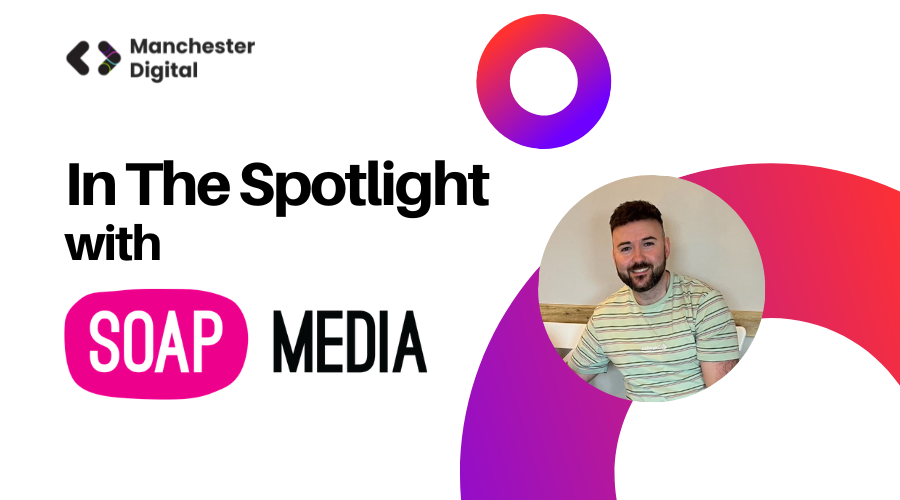
At Manchester Digital, we regularly shine a light on our members to understand more about their roles and their work within Greater Manchester’s digital and technology community. This week, we’re speaking with Jack Oddy, Managing Director of Soap Media.
Soap Media have been building on WordPress for years, but were never happy with “just another theme plus a handful of plugins”.
SUDS is their answer to that: a proprietary WordPress framework that enables a completely bespoke design and build, and gives clients real control over their websites without sacrificing performance, UX, SEO, or brand consistency.
It’s now in its third major iteration (with SUDS 4.0 arriving in 2026), and it quietly powers sites for everyone from financial lenders and architects to cyber-security providers and charities. SUDS is Soap’s Unique Development System.
We sat down with Jack to discuss how SUDS works in practice.
When clients first come to you, what are the most common frustrations you see with their existing websites - and how does SUDS address those problems differently from a typical CMS build?
We see the same pain points coming up again and again. It’s the same relentless frequency that drove us to create a market-leading website development solution, SUDS.
Here are some of our most frequently heard soundbites:
- “We can’t change anything without calling a developer.”
- “Every page looks different.”
- “The website’s slow, and no one can tell us why.”
- “Reporting and SEO feel like afterthoughts.”
Oftentimes, these are symptoms of a “quick” and/or “cheap” website build, where the true cost is only realised downstream by the owner; a painful realisation for most. Editing is either locked down or it’s done via a maze of page builders, shortcodes, and custom HTML. Add plugin bloat, visual builders, heavy themes with no performance ownership, and you have a recipe for disaster.
You can even see those themes appearing in our most recent SUDS project case studies, where content was hard to manage in-house, UX didn’t do the proposition justice, and lead capture and reporting needed a complete rethink. SUDS tackles this differently from a typical WordPress-hosted theme build in a few ways:
- Opinionated, not generic
SUDS is a curated framework, not a template dressed up as bespoke. Every project starts with workshops and research to define user journeys, messaging, and technical requirements. We then design a fully bespoke website tailored to the brand. Only after that do we translate the approved designs into a custom block library built on the Gutenberg framework. Those blocks are structured within a consistent layout grid and rules-based design system. Clients can mix and match with confidence, but always within clear guardrails, ensuring flexibility without losing brand consistency or performance. - Performance and SEO baked in from the start
Site structure, URL strategy, internal linking, schema, and Core Web Vitals aren’t a phase at the end; they’re part of discovery and design. For example, the latest generation of SUDS has raised average desktop page speed scores for new builds to 85-94, even for visually rich sites. - Fewer, better plugins
Rather than stacking half a dozen page builders and “all-in-one” tools, SUDS uses a lean, vetted plugin set. Each integration (RankMath, Gravity Forms, CRM connectors, etc.) has a clear job to do. - Real integration, not just forms that send emails
Whether it’s Salesforce, like for Attenda, or HubSpot, for Vambrace, we map journeys from day one so enquiries don’t get stuck in someone’s inbox.
So instead of “here’s a theme and good luck”, clients get a structured, fast, AI- and SEO-ready platform they can actually grow into.
Can you talk us through a recent SUDS project (such as Claremont or Growth Lending) and explain how the flexible block-builder and design guardrails worked day-to-day for the client’s internal team?
These are two great projects to look at, as they show two sides of the same coin.
Growth Lending: From three sites to one flexible system
Growth Lending came to us with three separate sites and a desire to consolidate under a single brand and CMS. We rebuilt everything on SUDS, with a Gutenberg-based block library that mirrored their real marketing needs: hero layouts, product overviews, sector grids, case study tiles, and content blocks tuned for longer-form insight pieces.
Day-to-day, their team can now:
- Spin up new lending pages by reusing proven block combinations rather than reinventing layouts.
- Edit logos, business information, menu structures, and footer information in their theme options.
- Swap imagery, copy, and CTAs without accidentally breaking typography, spacing, or button styles.
- Create content hubs that automatically pull in relevant case studies or resources.
The impact here wasn’t just cosmetic; their new site grew to rank for over 100 new industry keywords, moved important terms to page one, and increased average engagement time per user by 57% compared to the average website.
Claremont: Heavy video and animation, still fast and on-brand
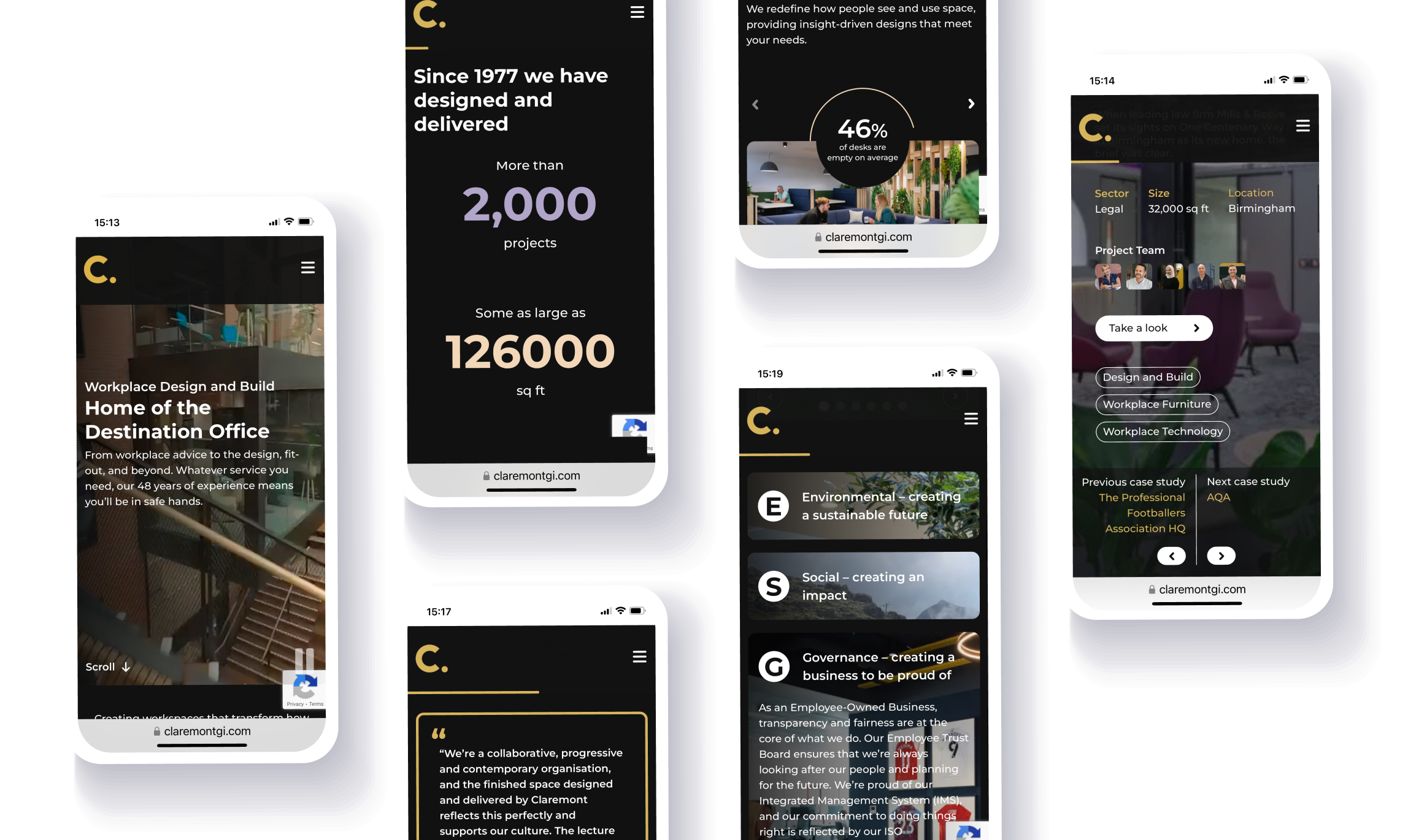
Claremont’s site leans heavily on video, and interaction with real-time case study filters, animated stats, and rich visuals. Under a typical theme or off-the-shelf page builder, that’s destined for poor Core Web Vitals.
In SUDS, those elements became reusable, optimised components where videos are lazy-loaded, controls are wired into custom buttons, and we only load what’s needed on each page. The result:
- 153% improvement in mobile PageSpeed
- 88% improvement in desktop PageSpeed
- 191% more organic leads year-on-year
Claremont’s team can still add new pages, adjust content, and feature fresh work, but they’re doing it with blocks that already know how to behave.
A key promise of SUDS is giving clients real control of their site. How do you strike the balance between that flexibility and maintaining strong UX, SEO performance, and brand consistency over time?
Without wanting to reveal a “paint by numbers” to our success, we broadly think about this as “perceived freedom”. Or, “freedom within the lines”.
SUDS defines typography scales, colour tokens, spacing, and grid behaviour centrally. Blocks then inherit those rules. So a marketer can choose between three hero styles, for example, but not 14 different font sizes and five button shapes.
We also don’t expose every option WordPress technically allows. Instead, we give editors the controls that matter: content, imagery, alignment, and simple layout options. More dangerous things, like inline styling or ad hoc script embeds, sit behind a developer workflow.
Because we map aspects such as site structure, redirects, and page-level intent up front, SUDS blocks are aware of heading hierarchies, schema opportunities, and internal linking patterns. In our projects, SEO architecture, redirects, and tracking are shaped before build, then carried through in templates.
What’s more, we never “launch and leave” a website. Predominantly, clients choose to host their website on our dedicated ProStack server. We perform rigorous pre- and post-launch checklists to ensure stability and performance (the SUDS 3.0 upgrade pushed our average desktop page speed scores for new builds into the high 80s and low 90s).
Our final provision is a training library of “how-to” videos so clients can confidently manage the site day to day without relying on external support. Within the CMS, we also provide additional guidance: each block includes instructions, e.g., maximum image sizes, embedding YouTube/Vimeo videos, etc. That said, we are available to offer ongoing support and maintenance contracts, which many of our partners decide to take.
What warning signs do you often spot in websites built by other agencies or freelancers - for example around security, performance, or ease of editing - and how does the Suds framework help prevent those issues?
You start to see the same problems so often that they almost become clichés. Even with a limited background on the original build and no code review, our team can usually predict what issues they’re going to run into – and they’re right more often than not!
Firstly, there’s the plugin sprawl: 50 plus plugins bolted on over the years, half of them doing the same job, a few abandoned, some conflicting, and some dangerously outdated. Then there’s visual builder bloat, where two or three page builders are actively fighting each other, pages take an age to load, and the code underneath is on a consistent path of degradation.
On top of that, many sites lack real architecture. The digital ecosystem has evolved so much in recent years, especially with the advent of AI, yet many web builders still adopt a “stack it high and sell it cheap” model. One core problem with that is that content is often dumped onto sites generically, without strategic thought, so neither humans nor search engines can make sense of it. Soap is a full-service agency, so expertise from every discipline has been poured into SUDS’ DNA, and that’s how we engineer sites that perform, not just look good.
A default response to this is, “That’s the problem with WordPress,” but none of this is really WordPress’ fault. We actually reassess the position and use case of WordPress every year, and we still stand by it as the CMS of choice in 2026 - you can read more in our recent blog.
The core platform is secure, well-maintained, and trusted by a huge chunk of the internet, including major brands and institutions. The issues we run into are almost always about how it’s been implemented, not the CMS itself. SUDS mitigates these problems by design:
- Curated plugin stack: We treat plugins like dependencies in any other software product: few, vetted, and maintained. Security and performance plugins are part of the core SUDS setup, not “added later if someone remembers”. We will always try to custom-build a solution before we decide to rely on a plugin.
- Framework, not “Frankenstein theme”: SUDS is our own modular build system. Sites have been rebuilt from the ground up on SUDS, giving them clean code, predictable behaviour, and a platform that scales without descending into chaos.
- Performance-first patterns: Lazy-loading media, splitting scripts intelligently, and handling third-party scripts on a case-by-case basis are all baked into SUDS. That’s how we can deliver big speed gains even for video-heavy builds.
- Structured discovery around integrations: We always clarify where data should go (Salesforce, HubSpot, GA4, etc.) and wire that into form journeys from the outset.
In short, we use WordPress as an open, battle-tested base, then apply product discipline so clients don’t inherit someone else’s technical debt.
From discovery through to launch, how does a typical SUDS web project run, and what feedback do clients most often give about how the experience compares to working with other agencies?
A whistle-stop tour of our web project delivery process looks like:
- Onboarding: Clear scope agreed, dedicated project manager appointed, and project plan created.
- Discovery: Collaborative workshop, site structure planning, and moodboarding to define direction.
- Journey Mapping: User journeys, site structure, and SEO foundations mapped early.
- Design: Prototyped designs created by UX-focused, W3C accessibility-trained designers.
- In-House Development (SUDS time): Built by in-house specialists with performance, security, and scalability in mind.
- Content Entry: Copywriting, content entry, and page creation delivered with SEO and brand consistency.
- Tracking and Measurement: Tracking and reporting dashboards set up to monitor performance from launch.
- QA, Testing and Launch: Extensive testing ensures everything works as intended for a successful launch day.
After every project, we conduct an internal retrospective. This keeps us grounded in continually improving the systems we create and our methods of delivery. We embody our company ethos of Your Partner In Digital, where good is not as good as great.
Claremont said, “Not only does the site look visually stunning, but it’s also far more flexible and user-friendly”.
Morgan Cyber said, “We now have far greater control over our site then we did before”.
Manchester Foundation Trust Charity said, “They listened to us when we told them the problems we faced on our old website, and helped us rectify those”.
Growth Lending said, “We have worked with a number of creative web agencies in the past, yet Soap seemed to instantly understand what it was that we were after and what we wanted to achieve”.
A social care charity said, “Easy-to-use CMS allows us to quickly add and update content without relying on developers”.
You can review more complete reviews like this on our Clutch profile.
Looking ahead, how are you evolving SUDS to keep client sites secure, fast, and ready for new opportunities - such as AI-driven tools, integrations, and changes in SEO best practice?
SUDS has never been a static “product” because we treat it as a living framework. There are three big areas we’re focused on next:
1) SUDS 4.0 and Core Web Vitals
SUDS 4.0, launching in 2026, is a major overhaul built on ReactJS, aimed at:
- Even faster WP Admin experiences (for editors)
- Leaner front-end output tuned to pass Core Web Vitals “out of the box”
- Smarter asset handling to keep those 85–94 desktop speed scores routine, not exceptional
2) AI- and search-ready structure
We’re already building sites to:
- Make it easier for AI-powered search and answer engines to find and cite content by tightening information architecture and internal linking.
- Support semantic markup and rich snippets so content is legible to both Google and generative search tools.
3) Integrations and data hygiene
We’re doubling down on:
- Clean, resilient integrations with CRM and marketing platforms (Salesforce, HubSpot and beyond).
- Privacy-first analytics setups and dashboards that make it easier to trust data in a cookieless world.
- Secure, well-maintained plugin stacks and hosting arrangements that minimise security risks while keeping room for innovation.
Underneath all of that is a simple principle: clients shouldn’t need a rebuild every few years just to keep up. A well-engineered SUDS site should evolve with your brand, your tech stack, and the wider digital landscape. All without becoming a burden. This allows our clients to focus on growing their business, not fighting with their CMS.
Thank you Jack!
To find out more about Soap Media, click here.