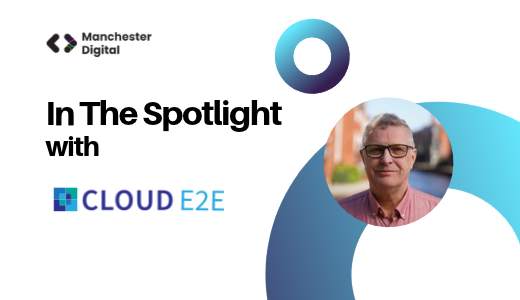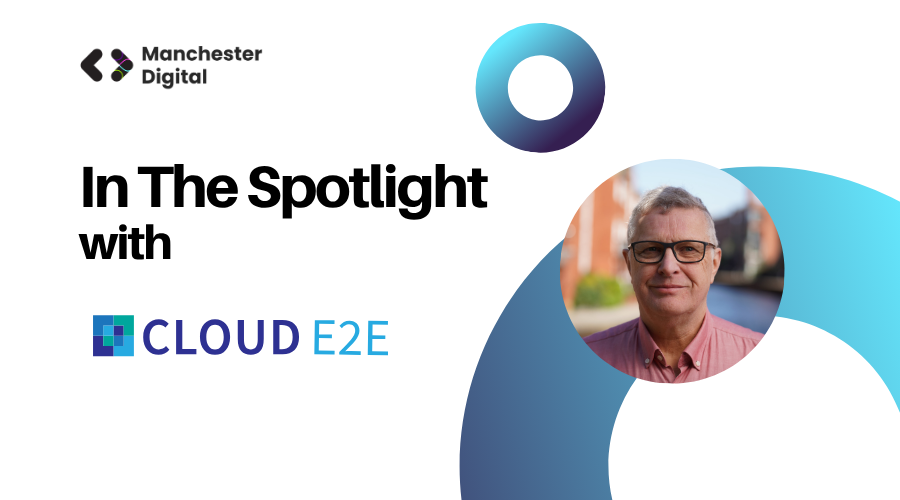
In the latest edition of In The Spotlight, we speak to Ian Tarry, Co-founder of Manchester-based Cloud E2E about helping businesses move beyond AI experimentation and start seeing real results.
We explore the company's approach to practical AI adoption, from workforce upskilling and secure cloud infrastructure to bespoke AI solutions, and why Greater Manchester's growing tech ecosystem presents exciting opportunities for collaboration.
Could you introduce Cloud E2E and share your main mission when helping businesses adopt artificial intelligence?
Cloud E2E is a software company that gets AI working for businesses on the cloud, with the same standard for a proof of concept as for a finished system. We are a Manchester family firm, and every one of us is a Google Cloud Certified engineer. Clients work directly with the architects who build their systems; there is no sales layer in between.
Our mission is to help businesses adopt AI properly. That means two things. It means upskilling their people, so the tools are used well inside the business. And it means advising them on the right solution for them: sometimes Google's managed tools, Gemini Enterprise or Google Workspace, which we set up for them; sometimes something bespoke, built on Google Cloud with the same security guarantees from the start.
Either way, we never deliver a prototype that isn't properly deployed on the cloud and ready to run.
What do you find most compelling about Greater Manchester's tech ecosystem, and how do you approach networking within the region?
Greater Manchester has a rich industrial history and a tech scene growing fast enough that you can feel it, and the two sit side by side. The region is full of established businesses that have collected years of data and never put it to work. Next door is a growing community of companies that can. That pairing is what we find most compelling, and there is a lot of support around it, from Manchester Digital among others.
We network in person: at events, and by going out to businesses and talking through what AI could do for them. A business that comes to rely on these systems wants to know the person who built them, and who will fix them if something goes wrong. The personal connection matters more now, not less.
You offer both workforce training ('Working with AI' & 'Building with AI') and 7-pillar AI Readiness Reports. What are the common challenges non-technical decision makers and technical teams face when preparing for AI?
Because AI is so new, there is a great deal of uncertainty about what these tools can do for a business. Organisations often fall back on old patterns and buy a new tool, in the hope that, as in the past, this is what buys them AI. When employees and leadership are upskilled together, the understanding changes: AI cannot be bought. It has to be integrated into the business from the ground up.
An AI readiness report gives leadership a detailed view of how to build the business for a future with AI. It also shows that slow, good decisions compound they can keep adding AI to the business responsibly.
On the employee side, businesses do not realise how much there is to gain from people using these tools properly. The shift is from treating them as assistants to treating them as agents you delegate work to. Delegating means managing knowing when to trust the output and when to verify it. Someone who treats it as an assistant gets a faster paragraph. Someone who treats it as an agent hand over the whole task, checks the parts that matter, and gets the afternoon back. That is the difference between a 10% gain and doubling what one person can carry, and it comes from training, not from the tool.
Cloud E2E focuses heavily on data-rich sectors. How does your rapid, low-risk prototyping model help these companies innovate safely without disrupting legacy systems?
The point of low-risk rapid prototyping is that a company does not have to buy one enormous solution that covers everything up front. It can pick off small, high-return use cases, build them responsibly, and, when they work, do more of them.
Systems can be made accessible to AI responsibly by giving each agent its own identity and, for example, read-only access to a database: it can look at the data but cannot change it. The infrastructure then guarantees that the agent can provide insight and nothing else, running alongside the legacy system. Where those legacy systems are on premises, we can also build the pipelines that bring the data onto the cloud. Given access to data in a secure and safe way, AI can now generate a real return.
Everything is built on cloud architecture that denies the agent any permission it has not been given. Set up properly, it cannot disrupt anything, because it can only do what it is allowed to do.
Your custom software solutions include model-agnostic chat assistants and SQL-based maintenance co-pilots designed to prevent hallucinations. What sets these bespoke tools apart from off-the-shelf enterprise products?
These solutions are all converging on assistants, and an assistant talks to the user through a chat window. Behind that window sit connections to the business's systems, and different agents become available through them. What you often find with off-the-shelf products is that they lack the bespoke element that some high-return use cases need.
Take someone working with a SQL-based agent, one that answers questions from the company's database. If they are going to trust a figure, they need to know it could not have been invented. Build a bespoke version of that agent and the answer from the database can be captured before it ever reaches the agent. The user then sees the agent's answer with the data alongside it and knows the agent could not have invented the figure. A workflow like that gives them the insight of an agent and a very quick way of verifying it.
The same applies to document-based tools. Agents can now handle a large part of a task, so the most important question is whether the user can verify the result quickly. If they have to go back over everything the agent did, you lose the ability to delegate work and manage several agents at once.
As new Manchester Digital members, what types of connections, partnerships, or community involvement are you most looking forward to exploring?
We are looking for partnerships with businesses that want to integrate AI: to prototype rapidly and to upskill their employees. With our expertise in AI and the cloud, we can help them build an AI strategy from the ground up, so they are not left buying tool after tool that then has to talk to everything else.
In the age of AI agents, it is very important that a company takes control of its own data and the systems that hold it. The mistakes made now are the hardest to unwind later: data stored in a form nobody can ask questions of, or half a dozen tools bought separately that were never going to talk to each other, kept apart by separate licences and separate systems. Rapid prototyping is the way round it. A tool built for the business, deployed on the cloud in the business's own environment, can be adapted as the need changes, and that is where the returns are. What AI can do is rarely the limit now; whether the data sits in the right place, in a form the AI can reach, usually is.
So, the companies we are looking forward to meeting are the ones ready to take that next step: to unlock what is sitting in their data by getting it onto the cloud, with a partner who can take them into the next chapter, securely and on a stable footing.
Thanks Ian!
To find out more about Cloud E2E, click here.