Data readiness for AI means the data an AI use case depends on is available, good enough for the task, clearly owned, lawful to use and reachable in a controlled way. It is judged use case by use case, not across the whole organisation at once.
That last point matters. Many organisations respond to AI by launching a large data improvement programme, and AI waits years for it to finish. The better approach is to ask a narrower question: is the data this particular use case needs ready, and if not, what is the smallest fix that makes it so?
Key takeaways
- Assess data readiness against specific, shortlisted AI use cases.
- Check five dimensions: availability, quality, ownership, lawfulness and access.
- Every dataset an AI tool relies on needs a named owner.
- Generative AI raises the stakes for documents and knowledge bases, not just databases.
- "Fit for this purpose" beats "perfect everywhere".
Why is data the most common blocker for AI projects?
Because AI exposes data problems that people have learned to work around. A caseworker knows which field is unreliable, which spreadsheet is the real one and which policy document is out of date. An AI tool does not. It treats what it is given as true.
The LGA's agentic AI playbook makes the same point about agents: they inherit the weaknesses of the data and instructions behind them. Out-of-date, duplicated or unowned data produces confident but wrong outputs, and with agents those outputs can turn into actions.
In our experience, data issues are the most frequent reason a promising AI use case moves from "go" to "fix first" during readiness assessment. Finding that out early is cheap. Finding it out mid-pilot is not.
What are the five dimensions of data readiness?
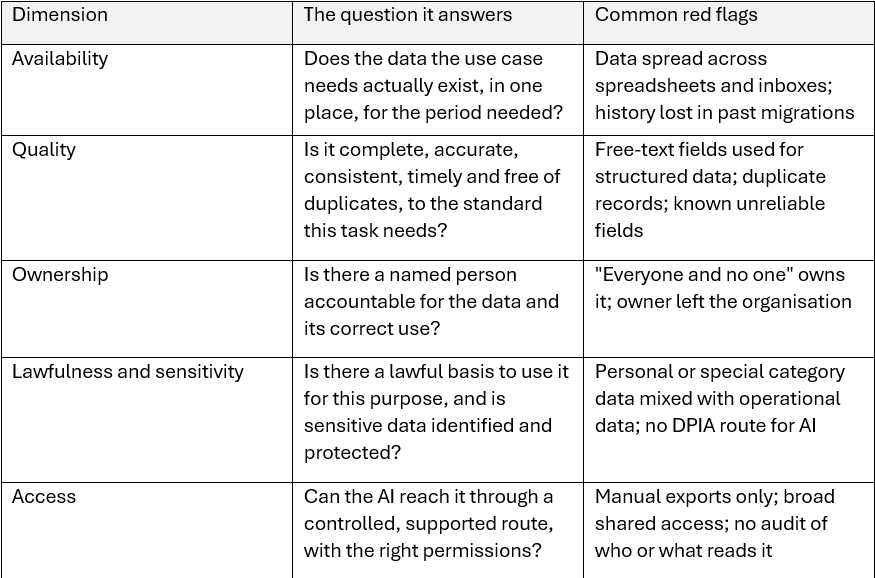
A use case needs to pass all five. High quality data with no lawful basis is not ready; perfectly owned data with no access route is not ready either.
How do you assess data readiness for an AI use case?
Work through six steps for each shortlisted use case:
- List the data the use case needs. Inputs, reference data, history for training or testing, and any documents it will draw on.
- Find the authoritative source and owner. For each item, identify the single source of truth and the person accountable for it. Where there isn't one, that is your first finding.
- Profile the data. Check completeness, accuracy, consistency, timeliness and duplication against what the task actually needs. A triage tool and a forecasting model need different standards.
- Check lawfulness and sensitivity. Confirm the lawful basis for this use, identify personal and special category data, and complete or update the DPIA. Agree retention for anything the AI produces.
- Confirm the access route. Establish how the AI will reach the data: a supported API, a governed data platform or a controlled feed, with permissions limited to what the task needs.
- Rate and plan. Mark each use case ready, fix-first or not-yet, with a costed remediation plan and an owner for every action.
This sits inside a wider AI technical readiness assessment, which also covers integration, infrastructure, security and the operating model.
Does generative AI need different data readiness?
Yes. Generative AI and AI assistants rely heavily on unstructured content: policies, procedures, guidance notes, case files and emails. The questions change from "is this field accurate?" to "is this document current, authoritative and correctly shared?"
Common problems include several versions of the same policy, superseded guidance that was never archived, and documents shared far more widely than intended. An assistant drawing on that content will give answers that are confidently out of date, or surface material people should never see.
The fix is knowledge hygiene: one authoritative version of each key document, clear ownership, regular review dates, archiving of superseded material and permissions tightened before AI is switched on. Our guide to Copilot governance covers the access side in more detail.
Does data have to be perfect before you start?
No. It has to be fit for the specific purpose. Waiting for organisation-wide data perfection is one of the most common reasons AI never starts.
A better pattern is to let AI use cases drive data improvement. Each prioritised use case justifies fixing the specific data it needs, which delivers visible value and builds data maturity steadily, rather than funding a large programme with no near-term payoff.
What are the quickest data readiness wins?
- Name an owner for every dataset your top AI use cases depend on.
- Archive or delete superseded documents in the knowledge areas AI will draw on.
- Remove organisation-wide sharing from sensitive document libraries.
- Fix duplication in the key reference data, such as addresses or service catalogues, that many use cases share.
- Document the access route for each core system, so integration questions are answered once.
How does VE3 help?
Our data readiness assessments are use-case-led. We profile the data each shortlisted opportunity depends on, confirm ownership, lawful basis and access routes with your data and information governance teams, and produce a prioritised remediation plan that is tied to the AI value it unlocks. Where systems are due for renewal, we fold data requirements into the layer, align or defer decision.
Conclusion
AI is only as reliable as the data behind it. Assess readiness against the use cases you actually want to deliver, check all five dimensions, give every dataset an owner and treat documents with the same care as databases. Do that, and data stops being the reason AI stalls.
Request a data readiness assessment. Talk to our team about assessing the data behind your shortlisted AI use cases.