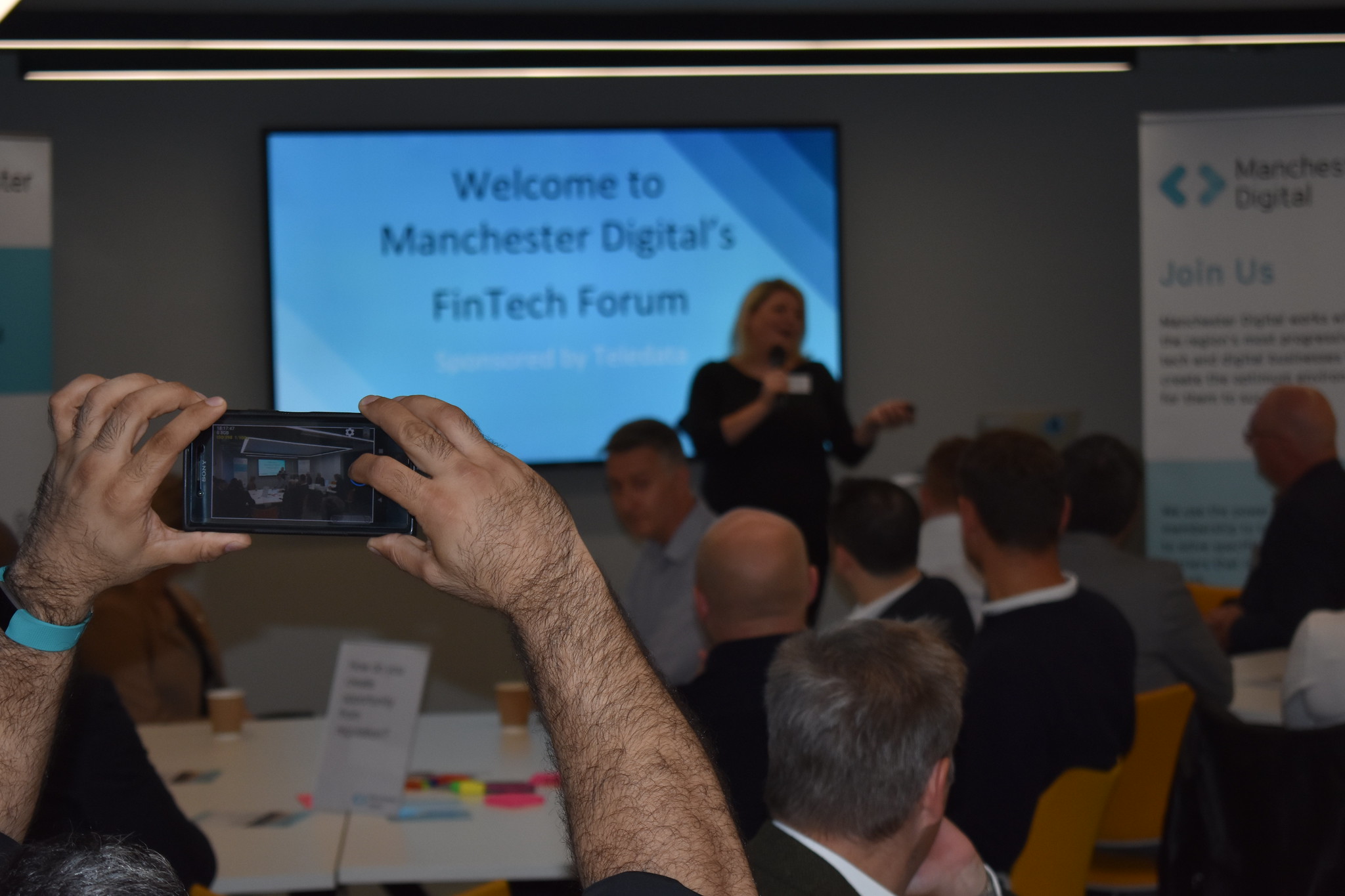
In June 2026, MD Fintech 26 brought together fintech leaders, financial services teams, consultancies, agencies and partners from across the North West to explore what comes next for the sector and how the industry moves from innovation into real-world impact.
Following the event, we asked contributors from across the ecosystem to share their perspectives on a single question: what’s next for fintech - and what needs to change for us to get there. From emerging technologies to regulation, customer experience to operational reality, the insights below reflect a sector actively shaping its next phase of growth and delivery.
Worldpay
Biggest opportunities in payments right now
Joe Brunning, Corporate Sales Director
According to Worldpay’s Global Payments Report 2026, looking at the UK, we are a card-first society, with cash only estimated to account for 7-9% of payments by 2030.
The major growing trend is the adoption of digital wallets such as Apple Pay, Google Pay and PayPal.
Digital wallets are the leading payment method in the UK and also globally, now making up 56% of ecommerce and 33% of POS value, respectively.
For businesses not just looking to scale but to even stay competitive, the offering of digital wallets and alternate payment methods is a must!
This trend is not only for retail but extends across industries. At Worldpay, we have personal experience in bringing mobile wallets to hospitality, travel, transportation, deliveries, insurers and even a wide range of B2B orgs.
As the appetite for digital journeys and payment methods increases, so must businesses be able to satisfy these requirements, or risk missing out on customer acquisition, retention and conversion opportunities.
Christian Towner, Corporate Sales Director
What I can see is the disruption of Shopify Payments and opening up the market to our embedded gateway, keeping the customer through the same journey, with just the removal of ShopPay. With our live merchants, we’ve seen an increase in growth due to the re-investment of the fees saved, either in optimisation of their website, heightened SEO and further adds to drive customers to the site.
A further example is a subscription service business for beer brewing turning over £10m in cards per year. Just from moving to Worldpay, we saved them £100k in fees and now they are looking to use that saving to grow their customer base.
Find out more about Worldpay here.
Integrity360
How an MSSP can help FinTech firms tackle AI-driven cybersecurity challenges
Richard Ford, CTO
FinTech companies are using AI to improve fraud detection, anomaly spotting in transactions, customer service, risk modelling and operational efficiency. However, the same technology is also changing the threat landscape. Cyber criminals are using AI to create more convincing phishing attacks, automate reconnaissance, bypass traditional defences and target digital identities at scale. Importantly, and of specific concern to the FinTech sector, they are adversarial attack against the AI models FinTech rely on.
For FinTech firms, the risks are significant. Mobile apps, APIs, cloud platforms and third-party systems already create a broad attack surface. AI increases the speed and sophistication of attacks across that environment. Deepfake-enabled fraud, synthetic identities, AI-generated social engineering and attacks against machine learning models can all put customer data, transactions and trust at risk. For those critical AI systems in use, attackers are attempting to manipulate them by poison training data sets and jailbreak them.
A Managed Security Services Provider can help FinTech organisations respond to these challenges without slowing innovation. Through managed detection and response, threat exposure management, cloud security, penetration testing, digital forensics, compliance support and user awareness, an MSSP can help identify exposures, detect suspicious activity and respond quickly to incidents.
An MSSP also brings specialist expertise, advanced tooling and 24/7 monitoring that many FinTech firms may struggle to maintain internally. By working with Integrity360, FinTech organisations can strengthen resilience, meet regulatory demands and continue delivering secure, trusted digital financial services in an AI-driven world.
Find out more about Integrity360 here.
Novacoast
Quantum risk, AI agents and the next security frontier for fintech
Chris Jamieson, Sr. Account Director, EMEA
As we near the close of the decade, the FinTech sector faces two profound challenges: Agentic AI and quantum computing. Both technologies must be recorded as high‑priority risks in every organization’s risk register, and board members must acknowledge they’ve a fiduciary duty to address them now, with actionable strategies and appropriate funding.
Perhaps the greatest vulnerability lies in the cryptographic foundations that secure our digital ecosystem and underpin trust in everyday online activities. Financial institutions should already be deep into post‑quantum cryptography (PQC) initiatives. The EU has long provided guidance for financial firms, urging them to first catalogue every cryptographic primitive in use. This inventory enables organizations to harden their encryption and protect against “harvest‑now, decrypt‑later” attacks.
Quantum‑enabled AI amplifies the threat: autonomous agents acting at machine speed, without human oversight or proper safeguards, potentially disrupting operations and society. This shift brings identity into focus. AI agents should no longer rely on broad service‑account privileges, or similar, but instead operate within “intent‑based” identities that define exactly what they are allowed to do.
At Novacoast, we see automation and AI reshaping the value of our traditional services. In response, we’ve proactively adopted AI to evolve our offerings, delivering deeper, faster, and more comprehensive security services to our financial sector customers.
Find out more about Novacoast here.
Chainguard
Why Trust Is the Next Competitive Advantage in Fintech
Hannah Hawken - Partner Solutions Engineer
The next chapter of fintech belongs to companies that can scale trust as quickly as they scale code. By leveraging AI, fintechs may accelerate their innovation, but only if developers consume trusted open source by default instead of turning into an extension of the security team as a remediation function.
Fintech teams need secure-by-default foundations across images, libraries, pipelines, policies, and eventually proprietary code paths so compliance evidence becomes a product outcome rather than a project. As AI increases release speed and dependency volume, the need for minimal, hardened, continuously rebuilt artifacts only grows.
The biggest fintech opportunity now is turning software supply chain trust into a growth enabler: faster launches, easier audits, and less time spent chasing CVEs after the fact. That is how fintech scales confidently all while maintaining the bare minimum compliance with frameworks such as PCI, SOC 2, and FedRAMP-style controls. Considerations of securing the entire Software Development Lifecycle for an efficient, accelerated adoption of AI for better, faster development will lead fintechs to greater innovation, security posture and ultimately a growth enabler.
Find out more about Chainguard here.
Nimble Approach
Rethinking FinTech Security in the Age of AI
Craig Haslam, Head of Division
As someone who has spent 15 years in the FinTech sector, from branch banking and corporate finance to Chief Product Officer at a growing FinTech building banking platforms, I've seen firsthand how priorities evolve as the industry matures.
While regulation and customer experience remain absolutely critical to scaling successfully today, it is the security of our platforms and our customers that must take centre stage.
Advancements in AI have fundamentally changed the threat landscape. Frontier models such as Mythos can uncover vulnerabilities at scale, enabling cyber attacks to operate at machine speed. In this environment, passive security measures are no longer enough.
The challenge with traditional defence is not a lack of signals, but the cost and time required to validate them. False positives consume valuable resources, leaving security teams stuck in triage rather than actively protecting the business.
To keep pace, FinTechs must adopt an active cyber defence posture, orchestrating systems that evolve as quickly as the threats they face. The next phase of FinTech security will combine agentic AI to handle execution at scale with expert human leadership to make the critical decisions. To defend against machine-speed attacks, we must respond at machine speed.
Find out more about Nimble Approach here.
LINX
Building sovereign, secure and high-performance financial infrastructure
Colin Peckham, Global Business Development
Modern financial services need to provide a slick experience to users – without compromising security, reliability or control.
They require more reliable digital services at a lower cost and with greater control and insights into their data. A large emphasis is being placed on not just where data is stored but also how it moves. Sovereign data is becoming more of a necessity than a nice to have. Quite often these requirements are now non-negotiable and business critical to operational standards and regulation. Data is the new currency by which we judge performance and success, it underpins how businesses operate.
The infrastructure fundamental to day to day business operation is being analysed and interrogated more than ever before. The way financial services interact and interconnect with each other and the consumers is key to their ongoing success.
LINX helps Financial Services providers take control of their data and deliver faster, safer, future-proofed digital services.
Find out more about LINX here.
Invest Manchester
From ecosystem strength to scaled impact across Greater Manchester fintech
Konrad Sobczyk, Business Development Executive-Financial Professional and Business Services Sector
Greater Manchester’s fintech ecosystem has reached an exciting point. With around 10,000 employees, nearly 150 firms and deep strengths across payments, lending and data, the opportunity now lies in scaling what already works, connecting innovation into everyday financial infrastructure.
One of the biggest shifts is convergence. AI, data and payments are not separate anymore, they are embedded into almost everything. Manchester’s depth in analytics, cyber and software means companies are well placed to build solutions that are both innovative and secure from the start.
We can already see that playing out. AccessPay chose Manchester as the base to grow its cloud-based banking and payments platform, while Crowdcube expanded here to get closer to the region’s growing pool of high-growth businesses and investors. It relates to a wider ecosystem that helps fintechs move from idea to traction.
In terms of challenges, it is less about disruption and more about trust, getting regulation right, building resilience, and proving long-term value to customers.
Scaling successfully today also looks different. It’s about access to talent, real collaboration, and making the most of Manchester’s mix of financial services strength and a genuinely scalable workforce.
Finally, as fintech matures, our roles are shifting. Increasingly, it is about joining the dots between finance, tech and policy, and turning new ideas into long-term solutions.
Find out more about Invest Manchester here.
Cloudguard
The Double-Edged Algorithm
Muhammad Fezzan, Junior SOC Analyst
The fintech industry loves AI tools. Faster fraud detection. Smarter credit scoring. Real-time risk decisions. These are genuine gains, but I work in an MSSP SOC, and from where I sit, the picture is more complicated.
For every threat AI helps us detect, it seems to be enabling a new one.
The same capabilities fintechs are deploying to spot anomalies are available to the people trying to exploit them.
- AI-generated phishing is now indistinguishable from legitimate correspondence at scale.
- Deepfake voice has already been used in social engineering attacks against financial institutions.
- Synthetic identity fraud is putting serious pressure on KYC processes that weren't designed for fabricated-but-plausible profiles.
And on top of this, there’s AI pipelines that log more than they should, third-party integrations with broader data access than anyone realises, and models trained on clean data that buckle when they meet real-world adversarial inputs.
When the industry talks about AI in fintech, the conversation centres on what we're building. It needs to equally centre on what we're up against.
The fintechs that win long-term won't just have the best models. They'll have built them in a way that can actually be trusted. And that means bringing security into the room early, not after the fact.
Find out more about Cloudguard here.
Venditan
The hidden security risk sitting inside every live checkout
Kamba Abudu, Head of Engineering
As we gear up for MD Fintech 26, discussions around payments and regulation naturally take centre stage. But while the industry shifts from pure innovation to real-world impact, a massive security gap has emerged right under our noses: the live checkout page.
We see retailers assuming their eCommerce platform is solely responsible for the security of their website.
In reality, while platforms protect their core infrastructure, individual merchants remain liable for third-party scripts, chat widgets, and marketing tags running on their specific payment pages. Each addition grows an invisible attack surface and acts as an open door for hackers.
The danger today isn't a clunky system breach; it's modern Magecart and card-skimming attacks utilising back door entries into your checkout environment.
These attacks operate silently in the background of consumer-facing checkout browsers and are not flagged by the eCommerce platform.
They don't disrupt payments or trigger immediate alarms; instead, they siphon card numbers invisibly, running for an average of five months before detection.
We created Checkout Audit to continuously monitor live payment pages, catching unauthorised changes the moment they appear.
If you aren't monitoring what’s running inside your live checkout today, you're flying blind between your standard assessments.
Find out more about Venditan here.
SF Technology
From AI hype to execution: where fintech value is really being created
Tommy Parkes, Talent Consultant
From my perspective as a recruiter specialising in Data, AI and Analytics, I’m seeing a real maturity process happening across fintech.
Over the last few years, fintech businesses have moved from experimenting with AI to focusing more on practical execution and commercial outcomes, asking themselves what the actual ROI will be. The conversation is becoming less about hype and more about implementation, particularly around data quality, governance and infrastructure.
In fintech specifically, this is becoming increasingly important across areas like fraud prevention, real time payments, automation and customer insight. Businesses are recognising that AI is fundamentally a data challenge first. Without strong underlying systems and reliable data, it becomes difficult to scale AI effectively in regulated environments where trust and explainability matter.
We’re also seeing this reflected in hiring trends. Demand for Data Engineers, ML Engineers and commercially minded technical talent continues to grow, alongside more “Forward Deployed Engineer” style profiles; highly technical AI specialists who can work closely with leadership teams and deliver practical outcomes quickly.
Manchester and the wider Northwest are also becoming increasingly important in this space, with Greater Manchester now home to the largest fintech ecosystem outside London.
The fintech firms making the biggest progress aren’t necessarily the ones adopting AI the fastest. They’re the ones using it with clear purpose to create measurable business value.
Find out more about SF Technology here.
ICIT
Planning as You Scale: Why Fast-Growing Fintechs Are Rethinking Their Finance Stack
Mark Bodger, Director
You built something that works. Revenue is climbing, headcount is growing, and the board wants a 3-year model by Friday.
Spreadsheets got you here. They won't get you to the next stage.
Scaling a fintech means your planning environment has to keep pace with your business - regulatory obligations, product line complexity, investor reporting, and operational headcount all compounding at the same time. The margin for error shrinks as the stakes rise.
Workday Adaptive Planning gives finance leaders at growth-stage fintechs a single source of truth that connects operational and financial data in real time. Scenario modelling takes minutes, not days. Driver-based forecasting replaces manual rebuild cycles. And when your CFO or board needs answers, your team isn't scrambling through version 14 of a spreadsheet.
The fintechs that scale well aren't just faster - they're more deliberate. They've replaced reactive reporting with forward-looking insight.
If your planning process is starting to creak under the weight of growth, that's the signal.
Book a discovery call with the ICit team to see what better planning looks like for your business.
Onside Accounting
The Next Chapter for Fintech Is Operational Excellence
Mike Scott, Commercial Director
For the last decade, fintech has been defined by innovation. The businesses that attracted the most attention were often those disrupting established markets, introducing new technologies, or creating entirely new customer experiences.
While innovation is critical, I think the next chapter for fintech is about operational excellence.
Many fintechs have already proven there is demand for their products. The challenge now is building resilient, scalable businesses that can grow sustainably while navigating increasingly complex regulatory, funding and commercial environments.
From my perspective, supporting scaling fintech companies at Onside, the businesses that stand out today aren't necessarily the ones moving fastest – they're the ones building strong foundations. They have clear financial visibility, disciplined cash management, robust reporting and a realistic understanding of what profitable growth looks like.
AI-driven automation will undoubtedly continue to transform the industry, but technology alone isn't enough. The winners will be the companies that successfully combine innovation with operational maturity.
The good news is that the UK fintech ecosystem is increasingly well-positioned to support that journey. We're seeing stronger founder networks, better access to specialist advisers and a growing pool of experienced, second or third-time founders, who have scaled businesses before.
The opportunity for fintech remains enormous. The next step is ensuring great fintech products become great long-term businesses.
Find out more about Onside Accounting here.
Classyk Digital
The Next Fintech Battle Isn't Another Shiny Tech: It is Trust
Faith Sodipe - Software Engineer
For over the past ten years, we have been proving that fintech can be faster, cheaper, and more elegant than traditional players. That game is finished. The next stage isn’t about another percentage point of speed or a cooler UX. It's about trust.
Here’s what I know from my experience: Customers and businesses have six banking apps on their phones today. They don't need a 7th. "What they want is a hand to hold when something goes wrong, a fraudulent transaction at 11PM, a closed account before a paycheck, an AI credit judgment they don’t understand.
The fintechs that win in the next five years won’t be the ones with the best engineering teams. It will be them who will incorporate true, costly, boring resilience into their operations: human help at 2 AM, transparent dispute processes, and an explainable AI that doesn't hide behind "the algorithm did it."
Today’s successful scaling is scaling trust as aggressively as you scale users. That’s tougher than establishing another payments API, but it's the only ship that won't sink.
Find out more about Classyk Digital here.