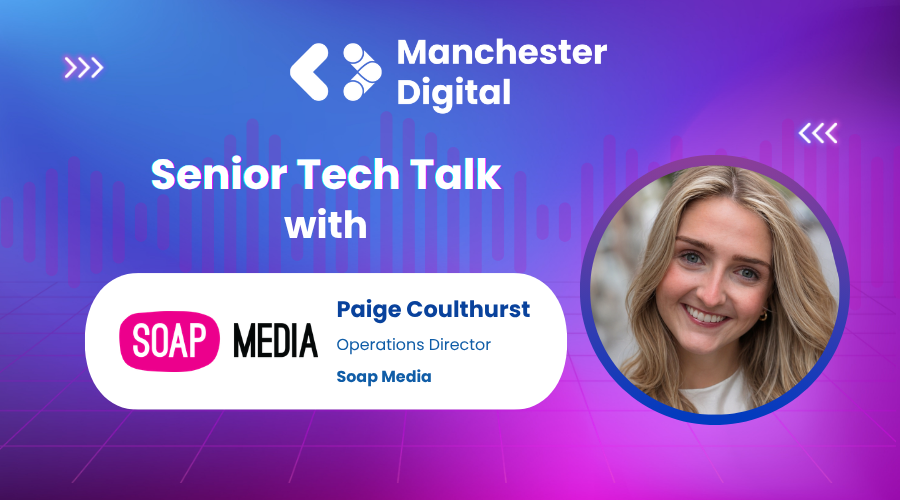
For this edition of Senior Tech Talks, we spoke with Paige Coulthurst, Operations Director at Soap Media, about leading teams through one of the biggest shifts the digital sector has faced in recent years: the rise of AI.
Paige shares how Soap Media is taking a strategic, people-first approach to AI adoption, focusing on improving established processes, empowering specialists and ensuring human expertise remains at the centre of client delivery.
You’ve said that “everything is AI” internally at the moment. As Operations Director, how would you describe your leadership approach to navigating such rapid change?
No one has all the answers right now, and it's about accepting that and working with it. My approach is openness: we're trialling things, retroing what works, and being honest when something doesn't land. It's also about not being distracted by the noise or the unsupported hype. We put strategy first in everything else we do, so why wouldn't we with AI? "Just start using AI" isn't something I'm a fan of either. Teams need objectives, goals and direction from leadership just like they do with anything else.
We've focused first on the manual processes we already have well-defined and that work well, and that's where we've seen the most success. We also ask ourselves where our biggest time drains are, and what our specialists believe could bring the greatest benefit to what they do - and in turn to the agency. From there it's a step-by-step approach: how do we use AI to make this better or faster? We trial it on real client briefs and measure the results. Pair that with free experimentation, a culture-first mindset, and a bit of structure - what are you trying to achieve, and have you documented it? - and you can move fast without losing the plot.
AI can create huge efficiencies, but it can also cause anxiety for teams. How are you leading in a way that protects your culture, respects your experts, and avoids AI being seen as “replacing” people?
The anxieties are real - job security, feeling behind, worrying your expertise and craft is being devalued. Structure helps, and so does involving specialists from day one. Who has more context on the process and the client requests than the team themselves? They know how a tool will actually be used.
But just as important is how we communicate the focus and the goals. When people understand exactly how something is going to help their role and make their work better, they aren't shaken by the AI narratives circulating online. I pay close attention to the language and approach we use, and we work hard to keep the energy around the excitement of what we can achieve rather than anxiety. When people see a real use case that genuinely improves their role, the anxiety eases - so we make sure to remind them of those wins and goals, regularly.
Internally, you’ve talked about “asking the expert, not just the AI”. How do you set expectations for your team so that AI is used as a powerful assistant, but human judgment still leads the way?
We've seen tools built without expert input miss the mark entirely - and retraining after the fact often costs as much as rebuilding properly. Our people have years in their craft; they spot nuance AI can't, and they know the things clients will hone in on. That's why experts are involved from the start in shaping how we use AI, not brought in at the end to rubber-stamp it.
The same principle applies day-to-day. When managing projects, I regularly use AI for project plans, briefs, wireframes and proposals - but it always gets an expert eye before a client sees it. More often than not, there are things that need changing, and you can't take it back once it's in front of a client. If AI has helped anyone on the team draft, plan or problem-solve something outside their own specialism, the same rule applies.
The other thing we've learnt is that AI is great at volume but not at judgement. It'll happily hand you a haystack when what you actually needed was the needle - and an expert's time is far better spent applying their expertise than sifting through AI output to find the useful bit. So we're intentional about what we ask it to do, and where the human comes in.
Where have you seen AI make the biggest positive difference to the way your teams work - whether that’s content, project management or development - and what leadership decisions have helped those changes land well?
Our biggest wins outside of web development (which is a beast in itself and has had AI integrated into almost all parts of the process) so far are in sales proposals, social media management, organic content writing for SEO, automated reporting, and website briefing and wireframing. We've got there by truly understanding the manual process first, then turning that into an AI process - not the other way around - with expert judgement on input and output. But it's worth being honest: for every win, there have been plenty of failures, and a key leadership decision has been to expect that and embrace it. There's a perception out there that "it's easy with AI" and while it's easy to create something, we’ve learned it's much harder to create something that's good, reliable, versatile across use cases, and scalable. And something that’s unique. That takes iteration, and iteration means things not working the first time. The other decisions that made the wins stick? Giving people protected time to think things through - we have weekly PDP time for our team and industry research time every other week for our team leads and department meetings to collaborate and explore things off the client billing time, supporting them to pressure-test a plan collectively before sinking time into it, and shouting loudly about what's working - both in a dedicated AI Slack channel and in our monthly company meetings. Visibility of success keeps momentum up, but being open about the failures is what keeps expectations realistic.
You’ve noticed that most clients still care more about trust, proactivity and outcomes than the tools you use. How does that insight shape your leadership decisions about when to discuss AI with clients and how openly?
We're yet to have a client come to us looking for an agency because it uses AI - if anything, they aren't looking for that. They want real human relationships with people they can trust, showcasable expertise and results, strong references, and a budget that fits. That said, our new AI processes often help us meet those budgets better or get to those results quicker. We're open about being an AI-utilising agency, but what clients really want to know is that it generates reliable results, in a secure way. That shapes our intentions clearly: can we get to the result, or a better result, faster with AI? And can we do that without compromise or risk? If the answer is yes, we move forward. We're also careful about client data and contractual boundaries, so we never take a blanket approach. Given how much manual expert input and judgement still goes into prompting, reviewing and tweaking, we see AI firmly as our assistant, we oversee everything - and that's the message clients respond to.
You’re active in Manchester Digital’s Mentor Her programme and have been exploring leadership in times of change. What have you taken from those experiences that’s directly influencing how you lead your team through the AI shift?
The most poignant thing for me is radical candour. You can't lead a team and expect great things if you don't know them, or relate to them on a deeper level. You certainly can't ask them to help you develop an AI tool for their department and expect honest feedback and trust in the goal - not if the trust isn't there. Being a manager and being a leader are two different things, and you'll only be a leader if your team sees you as one. Leadership isn't about a title either - it's in your actions, how you empower others, how you make people feel, and how you take charge when it matters. Some of the best leaders I've worked alongside didn't have "leader" in their job title. And whilst I got into Mentor Her as a mentor, I've benefited hugely from the programme myself - being surrounded by other women navigating leadership challenges, sharing what's worked and what hasn't, and joining the connect sessions, has shaped how I show up for my own team. I’m also a big believer in doing as I do, not as I say. If I want the team to experiment, share failures, and be honest about what's not working with AI, I have to do it first and loudest. That means getting stuck in, owning my own misses, and making real time for people when they raise concerns.
Looking 12–18 months ahead, what are your biggest leadership priorities when it comes to AI-both in terms of protecting and evolving your culture, and in continuing to deliver the kind of client work you want to be known for?
For me, "good" looks like using AI to win more work and deliver even better results for our clients - with a team that's still excited by it and keeping their finger on the pulse. We will have great people who are brand ambassadors, keep our clients happy, and love what they do.
Digital marketing is fast-moving. Tools and systems get built, but who's overseeing them? Who's keeping them updated with the latest best practice, algorithm changes and learnings? If everyone is optimised - doing the same thing with the same AI tools - then no one is. That's where you need to stand out.
I think clients will start asking more questions about AI usage in their work, and agencies need to be ready to be transparent about it. Equally, clients will start trying their own things with AI, and agencies need to be ready to consult and educate - helping them understand why something may need doing differently to actually get results. That balance of transparency and expertise is where we stand out - and how we live and breathe our tagline: Your Partner in Digital.
Thank you Paige!
To find out more about Soap Media, click here.