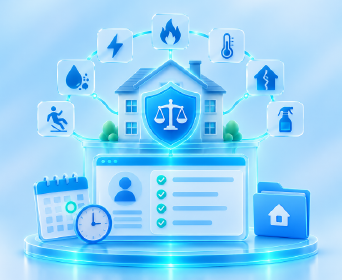
From 30 November 2026, Awaab's Law extends fixed investigation and repair timescales to seven more categories of housing hazard. The timescales themselves do not change. What changes is how many teams, systems and records must work together to meet them - which makes Phase 2 as much a data and workflow challenge as a repairs one.
Phase 1, in force since 27 October 2025, covered all emergency hazards and significant damp and mould hazards. Many landlords managed it inside repairs and damp and mould teams. Phase 2 brings heating, electrics, fire, structure and hygiene into the same statutory clock, and that is much harder to contain in one team.
What changes on 30 November 2026?
From 30 November, Awaab's Law applies to all emergency hazards (other than overcrowding) and to the following significant hazards:
- damp and mould (already in scope)
- excess cold
- excess heat
- falls, including falls on the level, on stairs and between levels
- structural collapse
- fire and explosions
- electrical hazards
- domestic hygiene, including personal hygiene and food safety
Government has confirmed a third phase will extend the law to all remaining Housing Health and Safety Rating System (HHSRS) hazards, apart from overcrowding.
The timescales landlords already work to are unchanged:
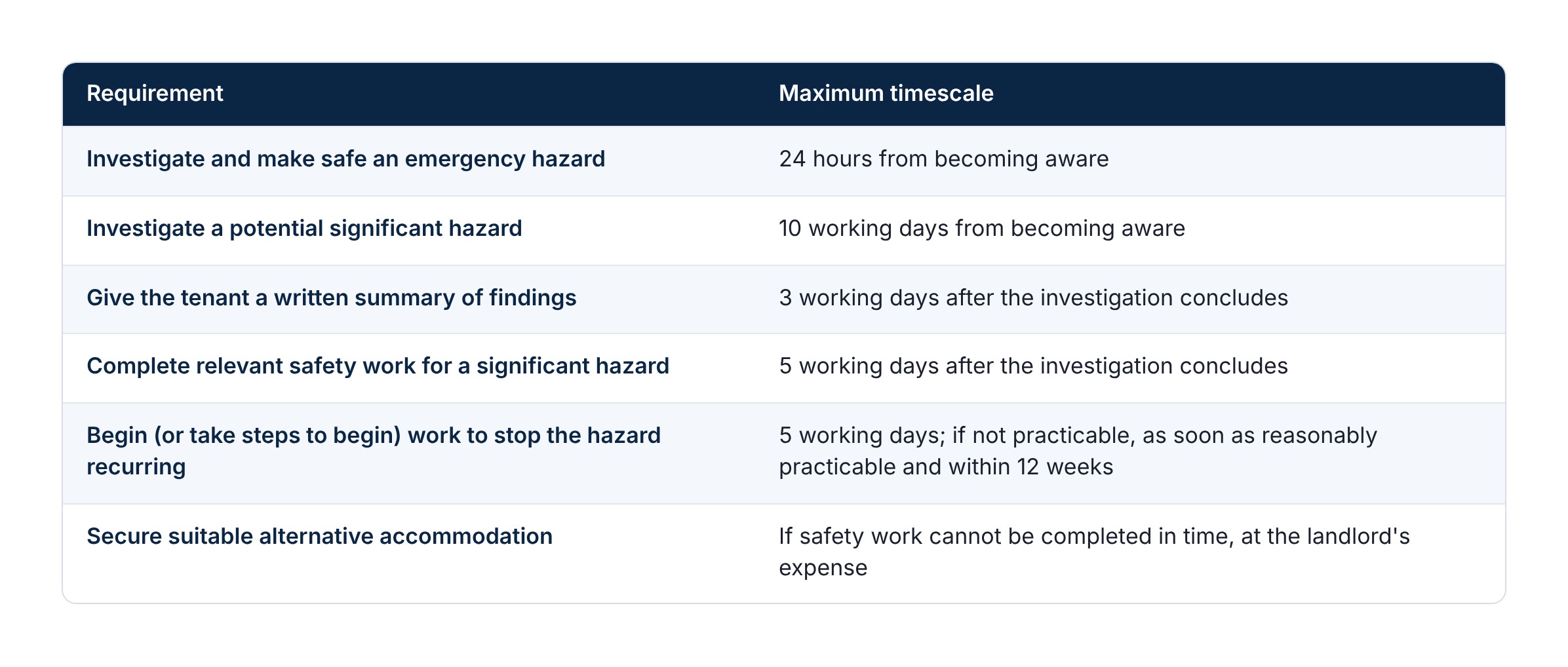
Local authority landlords should note that where another statutory regime, such as the Right to Repair regulations, sets a shorter timeframe, the shorter one applies.
Why is Phase 2 more than a repairs problem?
Because the new hazards cut across the organisation. A cold home may involve heating contractors, asset investment plans and tenant vulnerability records. A falls hazard may sit with planned maintenance or adaptations. A fire hazard inside a flat falls under Awaab's Law, while a fire hazard in a communal area may sit with the Responsible Person under the Fire Safety Order. Each route has different owners, systems and contractors.
If each team logs its own cases in its own system, nobody sees the full picture of a home or a household. Sector commentators reviewing Phase 1 have pointed to the same weakness: reports handled in isolation make it harder to spot recurring patterns. Under Phase 2, a missed pattern is not just a service failure; it can be a breach of an implied term in the tenancy.
When does the Awaab's Law clock actually start?
The clock starts when the landlord becomes aware of a potential hazard, not when the repairs team logs a job. The guidance is explicit that awareness can come from many routes: a housing officer's visit, a contractor on site, an advocate or neighbour, a regulator, or, for councils, an officer in a different department.
That has a direct operational consequence. Every channel that might hear about a hazard needs a reliable way to create or update the same case record, with a timestamp. That includes:
- contact centre calls and web forms
- housing officer and support worker visits
- contractor reports from site
- referrals from social care, health or schools
- complaints and Housing Ombudsman correspondence
A report that sits in an email inbox for two days has already used two days of the clock.
The same applies to a material change - a hazard getting worse, or new symptoms in the household. A material change restarts the requirements, so case records must capture it as a distinct, dated event rather than a note on an old job.
Why does tenant data decide whether a hazard is in scope?
Under Awaab's Law, a hazard is significant if a reasonable landlord, with the knowledge it has or reasonably ought to have about the occupier's health and circumstances, would make it safe within 15 working days. Unlike an HHSRS assessment, the test is about the actual household, not a notional vulnerable occupier.
So the same broken window can be in scope for one home and out of scope for another. The guidance gives exactly this kind of example: a broken ground-floor window facing a busy road, in a home with a young child, may need a faster response than a similar fault in a flat occupied by two adults.
That makes household data - age, health conditions, disability, communication needs and reasonable adjustments - part of the compliance decision. It also raises the bar for data protection, because health information is special category data under UK GDPR. Landlords need both: richer vulnerability information at the point of triage, and tighter controls on who can see it.
What does a compliant hazard workflow look like?
The guidance describes four types of investigation (standard, renewed, emergency and further), concurrent timescales and multiple tenant communications. In practice, a workflow that can evidence compliance needs to:
- Capture awareness once, from any channel, with a timestamp and the reporting route.
- Triage using what the landlord already knows about the home and the household, prompted by the guidance's suggested questions.
- Run the right clock in working days, starting on the correct day (the day after awareness, except for the 24-hour emergency clock, which starts immediately).
- Generate the written summary from investigation findings, using the government template where helpful, and record when it was given.
- Track safety work and preventative work separately, because they run on different timescales.
- Trigger alternative accommodation decisions automatically when safety work will miss its deadline.
- Record every access attempt and conversation, because the "all reasonable endeavours" defence depends on evidence.
None of this requires replacing a housing management system. It does require the systems a landlord already has to share a single case and a single view of the home and the household.
Seven checks to run before 30 November - and before Phase 3
- Map every awareness route. List each team, contractor and partner who might hear about a hazard, and how their report reaches a case record.
- Test the clock. Confirm your systems count working days correctly and start on the right day.
- Audit vulnerability data. Check what you hold, how current it is, and whether triage staff can see it lawfully.
- Check asset data for the new hazards. Heating systems, electrical installation records, smoke alarms and stair or balcony condition all now feed triage.
- Review contractor agreements. The guidance advises landlords to confirm that contracts match Awaab's Law obligations, including reporting hazards found on site.
- Rehearse the written summary. Make sure findings flow into a summary within three working days, in the tenant's preferred format and language.
- Report on patterns, not just cases. Build a view of recurring hazards by property, block and archetype, so preventative investment goes where risk repeats.
How we help
We work with councils and housing providers to connect the data and workflow they already have: joining tenant, asset and repairs records into one view of the home, building statutory clocks into existing case management, and putting reporting in place that shows patterns early. We start with the process and the evidence, then decide what technology is needed - often less than people expect.
If you want a second pair of eyes on your Phase 2 readiness, or are already thinking about Phase 3, we are happy to talk it through.