skip navigation
skip mega-menu
This event has now ended.

Explore how Software Defined Radios expose & detect radioโ€‘frequency vulnerabilities across 5G, autonomous systems & critical infrastructure

This event invites participants from all disciplines and backgrounds to come together, fostering interdisciplinary connections and discussions.

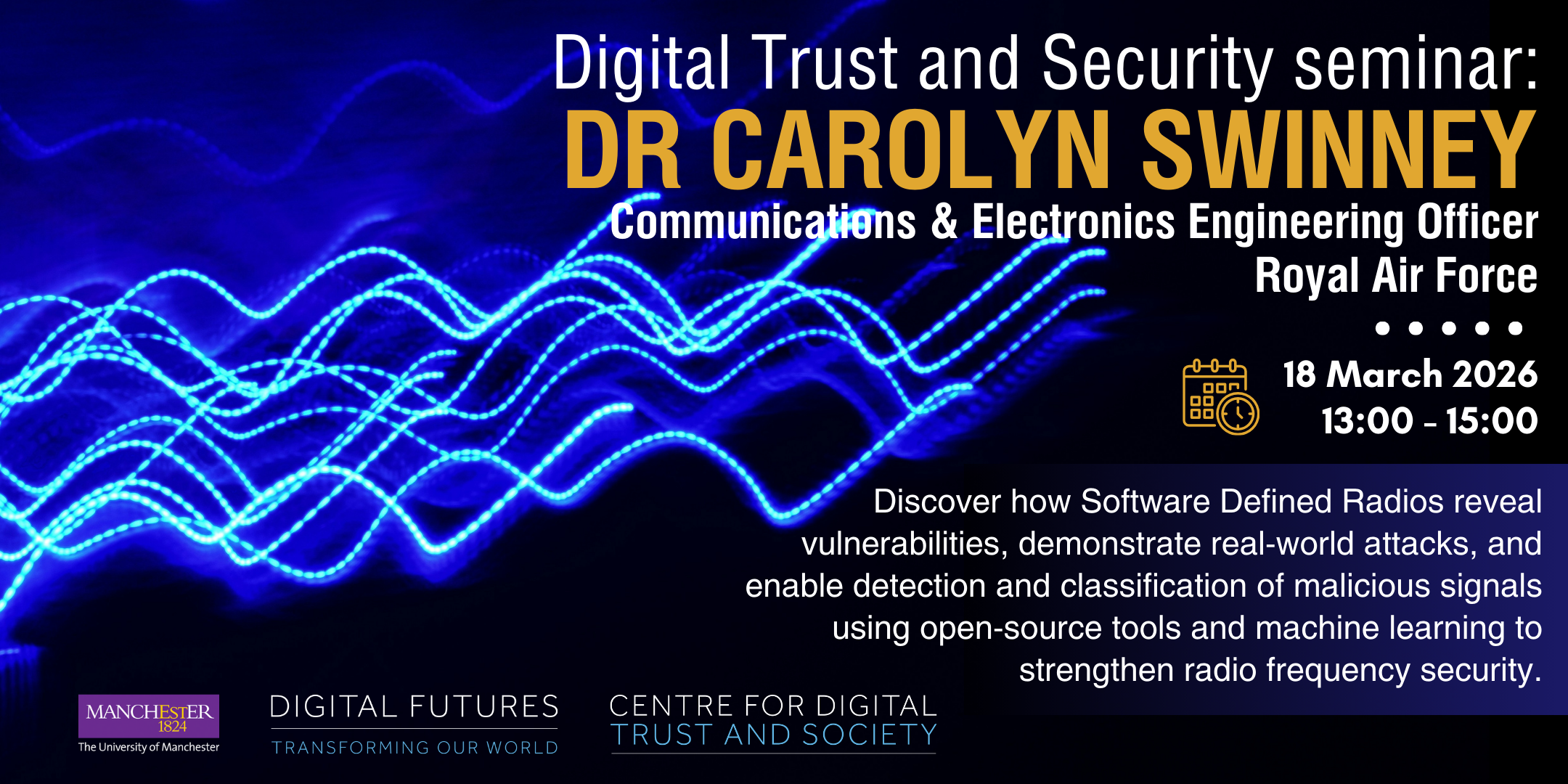
Talk Title: Software Defined Radios: RF Enabled Cyber Vulnerability Exposure and Early Warning

Often when Cyber threats are considered, fixed (or wired) Internet connections are the assumed way that a target device is accessed. However, Radio Frequency (RF) links are becoming more prevalent in connected systems, from 5G to driverless cars and even control systems for Critical National Infrastructure. There is a growing need to consider RF links when securing networks and identifying potential vulnerabilities. Software Defined Radios (SDRs) expose vulnerabilities by providing a viable means to access or even deny access to these links. In this seminar the term SDR will be defined and the capabilities of open-source software in conjunction with low cost, easily available devices on the market today, will be demonstrated through a practical implementation. Academic literature will highlight vulnerabilities to capabilities from Global Navigation Satellite Systems (GNSS) position and timing information to drone delivery services and remote keyless systems. However, SDRs can also provide early warning of unwanted RF signals and, in conjunction with machine learning techniques, can classify those signals with high accuracy. Hence, the seminar will also explore the use of SDRs for the detection and classification of threats.

Speaker Biography:

Carolyn J. Swinney received a B.Eng.(hons.) degree (first class) in 2007 and a M.Sc.(dist.) in Electronics Engineering from the University of Essex, Colchester, UK in 2013. She graduated as a Communications and Electronics Engineering Officer in the Royal Air Force in 2014. She is currently a student of the Advanced Command and Staff College at the UK Defence Academy and an Executive Fellow with the University of Essex. Her main research interests are signal processing, unmanned aerial vehicles, neural networks, machine learning and cyber security.


Free
18 March 2026 13:00 - 15:00 In Person
The University of Manchester

Explore Jobs

Marketing & Communications Manager

What we doDigital Futures brings together over 1700 researchers from different disciplines across all three of the University’s faculties into multidisciplinary communities to tackle important research problems, build critical mass in new and emerging research areas and to work with external stakeholders to support Greater Manchester's ambitions as a leading digital city.We bring our knowledge to bear on the great issues facing the world in the 21st century, exploring the complex interplay between scientific, engineering, social, wealth creation, and quality of life concerns. We are able to combine disciplines and capabilities to meet both the challenges of leading-edge research and the external demands of government, business and communities.DF FILM - https://www.digitalfutures.manchester.ac.uk/about-us/ How we can help youCome along to one of our external events or get in touch with academics from our 13 theme areas linked below.You can contact our team directly at digitalfutures@manchester.ac.uk to find out more about how we can work together.ThemesDigital SkillsFrom enabling individuals to transforming and driving industries, digital skills underpin our 21st century lives. Ranging from essential Digital Skills for Life and for work through to advanced technical skills for innovation, this theme focuses on how The University of Manchester will work with students, colleagues, employers and other education providers to identify and deliver the digital skills needed to support and responsibly transform the global workplace.”Topics:- pathways to lifelong learning- recognition and accreditation of digital skills- co creation of skills and content with industry- embedding digital skills in education and the workplace.Heath and CareDigital health brings together eHealth (digital processes in healthcare data) and mHealth, which enables these processes through mobile and digital technologies. The Digital Futures Health & Care theme's activities are delivered through the Christabel Pankhurst Institute for Health Technology Research and Innovation and through the Greater Manchester Connected Health Ecosystem. Cities and EnvironmentDigital technologies, including sensor networks, data analytics and agile control systems, have the potential to transform cities, and the lives of those who live and work in them.   Employment and ProductivityAddressing the potential for economic growth; the disruption of existing business models; and the impact of digital platforms and automation on patterns of employment and the future of work.  Industry 5.0Industry 5.0 is the integration of smart, connected, and autonomous digital and physical technologies like IoT and robotics with AI and value-adding human strengths in problem-solving and creativity.  Citizens and DemocracyExploring the nature of contemporary digital citizenship and democracy and understanding how it is transforming individuals' civic and political behaviour.  CreatechExploring the transformational impact of digital technologies ranging from digital preservation to virtual and augmented reality on the arts, education, community and heritage. Data Science and AIThe Institute for Data Science and Artificial Intelligence acts as an access point to the University's expertise in data science.  Digital Trust and SecurityAs we become increasingly dependent on digital technology, it's critical to understand whether we can trust the security and resilience of the systems we use and the people we interact with.   Human-centred DesignIncreasingly sophisticated automation means that everything we design, from cars to personal digital assistants, to algorithms, must have human understanding, behaviour and ethics at the centre.  Social Media and NetworksCommunication has been revolutionised. The implications of this are profound in many ways, affecting societies, cultures, politics, economics, science and media. Internet of ThingsInternet of Things (IoT) technology plays a crucial role in digital transformation across a range of sectors, providing the link between the physical and digital worlds. Policy and InnovationUnlocking the potential of digital transformation across many areas will require changes in public and business policy, regulation and regional investment.The University of Manchester is part of the prestigious Russell Group of universities, with outstanding facilities and the widest range of courses. We are highly respected across the globe as a centre of teaching excellence and innovative research.With 25 Nobel Prize winners among our current and former staff and students, we have a history of world firsts and brilliant discoveries, from splitting the atom to giving the world graphene.We’re committed to world-class research, an outstanding learning and student experience, and social responsibility in everything we do.ConnectAt Manchester we’re proud to be the hub of an ever-expanding network of people, stretching from this dynamic city to all corners of the globe.We are one of the UK’s largest universities but we’re also open and accessible. We want to make sure you find the right person to connect with at Manchester. Contact us:Digital Futures MarketingCareersServices for Employers

Digital Futures @ The University of Manchester

Subscribe to our newsletter

Sign up here