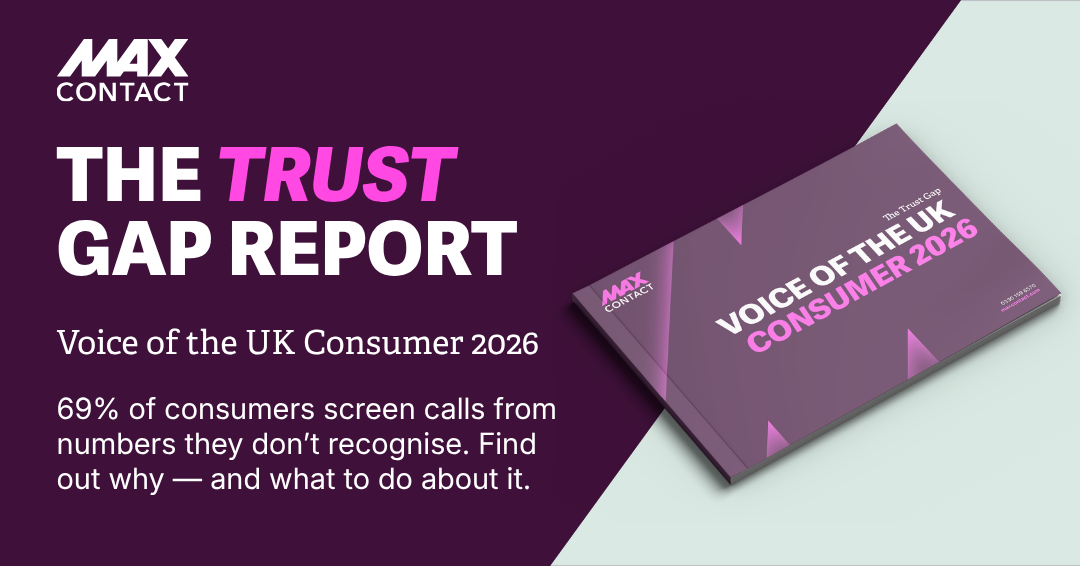
MaxContact's Voice of the Consumer UK 2026 report shows consumers are increasingly screening and ignoring legitimate business contacts because they cannot tell what is real and what is not.
In an independent survey of 1,000 UK-based consumers who had interacted with a contact centre in the last 18 months, it was found that engagement breaks down before the first point of contact.
Key findings from the report confirmed that
A whopping 69% of consumers always or often screen calls from unknown numbers
Half have ignored a message from a legitimate company because they assumed it was a scam or fraudulent.
Worryingly, only 22% of consumers strongly agree they can tell when an unexpected company contact is genuine
77% of those who have ignored a legitimate call have experienced a real consequence as a result
These call-screening findings indicate that this could become a serious operational and commercial risk for businesses. When customers cannot be reached, it can lead to missed appointments, disrupted service delivery and unpaid or delayed payments. There’s also a growing risk that if customers screen calls, it will add to a rising volume of unresolved issues, which may lead to poor customer service outcomes or loss of reputation.
What can businesses do about this?
To address the issue, businesses need to rethink how they contact customers. This means clearly identifying who is calling and why before the phone rings, being transparent about when AI is used, and choosing the right channel for each interaction.
Organisations that make their communications feel more recognisable and trustworthy from the outset are far more likely to be answered, reducing missed connections and improving customer outcomes.
Not all sectors are equally affected.
The report also shows significant differences between sectors in call answer rates.
Loans, credit and debt management companies are the most avoided, with 37% of consumers saying they would be least likely to answer a call from this sector.
Insurance follows at 25%, with technology, telecoms, retail and e-commerce following closely behind at 22-23%.
Banks and building societies fare better, with only 16% avoidance.
To overcome this sector variation, businesses need to better identify who the caller is and why they are calling to encourage consumers to answer the phone. As businesses look to improve contact rates, the growing use of AI is also shaping how and whether customers choose to respond.
AI is also highlighting a wider trust challenge for businesses.
AI and automation offer clear efficiency advantages, but MaxContact’s report highlights that failing to be transparent with consumers about any AI use can further erode trust.
While consumers are happy for AI to be used in communications, 88% of UK consumers say it’s important for businesses to clearly disclose when AI is being used.
A large majority (87%) of consumers believe they have interacted with AI or automation in a recent company interaction.
Of those, 22% were sure or fairly sure they had interacted with AI but weren’t aware of it at the time. That’s over one in five consumers who discovered, in retrospect, that part of their contact experience was automated.
When customers feel unsure about who or what they are dealing with, it can weaken trust, reduce engagement, and affect their response to important communications, such as service interventions, payment reminders, and account updates.
Speaking of the report, Ben Booth, CEO of MaxContact, says, “This data should make every business leader pause. Consumers broadly trust the sectors they deal with, but that trust doesn’t translate into picking up the phone. This turns brand trust into a clear operational issue, because businesses need to earn their customer’s trust if they expect them to answer the phone. If consumers can’t tell the difference between a legitimate call and a scam, they’ll start to become invisible to their own customers.”
“This trust gap is something that needs to be rectified. It’s the culmination of consumer frustration, the prevalence of scams, and the use of AI, leaving consumers unsure who to trust anymore. It’s not hostility, but uncertainty that is resulting in the call screening barriers, which is why we need to address this as a matter of urgency.”
Ben concludes,
“The Trust Gap is a solvable problem — but only for businesses willing to treat trust as an operational priority, not a brand one. That means being transparent about how you use AI, giving consumers clear signals of legitimacy before you dial, and recognising that the channel choices you make send a message before a word is spoken.”
To download a copy of the Voice of the Consumer 2026 report, please visit maxcontact.com.