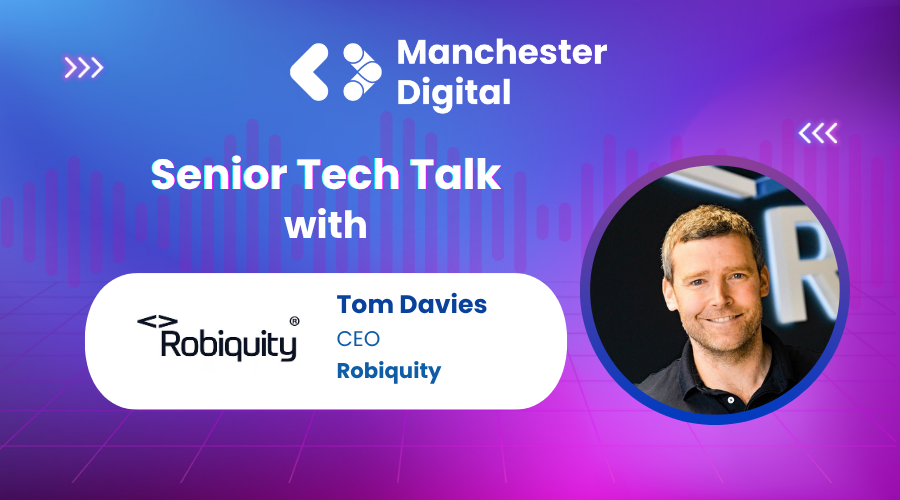
As Manchester-founded technology consultancy Robiquity celebrates its 10th anniversary, we caught up with CEO Tom Davies to reflect on the company’s journey so far and what comes next.
Tom discusses Robiquity’s evolution from robotic process automation into AI and intelligent automation, why businesses need to rethink how they operate to realise the full value of AI, and his ambitions to establish Robiquity as a genuine challenger to the industry’s biggest consultancies.
We also explore the company’s roots in Manchester, its approach to developing early-career talent and why creating more opportunities for local businesses and people should be central to the region’s continued growth
To start us off, can you tell us a little about your own journey into tech and how you came to lead Robiquity?
I’ve worked in technology consulting for more than 20 years, starting at PwCbefore moving to IBM and eventually returning to PwC.
I ended up working in regional consulting, where we built a technology consulting team in the North of England from scratch. We worked predominantly with mid-sized private-sector businesses looking to drive growth, profitability and efficiency through technology.
We were really successful, but I became frustrated with the traditional consulting model. We would develop the strategy and design, but then hand the actual delivery over to a large systems integrator. I wanted to get closer to actually building and delivering things.
Around that time, I became involved with Tech North and applied to lead the organisation. I didn’t get the role, but the process gave me the push I needed to do something different. I joined an AI software business coming out of the University of Salford, where part of my role was developing its partner channel. It was there that I met Robiquity.
Robiquity was looking for a CEO, someone who could help professionalise and grow the business’ consulting proposition. I loved the business — it was punchy, down-to-earth and straight-talking, which felt very different from the big consultancies. That was six years ago and we haven’t looked back.
Robiquity is celebrating its 10-year anniversary this year. Looking back over the last decade, how has the business evolved, and what are you most proud of achieving?
Given the rate of change in the tech sector, the business has evolved several times. Robiquity was founded by people from the recruitment industry and initially operated a recruit, train and deploy model, developing automation skills and placing those people into larger consultancies.
The founders saw the value those teams were delivering and realised there was an opportunity to retain that talent and build a consultancy themselves.
When I joined, we were still heavily focused on robotic process automation. We’ve continually evolved our skills, market positioning and technology partnerships as the market has changed. More recently, that has meant moving much more towards the broader Microsoft ecosystem, with a deep focus on AI.
We’ve effectively retrained and repositioned the business several times, and I’m particularly proud that we’ve managed to do that while continuing to grow profitably. We expect to exceed £20 million in revenue this financial year and, throughout Robiquity’s lifetime, we’ve never had an unprofitable month.
Another significant evolution has been our growth into the public sector. Historically we were almost entirely private-sector focused, but we made a conscious decision to establish ourselves in government.
That started with getting onto the right procurement frameworks and building our credibility. We then began working with police forces, including some fantastic projects with Greater Manchester Police around areas such as safeguarding vulnerable people, and have since expanded into central government departments including the Foreign, Commonwealth & Development Office and Ministry of Justice, as well as healthcare with NHS Scotland.
We’re increasingly being recognised as a credible alternative to the long-established consultancies in that space, based on our ability to get things done quickly.
AI and automation have changed enormously during that time. What are you seeing from customers today, and where do you think the biggest opportunities are for organisations looking to get genuine value from these technologies?
The pace of change is incredible. If you take Microsoft as our primary technology partner, new capabilities across Copilot, Power Platform, automation and AI models are being released constantly.
Even within the last 18 months, we’ve gone from building intelligent applications through low-code development to increasingly building them through AI prompts. That is dramatically increasing the speed of development and, importantly, the speed at which organisations can realise value.
There’s a big difference, though, between organisations embedding AI into individual tasks and those fundamentally rethinking how their organisation operates.
The organisations getting the greatest returns are asking how AI can be embedded throughout the organisation - into how people work, how processes operate and how customers interact with them. When you approach it that way, the potential return on investment can be significant.
At the other end of the spectrum, organisations can buy AIlicences for everyone and create a substantial additional cost while only achieving relatively small improvements in individual productivity.
The real opportunity is not simply to make existing tasks slightly quicker. It’s to rethink and reengineer how the organisation operates. The businesses prepared to do that will be the ones that survive and thrive.
Robiquity was born in Manchester and has remained firmly rooted here as the business has grown. What role has the city and its tech ecosystem played in the Robiquity story?
Manchester has been fundamental to the Robiquity story. It's where the business was founded, where most of our people are based today, and where our headquarters remains. Despite how much we've grown and evolved over the years, we've stayed true to that down-to-earth Manchester mentality. That's part of our DNA, and I think it's one of the reasons clients enjoy working with us.
Historically, a lot of the focus in Manchester's tech scene has been on product startups, whereas Robiquity is a services business. But I think there's now a real opportunity, and responsibility, for us to become even more invested in the city and the wider ecosystem. We've benefited from the fantastic talent here, and we can play a meaningful role in developing and retaining technology skills across Greater Manchester.
One challenge is that many organisations based here still look outside the region when buying technology services. There's world-class capability in Manchester, and I think we all have a role to play in supporting one another and ensuring more of that investment stays local. That's good for businesses, good for talent, and ultimately good for the city.
There’s a growing focus across Greater Manchester on ensuring that the region’s economic and technology growth creates opportunities for local businesses and local people. How does that align with Robiquity’s ambitions?
We have a huge role to play. I’m involved in initiatives and conversations around how we ensure local people, education and skills are part of the picture as businesses grow in Greater Manchester, and as a business we’re completely committed to that.
We have a proud record when it comes to creating opportunities for people from different backgrounds. Jack Rimmer, our founder, came out of the Army, spent six months in recruitment and then founded Robiquity. That mentality is still reflected in how we recruit today. We’re not particularly interested in which school or university somebody attended. We look first at whether they are a Robiquity fit, which comes down to attitude, aptitude to learn and ambition.
The technology is also making it increasingly possible to train people quickly and deploy them onto client projects.
If we can combine that model with a stronger commitment from local businesses to use local talent, the opportunity is huge.
Whether it’s retail, financial services, utilities or public services, AI creates an opportunity for Greater Manchester organisations to become leaders in their fields. Why shouldn’t that transformation be enabled by local technology businesses and local people?
Robiquity recently recruited someone through Manchester Digital’s Grad Recharge programme. Why is investing in early-career talent important to the business, and what more can the tech sector do to create meaningful routes into the industry?
It’s incredibly important that we continue bringing early-career talent into the business. Our graduate programme runs twice a year and we typically bring in between six and ten new employees through that route.
They bring new ideas, perspectives and experiences. They’re hungry and ambitious, and they help keep the culture of the business fresh and disruptive.
As a sector, I think we need to become less focused on lengthy lists of certifications and existing skills and think more about what people are capable of becoming within an organisation.
This is also a great story to clients. By choosing to work with businesses like Robiquity, clients are helping create genuine career routes for young people within the region. This is a differentiator for us while also having a positive impact on the wider ecosystem.
Alongside developing talent, how important is it for growing businesses like Robiquity to work with and create opportunities for other organisations within the local supply chain?
It’s something we already try to do wherever possible.
We work with a small local design agency on our brand and website. We used a local start-up property search business to help us find our current home in the former Granada TV building. We work with local talent acquisition partners.
We also host events at our office for the local technology sector and make the space available to other organisations.
We try to keep the local supply chain and community front of mind and ask how our own growth can help support the growth of other organisations around us.
As a Manchester-founded business that has grown significantly over the past decade, what are the biggest lessons you would share with other ambitious tech businesses in the region?
First: pick up the phone.
There’s no substitute for speaking to people and building relationships. Too often businesses rely on email or social media. One advantage Robiquity has retained from its recruitment heritage is that commercially we know our market, we know the people within it and we’re prepared to speak to them. Many of our strongest client relationships have become WhatsApp conversations.
Secondly, make decisions quickly. Every business makes mistakes — we’ve made plenty. Avoiding mistakes altogether is impossible. What matters is recognising when something isn’t working and acting quickly.
Sometimes that can be painful. You might make an expensive senior hire and realise they’re not the right fit. Making the decision quickly hurts at the time, but allowing the wrong decision to linger usually hurts more.
Finally, stay agile. Technology is changing incredibly quickly, so you have to recognise the direction the market is moving and be prepared to pivot with it.
Over our 10 years, we’ve seen plenty of firms become too attached to one way of working, one technology or one vendor relationship. Some of them no longer exist. Being willing to continually evolve has been fundamental to our success.
Finally, after celebrating the first 10 years of Robiquity, what does the next decade look like? What are your ambitions for the business, both in Manchester and beyond?
We want to continue our growth journey, but the bigger ambition is about what the Robiquity name represents.
I want us to reach the point where, when a boardroom asks, “How could we be doing more with AI?”, Robiquity is one of the first names that comes to mind.
We’re already a stone in the shoe of the global systems integrators and Big Four consultancies. Over the next decade, we want to become a nationally recognised challenger to those organisations.
And from a Manchester perspective, we want to be part of the fabric of what continues to make this city outperform nationally — whether that’s economic growth, emerging technology adoption or innovation.
We want Robiquity to be front and centre of that story.
Thank you Tom!
To find out more about Robiquity, click here.