What is G-Cloud 15?
G-Cloud 15 is the UK public sector's framework for buying cloud hosting, cloud software and cloud support services, managed by the Government Commercial Agency (formerly Crown Commercial Service). It is the first G-Cloud iteration run under the Procurement Act 2023 and the first to operate as an open framework, which means it reopens to new suppliers and updated services during its four-year term.
For organisations buying Oracle application support, the relevant lot is Lot 3: Cloud Support, which covers consultancy and managed services that support cloud platforms after they are implemented. Oracle licences themselves are normally bought separately; Lot 3 is how you buy the partner who keeps Oracle Fusion and EPM running, advises on each release and manages Oracle on your behalf.
Where does Oracle Fusion and EPM support sit in G-Cloud 15?
Oracle managed support is a cloud support service, so it is bought through Lot 3. A typical Oracle support requirement under Lot 3 covers:
- Application support for Oracle Fusion ERP and Oracle EPM (Planning, formerly PBCS): end-user errors, "how-to" requests and functional or configuration issues.
- Oracle Service Request management: raising, tracking and escalating SRs with Oracle Support on your behalf.
- Release management: reviewing Oracle's quarterly Fusion updates and monthly EPM updates, and running regression testing in the window before production is updated.
- Release and AI advisory: assessing which new features, including Oracle's embedded AI agents, are worth adopting.
- Minor changes: small enhancements, usually delivered from a pre-agreed pool of days.
- Service management: reporting, service reviews and continuous improvement.
If your requirement also includes new modules, a re-implementation or a major integration project, consider whether that work belongs in the same call-off or in a separately scoped engagement.
What has changed from G-Cloud 14 to G-Cloud 15?
Four changes matter most to Oracle support buyers.
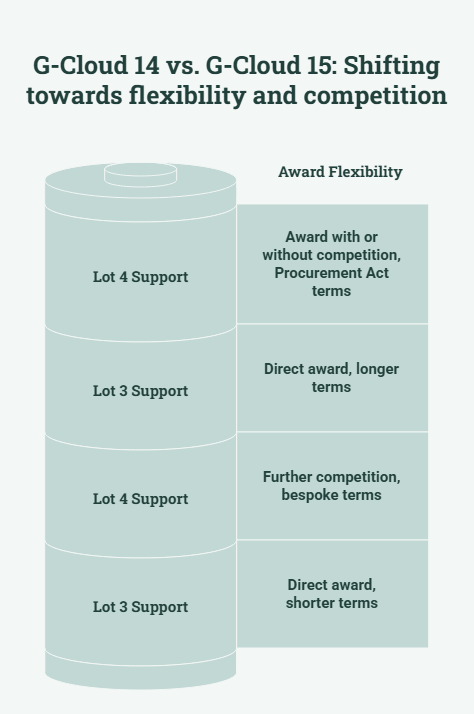
Two practical consequences follow. First, a multi-year Oracle support contract no longer has to be squeezed into a short term and re-procured soon after it beds in. Second, you can now run a further competition under Lot 3 when your requirement is complex, rather than being limited to direct award from catalogue listings.
What happens to existing G-Cloud 14 contracts?
Existing G-Cloud 14 call-off contracts continue until their own end date, even after the framework closes. What changes is how you buy next: once G-Cloud 14 closes on 28 October 2026, any new call-off or re-procurement goes through G-Cloud 15 or another route. Plan around your own contract's end date, not the framework's.
How do you buy Oracle support through G-Cloud 15, step by step?
- Start well before your current contract ends. We recommend beginning 9 to 12 months ahead. That leaves time to document the current service, run a search or further competition, and plan a transition that avoids your financial close, year-end and Oracle's update windows.
- Write down what you actually need. Capture the Oracle modules in use (Fusion Financials, Procurement, EPM Planning and so on), number of users and environments, typical monthly ticket and SR volumes, integrations, support hours, and how much minor change you expect each year. A clear requirement makes catalogue search and evaluation far easier.
- Choose your award route. Under G-Cloud 15 you can award without competition, where a listed Lot 3 service clearly meets your requirement, or run a further competition for more complex needs. Without competition, pricing defaults to the framework's published maximum day rates; further competition can be priced on outcomes or time and materials. Either way, keep a full audit trail of your search and decision.
- Search and shortlist on Lot 3. Filter for Oracle Fusion and Oracle EPM support services, then read each service definition and pricing document. Check that the listing covers both ERP and EPM if you need both, rather than assuming one partner's ERP service extends to Planning.
- Evaluate against how Oracle really works. Ask each supplier how they handle Oracle SRs, monthly EPM updates, quarterly Fusion updates and new AI features (see the questions below). Ask for named roles, governance cadence and a sample service report.
- Agree the call-off terms that protect you. Use G-Cloud 15's optional schedules where they help, particularly performance levels. Define service levels, a reporting pack, how minor-change days are approved and reported, and an exit plan from day one.
- Plan the transition before signing. Agree knowledge transfer from the incumbent, a shadowing period and a cutover date that avoids month-end, year-end and the fortnight between Oracle's test and production updates.
What should you ask an Oracle support supplier?
These questions separate partners who run Oracle day to day from those who mainly implement it.
- Service Requests: Who raises SRs with Oracle, how do you choose severity, and how do you escalate an SR that stalls?
- Release management: How do you review Oracle's quarterly Fusion and monthly EPM release notes, and what do you regression test in the window before production updates?
- AI advisory: How will you tell us which of Oracle's new AI agents and features are worth switching on, and what governance do you recommend before we do?
- Change: How are minor changes scoped, approved and reported, and what happens to unused days?
- Governance: What does your monthly service report contain, and which KPIs do you commit to beyond ticket counts?
- People: Who will we work with, which Oracle modules do they cover, and how do you maintain cover during holidays and peaks?
- Exit: What documentation, runbooks and knowledge do we own at the end of the contract?
How do you switch Oracle support providers without disrupting finance?
The risk in switching is not the contract; it is the undocumented knowledge sitting with the incumbent. A safe transition usually moves through discovery, shadowing, parallel running, cutover and a short hypercare period. Two timing rules matter most for Oracle estates:
- Avoid financial close and year-end. Do not cut over in the weeks your finance team is closing the books or setting the budget.
- Avoid Oracle's update windows. Oracle updates Fusion test environments, then production, on a fixed quarterly schedule, and EPM monthly. A new partner should not be learning your estate during a regression window.
Our 90-day transition plan sets out each phase in detail.
How VE3 can help
We provide Oracle Fusion ERP and Oracle EPM managed support for UK organisations, covering application support, Oracle SR management, release management with regression testing, release and AI advisory, minor changes and service governance. If you are planning a re-procurement, we are happy to review your current support scope and help you shape a clear requirement before you go to market. Talk to us about Oracle support on G-Cloud 15.