Ask three departments what counts as an "active customer", and you'll often get three different answers. For years that was a reporting nuisance. People learnt which figure to trust and quietly worked around the rest.
AI removes that safety net. An agent doesn't know which definition finance prefers. It uses whichever one it finds, and it answers with the same confidence either way. As organisations move from copilots that suggest to agents that act, the cost of an unclear definition rises from a confusing dashboard to a wrong decision taken at scale.
What are semantic models and ontologies, and why does AI need them?
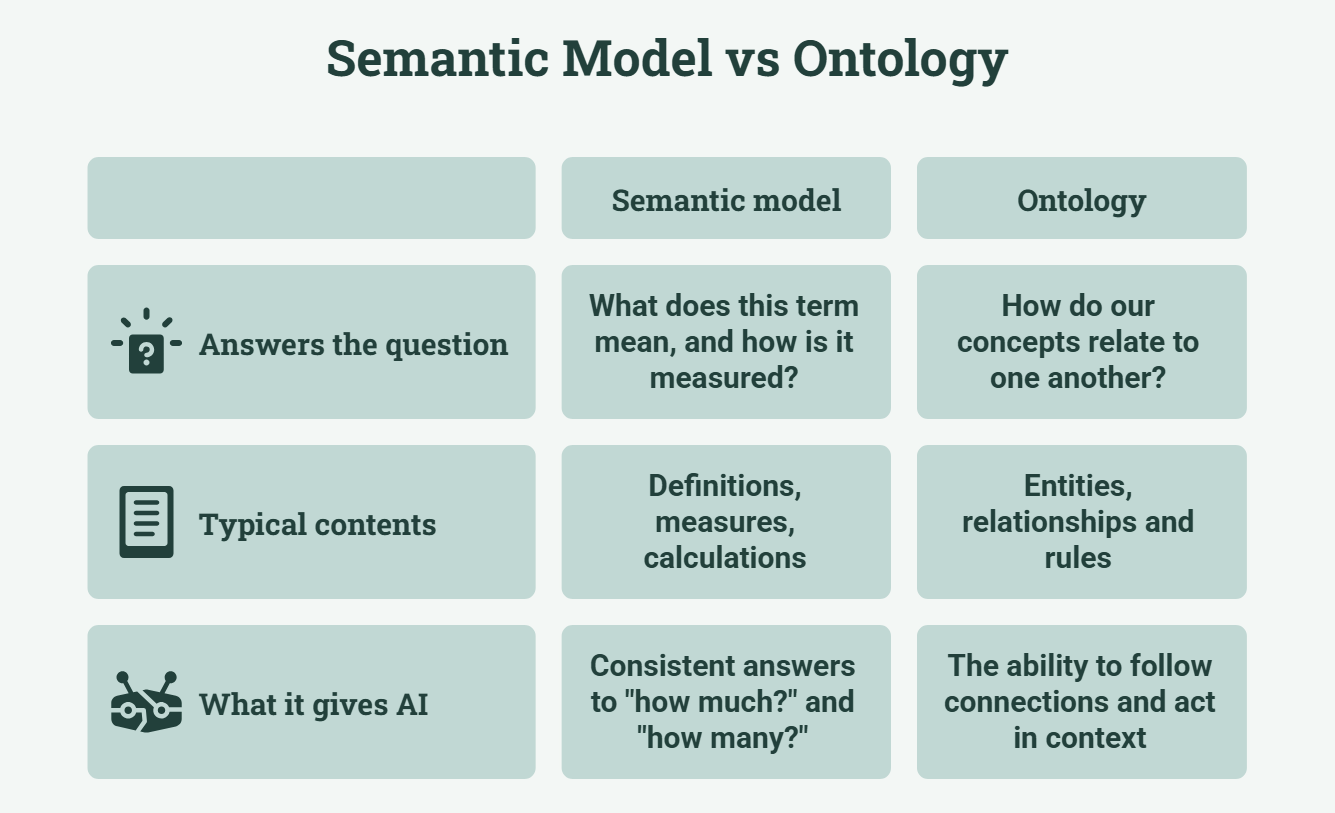
A semantic model is a business-friendly layer over your data. It records what each term means and how each measure is calculated. An ontology maps how those concepts relate to one another: a customer holds contracts, a contract covers assets, an asset sits at a site. If the semantic model is the dictionary, the ontology is the grammar. Together they form the vocabulary AI uses to reason about your organisation.
AI needs that vocabulary because a language model knows nothing about your organisation in particular. It doesn't know that your "active customer" excludes accounts in dispute, so without a semantic layer it guesses from table names and documents. Most organisations already have semantic models behind their dashboards, so the reporting investment pays off again for AI.
Why do ungoverned definitions make AI answers untrustworthy?
Ungoverned definitions make AI answers untrustworthy because the AI can't tell which version is right, and gives no sign that it had to choose. Three risks follow:
- Inconsistent answers: Ask the same question twice, and you may get two different answers, each delivered with the same confidence.
- Plausible errors: A figure that counts a lapsed customer as active sounds entirely reasonable, so nobody checks it.
- Bad actions, not just bad answers: An agent that misreads a definition might send the wrong renewal notice or report the wrong figure to a regulator.
None of these is a model problem. A more capable model working from conflicting definitions is simply more convincing when it's wrong.
Semantics is necessary, but it isn’t sufficient on its own. Clear definitions applied to inaccurate, incomplete or out-of-date data still produce poor answers. Governed semantics works alongside data quality and the wider disciplines of data governance, including lineage, access control and retention. What semantics adds is the piece most often missing: an agreed meaning that every system and every agent can share.
What does it mean for business definitions to be governed, and who owns them?
A business definition is governed when the organisation knows who owns it, which version is current, and how it can change. In practice, that means:
- A named business owner, accountable for what the term means.
- One agreed version, with conflicting variants retired or renamed as different measures.
- Controlled change, with the impact on reports and agents understood before anything changes.
- Traceability, so any AI answer can be traced back to the definitions and sources behind it.
- Permissions built in, so AI sees only what the person it serves is allowed to see.
Ownership belongs with the business, with the data team as custodian. Definitions encode business decisions, so the most common mistake is treating semantics as a technical clean-up for IT.
Why is business meaning becoming a board-level governance issue?
Business meaning is becoming a board-level issue because agentic AI moves from advising people to acting for the organisation. When an agent sends a notice, prioritises a case or reports a figure, the organisation is accountable for that action, and so is its board. The definitions the agent relied on become part of how the decision was made.
That changes the questions boards should be asking about AI:
- Accountability. Who owns the definitions behind our most important decisions and reporting?
- Explainability. Can we trace any AI-driven answer or action back to the definitions, data and permissions it used?
- Change control. When a definition changes, do we know which reports and agents it affects?
For most organisations, the answer belongs in their existing AI governance framework and risk register, alongside data protection and cyber security. Each member of the leadership team has a stake. For the CDO it's the data strategy for AI, and for the CISO it's part of how AI stays within agreed boundaries. For the CEO and the board, it decides whether AI output can be acted on with confidence or must be double-checked.
What does this look like in health, energy and education?
Every sector has terms that sound obvious but mean different things to different teams. These are illustrative examples of where definitions can diverge, and what an AI system could get wrong as a result.
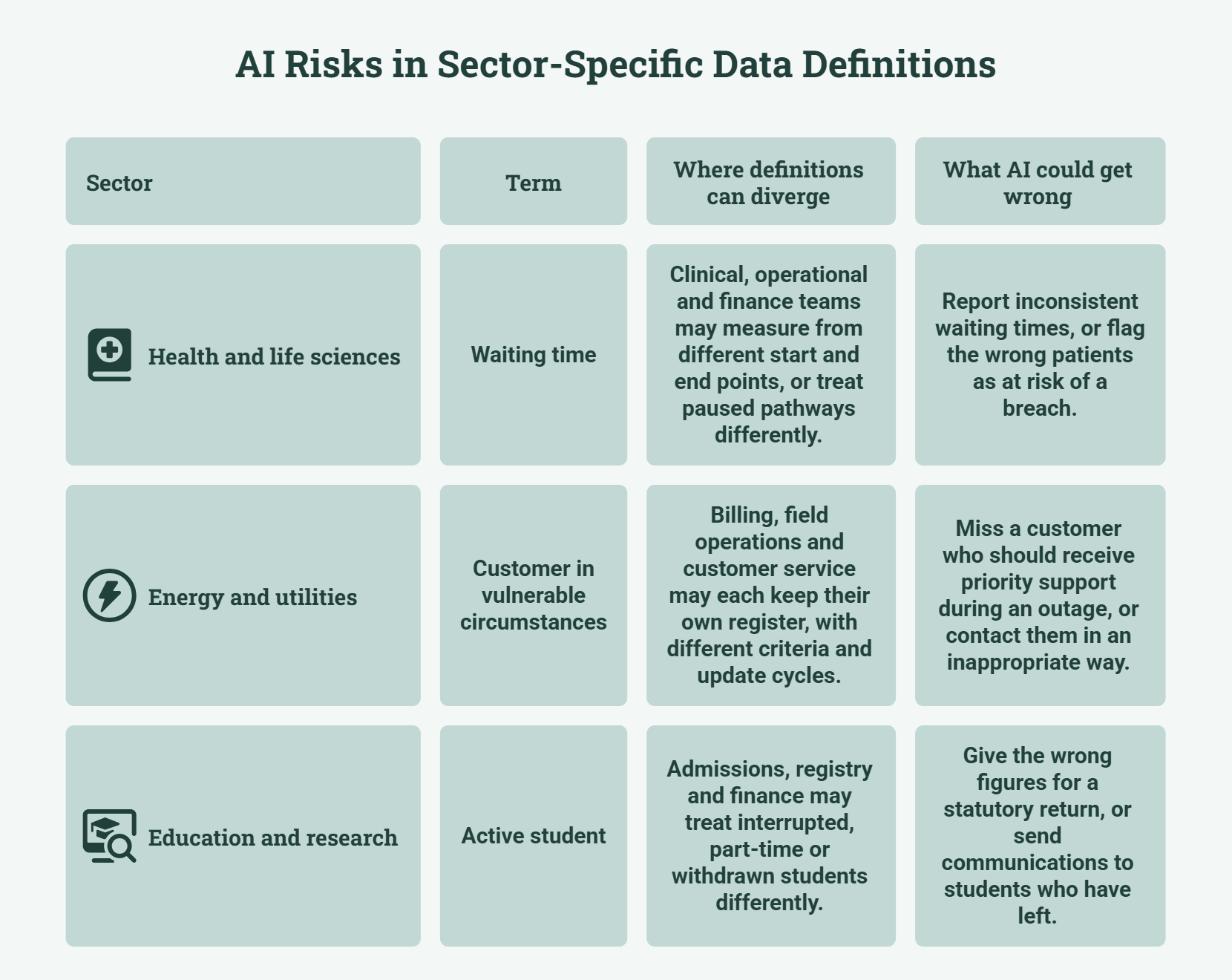
In each case, the data exists. What's missing is an agreed, governed definition the AI can rely on. In regulated sectors, a wrong answer isn't just inconvenient. It can affect people directly, and it has to be explained afterwards.
Why does business meaning need to be consistent across systems?
Business meaning needs to be consistent across systems because AI no longer works inside a single system. A person checking a customer's position might look at the CRM, then the finance system, then a contract in SharePoint, and mentally reconcile the differences. An agent does the same journey in seconds, without the instinct to notice that "customer" means something slightly different at each stop.
In most organisations, every major system carries its own version of the business: the CRM, the ERP, the HR platform, the data platform and the document estate. Each was set up for its own purpose, and each definition made sense locally. The underlying principle for trustworthy AI is simple: define each important concept once, and make that meaning available wherever AI looks. That's a design principle, not a product. It applies whether your data sits in Microsoft Fabric, Databricks, Snowflake or a mix.
Microsoft's direction shows how central this has become. Microsoft IQ brings together four sources of context for copilots and agents. Work IQ covers how people work across Microsoft 365, Fabric IQ covers business data, Foundry IQ covers enterprise knowledge for agents, and Web IQ covers live web information (Microsoft Partner blog: Build 2026 recap). In Fabric, Fabric IQ pairs Power BI semantic models with an ontology so that concepts such as Customer are defined once and stay consistent across reports and agents (Microsoft Learn: Fabric IQ overview). At the time of writing, Microsoft Learn labels the ontology as preview.
How does a shared vocabulary make AI agents trustworthy?
A shared vocabulary lets an agent understand a request, find the right information and act on it, using the organisation's own meaning at every step. Take two everyday requests:
- "What's my staff number?" This is simple, but only if the organisation defines and governs "employee" and "staff number" in one place, with the right permissions.
- "Who am I meeting today, and what's our relationship with them?" The agent must link a calendar entry to a person, the person to a CRM account, and the account to its contracts and open cases. If the CRM and finance disagree on what an "account" is, the briefing will be confidently inconsistent.
The stakes rise as teams publish their own agents. An HR team that rolls out a policy agent to every colleague has to keep it current as policies and definitions change. Multiply that across departments, and agents can become the next generation of shadow IT. Governed semantics keeps this manageable. A definition changed once flows through to every agent that uses it, and agents can be tested against agreed definitions before they're published.
How can organisations make their semantics AI-ready?
Start small, with the terms that matter most, and put ownership in place before scaling up:
- Pick the terms that carry the most risk. Focus on the concepts behind your key decisions and regulatory reporting.
- Find where definitions disagree across reports, systems and teams. Each disagreement is a place where AI could give two different answers to the same question.
- Assign owners and agree on one version of each term. Build on your existing semantic models, and map the key relationships into an ontology.
- Test AI against the definitions before agents go live, and again whenever a definition changes.
None of this has to wait for a major platform programme, and reporting benefits straight away.
Conclusion: before choosing a model, agree on your own words
Much of the AI conversation still centres on which model to use. But models keep changing. Alongside good data quality and sound governance, one of the things that decides whether an AI answer can be trusted is the meaning of your own business language, held consistently across every system AI draws on. Semantic models give AI consistent definitions, ontologies give it relationships, and governance makes both dependable. Organisations that get this right will get more from every copilot and agent they deploy. Those that don’t will find their AI is most convincing exactly when it’s wrong.
How VE3 helps organisations put trusted AI into operation
We help organisations move AI from promising pilots into trusted operational use. As a Microsoft-native data and AI consultancy, we work with business, data and risk teams to:
- identify the business terms that carry the most risk, and agree and govern them with named owners
- build semantic models and ontologies so the same meaning reaches reports, Microsoft 365 and AI agents
- design for traceability, so every AI answer or agent action can be traced back to the definitions, data and permissions behind it
- put the controls in place to test, publish and maintain agents as definitions and policies change
Much of our work is in regulated environments, including health and social care, the public sector and utilities. There, being able to explain how an AI system reached its answer is a requirement, not a nice-to-have.
Our own platform, PromptX, is built on Azure and includes native ontology support. That helps organisations put their governed business vocabulary at the heart of the AI applications and agents they build.
If you're planning copilots or agents and want to know whether your semantics are ready, talk to our team.