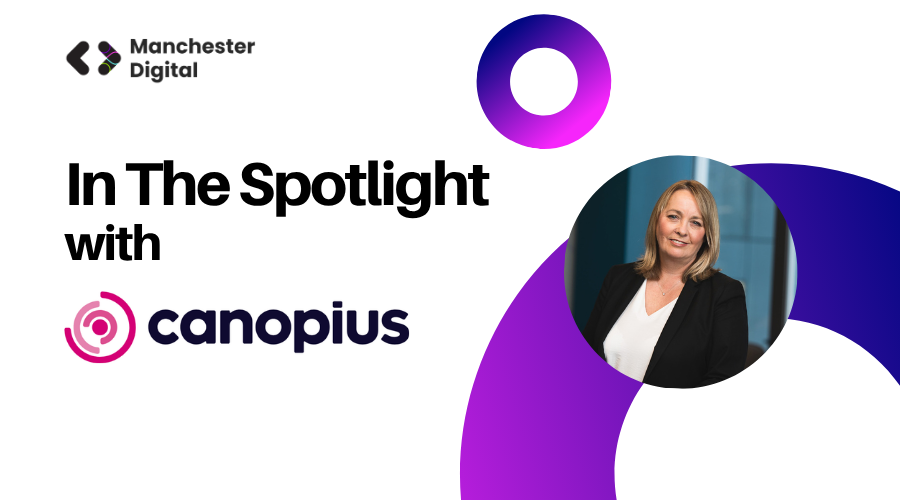
At Manchester Digital, we regularly shine a light on our members to understand more about their roles and their work within Greater Manchester’s digital and technology community. This week, we’re speaking with Kate Roy, Group Chief Operating Officer at Canopius.
At Canopius, what are the key priorities shaping your role at the moment?
As a global (re)insurer, our top priority is always to find ways to support clients in a world of increasing risk. We're growing rapidly across our chosen markets, and we've taken an AI-first approach to support that growth and drive innovation more broadly. A major focus for me over the last 18 months has been our Manchester Centre of Excellence. We first established a presence here three and a half years ago, initially concentrating on technology and data roles. Following that success, we're now expanding to bring our Change and Resilience expertise under the same roof.
Canopius operates across complex and highly regulated areas, how are you seeing risk evolve in financial services today?
Risk and regulation are distinct but linked. We've always operated in tightly regulated environments across the UK, US and APAC, so that's simply part of how we do business, and those risks are well understood and embedded. What's more interesting is how new risk categories are emerging alongside new technologies. Every wave of innovation opportunities also brings fresh risks, and we're constantly working out how to help clients manage and transfer that risk in a bespoke and practical way, while also managing it ourselves and supporting our regulators as they try to keep pace. AI, in particular, is accelerating at a rate we haven't seen before, and that's a genuine challenge for regulation, which naturally moves more slowly.
In response, we’re encouraging our people to use technology to innovate, but we are doing so within a controlled environment where we can pilot, monitor and learn. It's about finding the right risk-reward balance rather than either shutting AI out entirely or opening the door without safeguards. Innovation within set guardrails is like allowing people to drive themselves as long as there are clear road signs and markings – it keeps everything moving smoothly and allows us to spot when something might go wrong and stop it before it does.
With the rise of AI and increasingly sophisticated fraud, how are organisations needing to rethink trust and resilience?
Canopius operates through brokers and intermediaries rather than direct to customers, so our focus is on our own cyber resilience and that of our clients. Every advance in AI that benefits legitimate businesses can equally be exploited by threat actors. Technology doesn't only serve the good guys. We invest heavily in our cybersecurity function and cyber operations centre, and what we're seeing isn't necessarily just new categories of threat, but existing ones accelerating.
Activity that once took weeks or months to develop can now be learned and scaled by AI in a fraction of the time, which means our defences must move just as fast. Where we might once have patched vulnerabilities weekly or monthly, we're now patching daily, sometimes multiple times a day. Resilience today is really about speed and responsiveness. If your turnaround times aren't quick enough, you become more exposed, and that's the single biggest risk I focus on controlling.
Canopius has recently expanded its presence in Manchester — what drove that decision, and what opportunities do you see in the region?
We're committed to Manchester for the long term. We recognised that the talent market in London is extremely competitive, meaning it’s also increasingly challenging for our business to be able to sustain a scalable, operational function in London.
Manchester stood out because of its talent base, particularly graduates and young professionals with a strong propensity for technology. We spent three years building a team of around 70 here before deciding to centralise all of our operational technology and data activity in the city. We've since invested heavily in our new office, designed specifically around how our teams actually work, with quiet, screen-heavy space for data engineers and developers, alongside collaborative areas for the teams driving our AI and agentic technology work.
We're midway through the transition and expect to have close to 200 roles here by next year. It's a genuine long-term commitment to both ourselves and the North West, not just a satellite office.
As you scale your team in Manchester, what are you looking for in talent, and how is the local ecosystem supporting that growth?
We're recruiting for skills rather than insurance experience. We’re not expecting to find data and technology talent with automatic and deep-seated knowledge of the London insurance market, so we've been deliberate about expressing that. We can teach people insurance, but we need them to bring the technical capability and, just as importantly, share our values. Investing in talent from outside the insurance sector has delivered significant benefits through the introduction of diverse perspectives and ideas from a broad range of industries, helping to shape more robust and innovative solutions.
This approach means we can attract talent at every career stage, from apprentices and graduates right through to senior, technically experienced hires. Organisations like Midas, Manchester's inward investment agency, have supported us from choosing premises through to building connections with local further and higher education organisations.
Our partnership with Manchester Digital works both ways, helping raise our profile while showing talented professionals who might otherwise gravitate towards a tech start-up that a global insurer can offer an equally, if not more, exciting technology career. Culturally, we're a collaborative, mid-sized business, with ambitious people that have a thirst for knowledge. I'm often having to space out colleagues' requests for running another lunch and learn, which is a lovely problem to have. That energy is exactly what helps new joiners feel genuinely connected and excited about our direction.
What are the biggest operational challenges organisations face as they scale — particularly around governance, compliance and infrastructure?
Beyond the regulatory and risk considerations I've already touched on, I think any organisation wanting to properly take advantage of modern technology needs two things in place. First, a genuinely modern, cloud-hosted, resilient infrastructure. Legacy platforms simply aren't compatible with where AI is heading. Second, and just as important, real investment in data capability. We've spent four years building our own Azure-hosted data platform, surrounded by strong governance, so we understand exactly where our data comes from, its lineage, and its definitions across every market we operate in. That matters because AI learns by searching across your organisation, and if the same term means something subtly different across systems, the technology can't reconcile that. The more governed and consistent your data, the more value you can unlock from AI. It's also changing how we're audited. Our auditors now spend as much time examining our technology controls as they do our financial accounts, because so much now relies on what sits behind the systems.
How do you balance innovation with risk management as new technologies and business models emerge?
There will be ongoing challenges for business leaders as the pace of technology continues to accelerate. Ultimately, we're running a business, and this technology isn't free and costs can become unpredictable, so we’re being deliberate about where and when we invest.
On an individual basis, we’ve given every colleague at Canopius access to foundational AI tools like Microsoft Copilot, and we track and share how people use them so productivity gains benefit the wider organisation, not just individuals. The only ask is that if someone finds something that works well, they share it.
Alongside that broader enablement, we're also investing more heavily in specific, higher-level development, such as the technology supporting our claims proposition, where the potential return justifies a much closer, more considered look. As these bets get more expensive, organisations will increasingly need to be selective about which initiatives are likely to deliver the strongest return, rather than spreading investment too thinly.
What AI tool has had the biggest impact on your team?
We've had early access to some of the newer tools in the Microsoft Copilot suite, and Cowork has genuinely been game-changing, even though it's only been available for around two and a half months. I've got team members who've told me that it has made a world of a difference to their work and that it’s hard to imagine how they managed without it.
It's not just about handling routine tasks either. It actively does tasks for you once it's learned how you operate, whether that's building a PowerPoint deck in minutes or pulling together information that would previously have taken far longer, sometimes reducing admin or research tasks from days down to minutes.
What's struck me most is how accessible the application is. It's been dropped onto the desktops of senior managers who aren't technologists, and they've been able to pick it up and reclaim real thinking time almost immediately. We're still piloting it, and no doubt the pricing will reflect its value once that's confirmed, but it reinforces a point I keep coming back to - you have to be thoughtful about where these tools deliver the most value.
Thanks Kate!
To find out more about Canopius, click here.