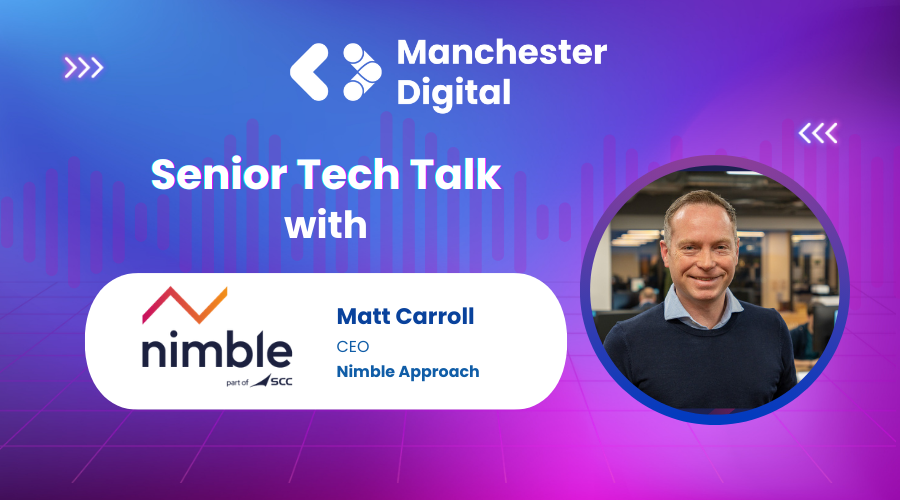
Matt Carroll recently stepped into the role of CEO at Nimble Approach, bringing more than two decades of experience in technology delivery, consulting and platform leadership.
In this Senior Tech Talk, Matt shares his journey into tech, his early priorities as CEO, and why he believes organisations need to go beyond the hype around AI.
To start us off, can you tell us a bit about your background and your journey into tech? What led you to Nimble Approach?
My journey into tech started over two decades ago as a software tester and developer, fresh out of university. After a couple of years, I moved into project delivery, but I’ve always stayed within the technology domain.
I spent the last 12 years at Accenture, where I was leading and growing technology platform businesses. At the start of this year, I had the opportunity to join Nimble as CEO to drive its next wave of growth. I’m only a couple of months in, but it’s an exciting time to step into the role.
For those who may not know Nimble Approach, how would you describe the business and the kind of organisations you work with?
Nimble is a technology consultancy founded in 2016, so this year marks our 10-year anniversary. We’re a 120-person business across Manchester, Leeds and Sheffield, working across both public and private sectors.
Put simply, we help organisations deliver better digital products and services, faster.
Our core capabilities span three main areas. Firstly, Product and Design - Product Management, Service Design and User Research. Secondly, Engineering - including AI-Driven Development and Cloud Platforms. Thirdly, Data - Architecture, Data Platforms and AI.
AI is obviously a big topic, but we don’t see it as a standalone capability. It runs through everything we do, and we’ve been on our own journey to ensure our teams are using it to augment and accelerate their work.
Where we really add value is by bringing Product, Engineering and Data together to drive business transformation. Technology and data alone don’t deliver outcomes — it’s the product lens that unlocks value.
In terms of sectors, we do a lot in the Public Sector, particularly in education. There’s a huge opportunity there to use data and AI to personalise learning and improve productivity. For example, we’ve helped a client create an app that reduces the time teachers spend marking, giving them more time to focus on teaching.
Beyond that, we work across many industries including energy, fintech, retail, betting and gaming - everything from shaping agile ways of working, to building apps, to modern tech and data transformations.
What does your role involve day-to-day, and where do you feel you add the most value for clients?
Two months in, I’m spending a lot of time listening — meeting clients, understanding their challenges and exploring how we can help.
Internally, we’re sharpening our strategy and go-to-market proposition, so I’m working closely with our teams to align our capabilities to real client problems.
Where I add value is ensuring we have the right people, the right teams and the right solutions in place to help clients achieve their growth and efficiency ambitions. That’s why there’s a strong focus right now on clarity of strategy and proposition.
There’s obviously a huge amount of noise around AI at the moment. You’ve written about going ‘beyond the hype’ — what does that mean in practice for organisations?
There’s definitely a lot of noise, and the pace it is developing is rapid. AI has been around for decades, but it’s now at a level of maturity where real use cases are delivering tangible value — and that’s what’s driving traction.
Organisations that were experimenting with proof of concepts are now asking how to scale AI meaningfully. Much of the conversation is about efficiency — reducing effort and accelerating time to value — but increasingly it’s also about growth, particularly around personalisation at scale and improved customer experiences.
In practice, we see three priorities.
First, modernising tech and data foundations.
Second, embedding AI governance - both in the development lifecycle, with security by design, and operationally, with clear compliance and risk management.
Third, adopting product thinking. Moving away from a traditional project mindset to one where outcomes, value and learning define progress.
When those three elements come together, and this is our sweet spot, organisations can genuinely move beyond the hype and realise meaningful impact.
AI presents huge opportunities for growth and efficiency - but also risk. How are you advising organisations to think about governance and responsible adoption?
It’s a massive opportunity, but the organisations that will see the biggest returns are the ones that address the risks head-on.
AI governance is about building trust. Risks span operations, reputation, compliance and finance, and more, so organisations need clear principles, policies and standards. Regulation is evolving quickly - from the EU AI Act to the AI Cyber Security Code of Practice - so staying informed is critical.
Two areas stand out.
Ethics is a major consideration, particularly around data biases and the non-deterministic nature of AI outputs.
Cyber risk is another. AI increases the attack surface, so security and data protection must be built in from the start.
One thing we often see is siloed AI adoption - teams using tools independently. That creates risk and missed opportunity. We help clients assess what’s happening across the organisation, put governance frameworks in place and implement solutions that balance innovation with control.
What opportunities do you see in Manchester and the wider North right now for Nimble to grow - particularly in data, engineering and AI?
I’ve worked globally but lived in Manchester all my life, and there’s real momentum building here - and across the North - around digital growth through data and AI.
The ecosystem is thriving, from universities and early talent through to start-ups, scale-ups and major organisations opening offices in the region. Investment in infrastructure - innovation districts, science parks — is strengthening that further.
Organisations like Manchester Digital are doing a great job of facilitating collaboration, which creates real energy in the ecosystem.
We’re contributing to that too — hosting roundtables and bringing leaders together to share perspectives on modern data transformation. That kind of collaboration is what fuels sustainable regional growth.
Early talent and skills development are big topics, especially with AI reshaping roles. How should businesses be thinking about building the right teams for the future — and why is Manchester particularly well placed?
AI is definitely complicating the picture. There’s growing concern about entry-level roles being displaced, and that’s something we as leaders need to take seriously.
I’ve previously run early talent programmes and still mentor and have reverse mentoring today. I see first-hand the potential early-career professionals bring.
We still need experienced professionals, but we also need diverse teams that blend experience with fresh thinking and familiarity with emerging technologies.
Manchester - and the wider North, including Leeds where we also operate - is well placed because of its talent pipeline and reputation as one of the fastest-growing tech hubs. That gives us a real opportunity to shape the next generation of technology professionals.
Diversity and inclusion remain critical issues in tech. How important is it to build diverse teams - particularly in emerging areas like AI?
It’s extremely important. I’ve seen diverse teams deliver better outcomes - it’s not just the right thing to do, it drives performance.
Focusing on women in tech, it’s well known that representation remains too low. As a leader and an ally, I see it as my role to create platforms for women to share their stories - to inspire others into the profession and, just as importantly, to retain them.
Retention is a big part of the conversation. How do we ensure women - and other underrepresented groups - feel supported to build long-term careers in tech?
At Nimble, we’re actively sharing stories internally and externally, and we’re putting plans in place to better support diverse groups as part of our evolving culture. Our ambition is to be the best place to work, learn and grow — and that requires continuous listening and improvement.
In AI specifically, diversity is critical. Bias can be embedded in historic data, so responsible AI adoption must include addressing data bias as part of broader governance. Inclusion isn’t separate from AI strategy - it’s fundamental to it.
Thank you Matt!
Find out more about Nimble Approach here.