We know AI has shifted the conversation in boardrooms.
The pressure to do something with AI is real. Boards are asking questions. Investors are watching. Employees are experimenting. Customers are starting to expect more. Doing nothing is no longer a credible option.
But doing the wrong thing is expensive.
AI is not yet enterprise‑ready to solve end‑to‑end transformation challenges on its own. That doesn’t make it irrelevant. It means leaders need to be far more deliberate about where and how it is applied if it is to improve business performance rather than erode trust.
Performance before possibility
When we talk about AI improving performance, we need to be clear about what performance actually means.
For any organisation, it still comes down to three outcomes:
growing revenue
protecting or improving margin
strengthening resilience
AI initiatives that do not clearly contribute to at least one of these outcomes are experiments, not transformation. That distinction matters – especially in an environment where delivery capacity, budgets, and leadership attention are already stretched.
Where AI is paying back today
From the work we see across organisations, AI is delivering value in two very different ways.
Personal productivity tools are everywhere. They help individuals work faster, structure thinking, and remove friction. They can be genuinely helpful – but they rarely deliver measurable business‑level performance improvements on their own. In many cases, they add cost without changing revenue, margin, or resilience.
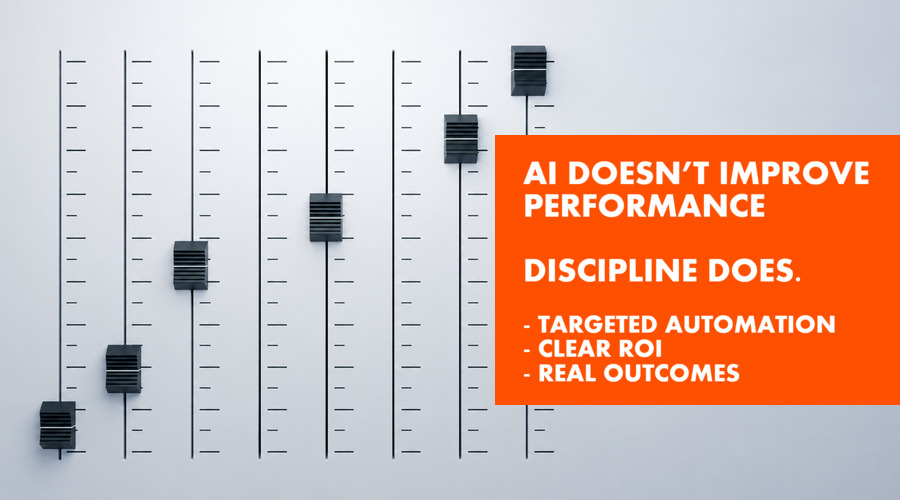
Targeted automation and decision support, applied to repeatable processes and high‑volume decisions, is where AI starts to pay back. This is where AI connects to the value chain – improving throughput, reducing error, lowering cost, or strengthening control.
The difference is intent.
Fewer use cases. Stronger outcomes.
The organisations making progress with AI are not doing more. They are doing less – deliberately.
They focus on a small number of use cases with a compelling business case. They are clear about the cost of delivery, the operational impact, and the expected return. And they are prepared to stop initiatives that don’t deliver.
Being brave about ROI is essential.
If an AI initiative is not helping to grow revenue or reduce cost – directly or indirectly – it should be questioned. If it increases complexity or technical debt without a clear path to value, it should be stopped.
This is not anti‑innovation. It is disciplined leadership.
Preparing the organisation, not just the technology
AI amplifies whatever it is applied to.
In organisations with complex technology estates, poor data quality, fragile processes, and exhausted teams, AI will amplify those weaknesses. That is why preparation matters as much as experimentation.
Leaders should be focusing on:
improving data quality and governance
simplifying processes before automating them
building AI literacy across leadership and delivery teams
creating clear ownership and decision rights for AI initiatives
This is foundational work. It is not glamorous – but it is what allows AI to improve performance rather than create new risk.
Learning, adapting, and staying close
AI is still evolving. Standards are not set. Platforms will change. Some bets will be wrong.
The right response is not to wait for certainty. It is to invest in learning without locking the organisation into brittle solutions. That means piloting with intent, measuring impact, and staying close enough to pivot as the technology matures.
AI will transform organisations faster than previous waves of technology – just as the internet, cloud, SaaS, and mobile did before it. The pace will be quicker, and the consequences of getting it wrong will be higher.
From AI activity to business performance
AI does not improve performance by default. Leadership does.
When AI initiatives are anchored to strategy, governed with discipline, and applied where they genuinely change outcomes, they can be a powerful lever for revenue, margin, and resilience.
At Relentica, we help leadership teams move beyond AI activity to AI that improves performance – aligning strategy, automation, and delivery so organisations are prepared for what AI can do today, and ready for what it will become tomorrow.