Everyone wants AI to deliver. Very few have the foundations to let it.
In 2025, organisations finally realised something uncomfortable: the biggest barrier to AI wasn’t the model, the platform, or the vendor. It was their own data – unmanaged, untrusted, ungoverned, and unconnected to the decisions that actually drive value.
AI did not fix this. It exposed it.
At Relentica, we’ve seen the same pattern on repeat. Businesses want to move faster, automate more, and make sharper decisions. But they are trying to build acceleration on foundations that were never designed for it.
Data is a journey – with a vision, a destination, and many stops along the way – but it never ends.
And if you don’t take control of that journey, AI will take you somewhere you didn’t intend to go.
The Data Problem We Created
For years, we collected more data than we could ever use. Storage was cheap. Cloud platforms like Snowflake, Azure, Databricks, and BigQuery made it easy to keep everything “just in case.”
But volume without purpose doesn’t create value.
It creates:
Data debt
Duplicate truth
Operational drag
Endless reconciliation
Slow, confused decision-making
Businesses didn’t intentionally build complexity. It accumulated. And in a volatile economy, it was easier to prioritise survival over stewardship.
But now AI has raised the stakes.
AI: The Amplifier, Not the Fix
There’s a myth that AI can transform messy data into clarity.
It can’t.
AI amplifies whatever it’s fed – good or bad.
If the source data is incomplete, AI fills the gaps.
If the definitions are inconsistent, AI makes them confidently wrong.
If the processes are broken, AI automates the breakage.
And because AI moves fast, mistakes scale fast.
Businesses discovered this in 2025: AI can generate insight. But it cannot create truth. Truth still comes from governance, quality, architecture, and leadership.
Data Is a Journey – Not a Warehouse
Too many organisations treat data as something you “have” rather than something you run.
Data is a journey because:
Decisions evolve
Markets shift
Customers change
Regulations tighten
Technology moves at speed
AI capabilities expand monthly
This means your data ecosystem must evolve continuously:
Strategy
Governance
Architecture
Quality
Integration
Measurement
This is what makes data a product – not a project.
And like any product, it needs ownership, investment, and modern engineering.
The Breakpoint: Strategy → Data → Delivery
Here’s where most organisations fall down:
They define a strategy (growth, expansion, margin uplift, customer improvement)
They collect data (volumes of it)
They expect delivery teams to execute
But nothing connects the three.
Strategy lives in PowerPoint.
Data lives in platforms.
Delivery lives in cycles.
And because nobody owns the system end-to-end, the organisation is always:
Busy, not effective
Informed, but misaligned
Optimistic, but inconsistent
Data-rich, insight-poor
Data should accelerate delivery – not compete with it.
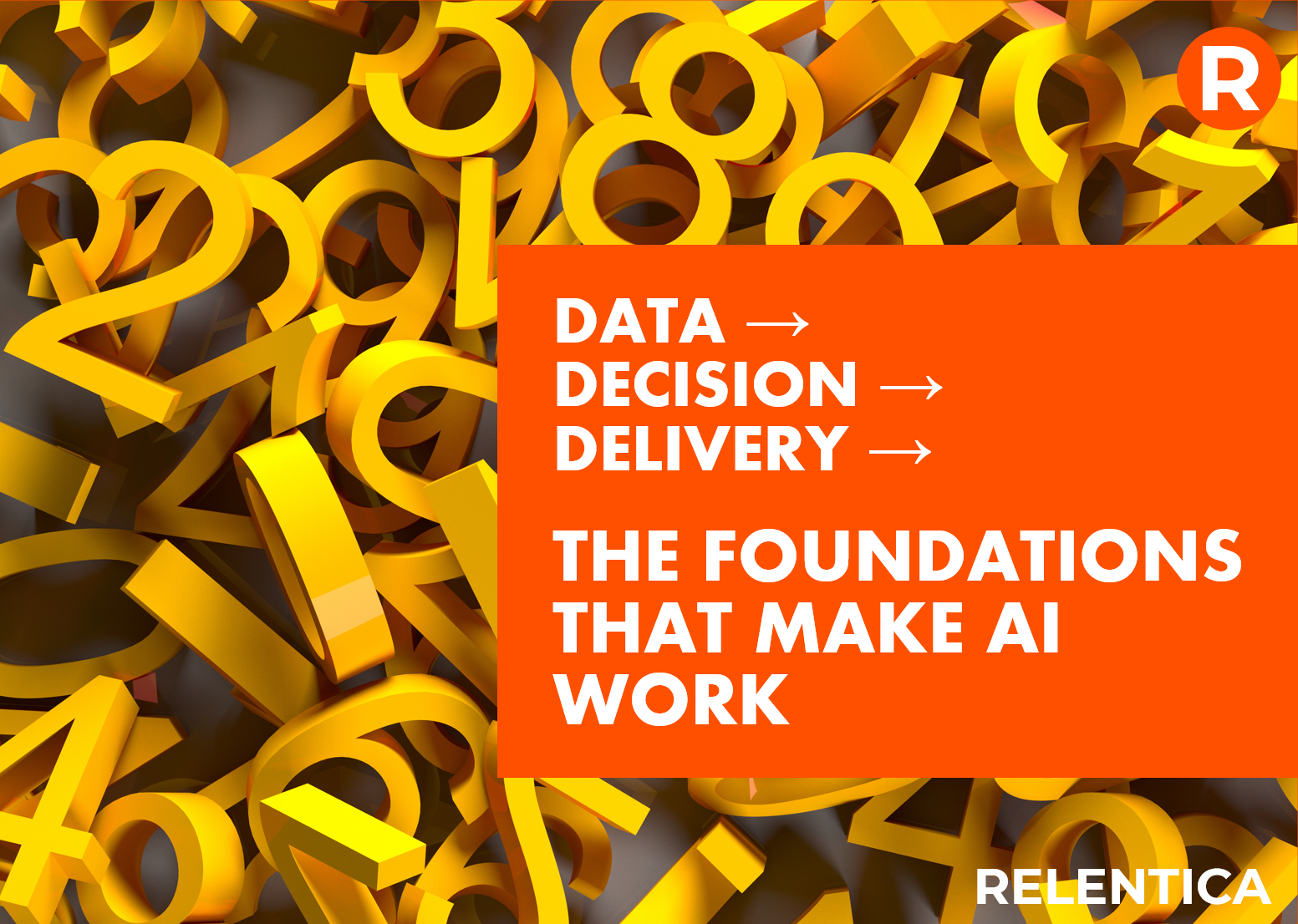
The Relentica Model: Data → Decision → Delivery
AI only works when the operating model works. Great decisions only happen when leaders trust the data behind them. Delivery only succeeds when teams can act quickly and confidently.
This is the loop we build:
1. Define the decisions that matter
What outcomes drive revenue, margin, or risk?
Everything else is noise.
2. Engineer the data that supports them
Modern architectures (Snowflake, Azure Fabric, Databricks) let you build flexible and scalable ecosystems.
3. Establish tight governance
Governance isn’t bureaucracy – it’s protection.
It safeguards truth, traceability, and trust.
4. Embed insights into workflows
Data only has value when it changes behaviour. Delivery teams need signals, not dashboards.
5. Deliver value in short cycles
2-4 week iterations.
Continuous validation.
No two-year transformation programmes.
6. Continuously refine
Data quality, models, processes, architecture – nothing stays fixed. The journey never ends.
The Outcome: AI That Works
Organisations that got this right in 2025:
Moved faster with less friction
Made better decisions with more confidence
Automated safely
Reduced operational drag
Improved customer experience
Protected margins in volatile markets
They didn’t get lucky.
They got disciplined.
AI wasn’t magic.
It was the result of strong foundations.
What Are You Going To Do Next?
If you want AI to work for your organisation in 2026, start here:
Clean your data
Strengthen your governance
Modernise your architecture
Shorten your delivery cycles
Build clarity from board to backlog
Data is the foundation.
Delivery is the multiplier.
AI is the accelerant.
Get the first two right – or the third will break you.
Relentica helps organisations build the systems, leadership, and foundations that make AI valuable rather than risky.