More than half (59%) of UK marketers say proving ROI remains their biggest frustration in influencer marketing, exposing a widening gap between how influence works and how it is measured.
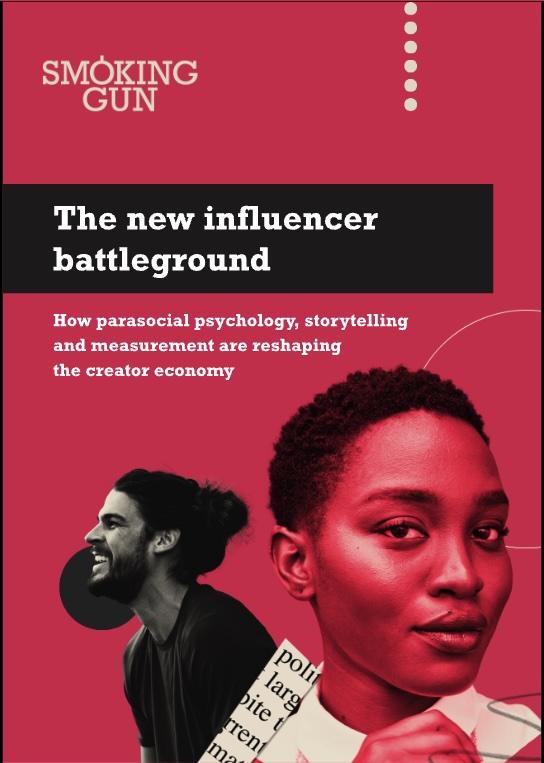
That is the central finding of new research conducted by earned-first agency Smoking Gun, as it continues to evolve its approach as an influencer marketing agency. It quizzed 100 senior UK marketers, and ROI is the problem explored in its latest report, The New Influencer Battleground.
The research shows that while nearly two thirds (64%) of brands plan to increase influencer investment in 2026, most still struggle to explain what is really driving impact.
Marketers can see views, reach and engagement, but lack a shared understanding of how creator storytelling builds trust, shapes preference and leads to action.
To address this gap, The New Influencer Battleground introduces a new human-centred evaluation framework, created to help brands design and assess influence with greater clarity and confidence.
Rather than replacing performance metrics, the framework sits alongside them, helping marketers judge whether creator partnerships are psychologically set up to work before results appear.
Developed in collaboration with behavioural psychologist Dr Eleanor Bryant, Associate Professor of Psychology at the University of Bradford, the framework draws on parasocial psychology, narrative theory and behavioural science. It focuses on four core drivers of influence: meaning, credibility, connection and action.
Rick Guttridge, CEO of Smoking Gun, said: “Influencer marketing has grown faster than the tools used to evaluate it. Our research shows confidence in the channel is high, but frustration around how to design and measure content to prove business impact is even higher.
“Brands are investing serious money, yet too often they are relying on surface-level signals that explain what happened, not why it happened. We work every day at the intersection of creator storytelling, behavioural insight and commercial performance, and this report brings that thinking together in a way brands can actually use.
“If influencer marketing is going to keep growing, it needs clearer standards and a better understanding of the human forces that make influence work.”
Dr Eleanor Bryant said: “Creator influence is not just a media effect, it is a psychological one. When audiences feel emotionally connected to creators, stories are processed more deeply, remembered for longer and more likely to shape behaviour.
“Understanding these mechanisms allows brands to evaluate influence in a way that reflects how people actually think, feel and decide, rather than relying solely on surface-level signals.”
The report also challenges the growing reliance on influencer metrics such as EMV [Earned Media Value], describing them as the creator economy’s equivalent of AVE. It argues that these measures inflate perceived value while offering little insight into real business impact.
Instead, The New Influencer Battleground calls for more human-centred indicators that reflect emotional resonance, trust and narrative strength, alongside traditional performance data.
The publication marks the second major release from Smoking Gun’s Intention Unit, the agency’s specialist team focused on understanding how influence works and how to measure it with confidence.
The New Influencer Battleground is available to download for free here now.