Most businesses do not have a content problem. They have a content capture problem.
There are people with useful knowledge, projects worth showing, customer questions to answer and stories that could strengthen their marketing. Yet when it is time to publish something on LinkedIn, Instagram or the company blog, the same question comes up: what are we going to post?
A planned filming day can help solve that problem.
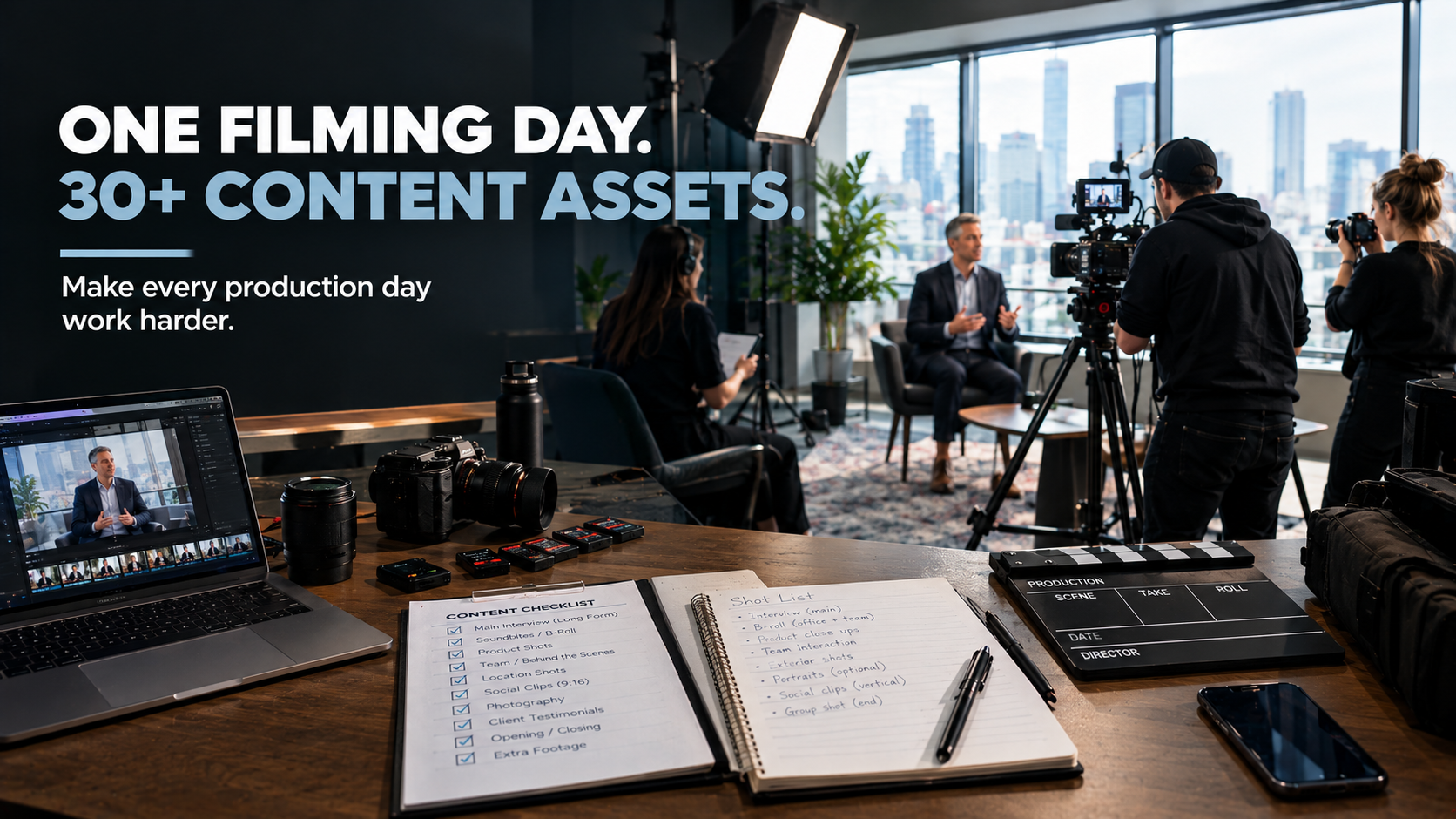
With the right preparation, one day of filming can generate 30 or more pieces of content, from a main brand film and short videos to vertical social clips, stills, quote graphics and an article. Instead of organising a new shoot every time the content calendar runs empty, businesses can build a library of material designed to last.
The important part is that the day is not planned around one finished video. It is planned around everything the business wants to publish.
Here is how the approach works, what needs to be prepared and how to assess the cost of each finished asset.
What Can One Filming Day Actually Produce?
The exact number depends on the subject, the people involved, the filming schedule and how much editing each asset requires. However, a well-planned session can create a useful collection of content from a single set of interviews and supporting footage.
A potential content plan might include:
One main film: A two-to-four-minute company, service or campaign video communicating the central message.
Three to five standalone short videos: Clips of around 30–90 seconds, each focused on one topic, question or idea.
Ten to fifteen vertical clips: Short-form content prepared for platforms such as Instagram Reels, YouTube Shorts and TikTok.
Five to eight quote cards or stills: Strong statements, selected frames and photographs to support social posts.
One long-form article: A written piece developed from interview transcripts, notes and supporting information.
One email campaign: An email built around a useful clip, with a clear reason for subscribers to watch or read more.
Depending on how the material is repurposed, this could produce approximately 21–31 assets, with the potential to exceed 30 when the shoot captures additional usable clips and stills.
The distinction matters. Thirty assets should mean thirty useful, publishable pieces, not thirty slightly different exports of the same video.
The objective is to create enough variety to support a month of publishing, or longer if the business follows a lighter schedule.
Why Most Filming Days Produce Only a Handful of Assets
The traditional approach is straightforward: decide on one video, write a brief, film it and edit the footage into a final piece.
There is nothing wrong with that process when a single video is the only requirement. The problem appears when the business expects the same shoot to supply its social media and wider marketing for weeks afterwards.
If every interview question serves the main film, the answers may not make sense outside that edit. If the camera only captures shots needed for one story, the editor has fewer options for creating shorter pieces. If nobody plans for vertical video, important details may be cropped out when the footage is adapted for mobile screens.
The result is often one finished film, a couple of clips and a folder of footage nobody has time to revisit.
Producing more content does not necessarily require filming faster. It requires deciding what the content needs to achieve before the cameras start rolling.
Start With the Content List, Not the Shot List
Before choosing camera angles or writing interview questions, list every piece of content you want to create.
This reverses the usual process. Rather than filming a general collection of footage and hoping it can be repurposed later, you work backwards from the finished assets.
Start with the main business objective. Perhaps you want to explain a service, demonstrate expertise, answer recurring customer questions or build awareness of a new offer.
Then identify the messages that could support that objective across different formats.
For example, a B2B company could plan content around:
A main film introducing its service and the problem it solves.
Short videos answering common questions from potential customers.
Employee interviews explaining how the service works in practice.
Clips showing the people and processes behind the business.
Expert commentary addressing common misconceptions.
Supporting photographs and quotations for social posts.
A longer article exploring one of the main topics in greater detail.
Each asset has a purpose, even if several are captured during the same interview.
Once the list is agreed, the production team can identify the answers, scenes and supporting shots needed to make each piece work.
This is also the point to identify gaps. If a planned article needs facts that nobody will cover on camera, gather them before the shoot. If the main film requires footage of a particular process, arrange access in advance.
A few hours of planning can save considerable time during editing.
How to Film Interviews That Create Multiple Videos
Interviews are often the most valuable part of a content day because one knowledgeable person can provide material for several different assets.
The challenge is making sure the answers work independently.
Ask one clear question at a time
Broad questions tend to produce long answers that cover several subjects at once. These can be useful for a main film, but they are harder to turn into focused short-form content.
Instead of asking someone to explain everything about the company, break the conversation into smaller topics.
For example:
What problem do customers usually come to you with?
What is one mistake businesses make when choosing this service?
What happens during the first stage of working with you?
What would you tell someone considering this approach?
What makes your process different in practical terms?
Each question creates an opportunity for a standalone answer.
The interview can still feel conversational. The aim is not to force people into a rigid script, but to give them clear prompts that make their expertise easier to capture.
Encourage complete answers
A short clip often needs to make sense without the question appearing on screen.
If someone answers, “Because it saves time,” the editor may have no idea what the statement refers to when the clip is viewed independently.
A more complete answer might begin, “One reason businesses use this process is that it saves time during onboarding.”
That gives the clip context immediately.
Before filming, explain to speakers that they should answer in complete thoughts, avoid relying too heavily on the wording of the question and provide examples wherever possible.
A useful 40-second answer might become a standalone video, a section of the main film and a quotation for a social post. The final uses depend on the quality and relevance of the material, but the opportunity is built into the interview.
Capture different people and perspectives
If two or three people are available, give each person a defined role in the content plan.
One might discuss the company's approach, another could explain the practical work involved, and a third could share a customer-facing or operational perspective.
This creates variety without requiring everyone to repeat the same messages.
It also helps the content feel more natural. A business is rarely represented well by one person answering every question about every part of the organisation.
Why Supporting Footage Makes Such a Difference
Interviews provide the substance, but supporting footage helps the finished content hold attention.
Often called B-roll, this footage includes workplace details, people carrying out their work, products being used, conversations between colleagues and the processes that make the business distinctive.
These shots might seem secondary during filming, but they give the editor more options when creating multiple assets.
Imagine an employee explaining how a product is manufactured. If the only usable footage is their interview, every short clip may look almost identical. If the shoot also captures machinery, materials, close-up details and the finished product, the editor can introduce more visual variation.
The same principle applies to an office-based business. Screens, working documents, team discussions and genuine interactions can help illustrate the subject without relying entirely on a talking head.
Plan these shots deliberately. Capture enough variety to support the main film and smaller videos, rather than treating B-roll as something to gather only if time remains.
Plan for Horizontal and Vertical Video From the Beginning
A common mistake is to film everything in a conventional horizontal format and assume it can all be converted into vertical content later.
Sometimes it can. Sometimes important parts of the image end up cropped out, leaving the speaker awkwardly positioned or removing the visual detail that makes the shot useful.
If vertical content is part of the deliverables, decide how it will be captured before filming.
Depending on the setup, the production team might use separate cameras, adjust framing to leave safe space for crops or capture dedicated vertical footage for selected scenes. The right approach depends on the camera setup, movement, number of subjects and intended platforms.
Consider captions, on-screen text and the position of important visual information as well. These elements need to remain readable on a phone.
Planning for different formats does not mean every clip needs a separate shoot. It means making deliberate production decisions so the footage has a better chance of working wherever it is published.
Understanding the Cost Per Content Asset
Suppose a production day costs £2,000.
If the finished package contains one video, the simple production cost per asset is £2,000.
If the same £2,000 production generates 30 finished assets, the average becomes approximately £67 per asset.
That illustrates how a planned content day can spread the production investment across a larger collection of outputs.
However, £67 is an illustrative average, not a guaranteed price for every finished piece. It assumes a total production budget of £2,000 and 30 completed assets. It does not mean that every possible edit, graphic, article or additional deliverable can be included without affecting the budget.
Editing scope matters. Thirty short clips with minimal editing are not the same workload as 30 individually produced videos with complex graphics, animation, detailed captions and extensive revisions.
The more useful question is how much usable content the business receives for its total investment.
When requesting a quote, ask the production company to separate filming costs from post-production and deliverables. Clarify how many finished videos are included, their approximate lengths, which aspect ratios will be supplied, how many revision rounds are allowed and whether stills or written content are part of the package.
That makes it easier to compare proposals and decide where the budget should go.
What Your Business Needs to Make It Work
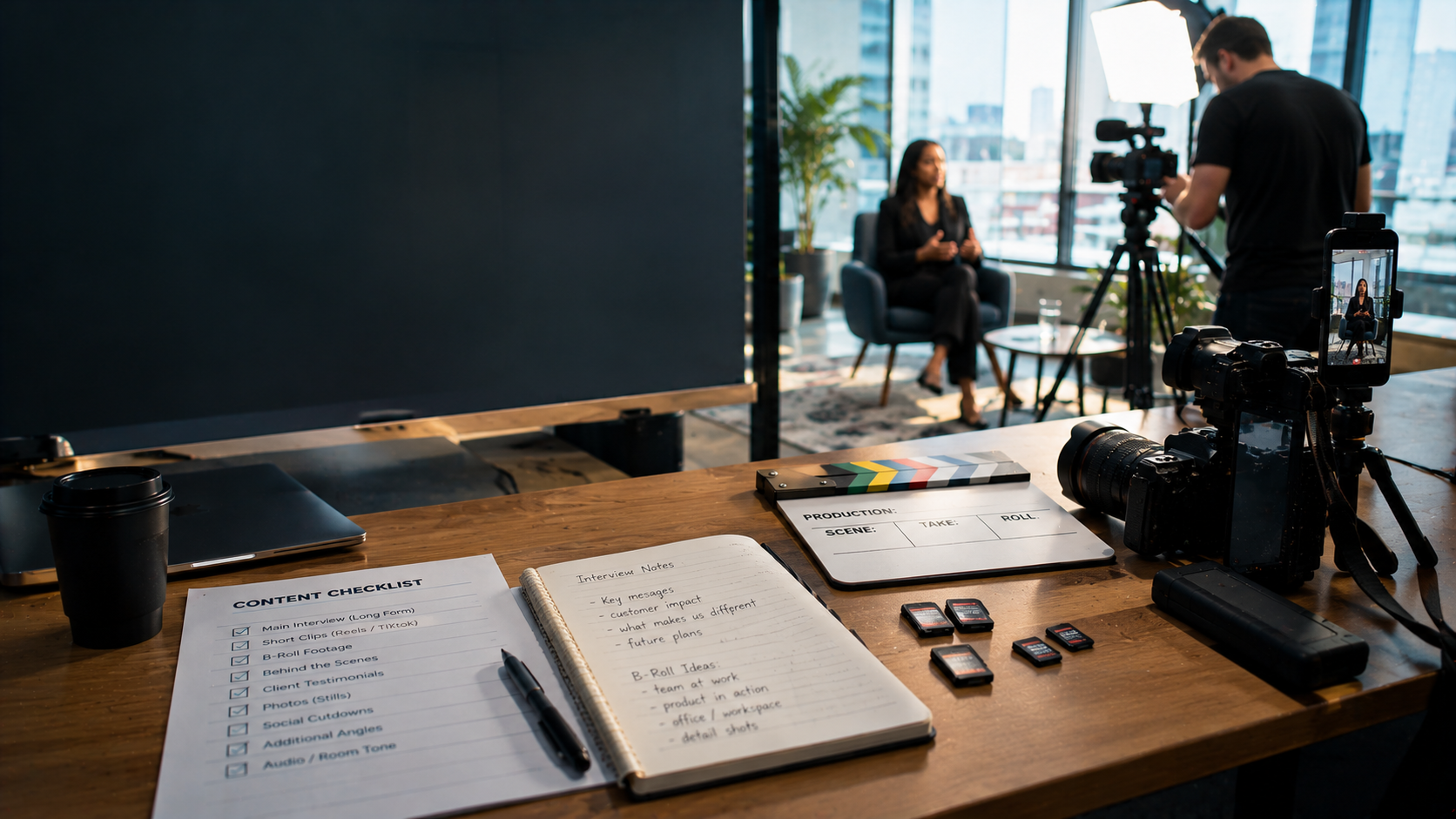
A high-output filming day does not require a huge cast, multiple locations or an elaborate production schedule.
For many businesses, the essentials are relatively simple.
Two or three prepared speakers. Choose people who understand the subject and can explain it clearly. They do not need to be professional presenters; they need to be willing to share useful information.
A suitable location. One workplace can provide several distinct backdrops if the team plans the shots carefully. Make sure filming areas are accessible, safe and appropriate for the work being shown.
A clear content plan. Agree on the topics, target audiences, intended formats and required assets before the shoot. This connects the filming schedule to the final output.
A named decision-maker. Someone needs to approve the messaging, coordinate the people involved and provide timely feedback during editing. Delayed approvals can slow delivery even when the filming itself runs smoothly.
A realistic editing budget. The filming day captures the material, but the finished content still needs to be reviewed, edited, formatted and approved. Build the post-production work into the plan from the beginning.
With those elements in place, the production team can focus on capturing the material needed rather than improvising the entire content strategy on location.
Turn One Filming Day Into a Publishing System
The biggest benefit of a content day is not simply having a folder full of videos. It is having a planned supply of material that can be published consistently.
A main film might introduce a service at the beginning of the month. Short clips can then answer specific questions, introduce team members or explain individual aspects of the offer. Supporting stills and quotations can reinforce the same themes, while an article explores one topic in greater depth.
The content should not all be published at once. Give each piece a role in the wider schedule, adapt the format to the platform and make sure every asset provides something useful to its audience.
It is also worth reviewing performance. Look at which topics attract meaningful engagement, which videos generate enquiries and which questions continue to come up in sales conversations. Those insights can shape the next filming day.
Over time, each session becomes part of a repeatable process: plan the content, capture the material, create the assets, publish them and use the results to improve the next round.
At Title Productions, we approach content production with that wider system in mind. The objective is to make each production day work harder for the business, with the right combination of video, photography and supporting content planned from the outset. Explore our video production work to see how professionally produced content can support different communication needs.
The Real Value Is in the Planning
One filming day can produce 30 or more useful pieces of content, but the number is not the point on its own.
The real advantage is capturing material with a clear purpose, reducing the need to organise separate shoots for every new idea and giving the marketing team a more reliable supply of content.
Start with the assets you actually need. Plan interviews that produce complete, reusable answers. Capture supporting footage deliberately. Account for vertical and horizontal formats, and agree on the editing scope before production begins.
That is how a single filming day becomes more than one finished video.
If your business needs a more consistent supply of marketing content, contact Title Productions to discuss a filming day planned around your goals, channels and required deliverables.