Most public bodies don't need convincing that AI matters. What they need is a reliable way to move from ambition to investment: to find the opportunities that genuinely pay back, prove they work, and give leaders the evidence to fund what comes next. This page sets out the five-phase, stage-gated methodology we use to do that, and links to our detailed guides for each step.
At a glance
Five phases: Mobilise, Discover, Design and readiness, Pilot, Scale.
Five decision gates, so leaders approve each step on evidence, not optimism.
Responsible AI, information governance and workforce impact built in from the first week.
Designed for public sector accountability, with benefits baselined before any pilot starts.
What is an AI transformation methodology?
An AI transformation methodology is a structured, repeatable approach for identifying, testing and scaling AI across an organisation. It defines the phases of work, the outputs of each phase, the governance decisions between them and how benefits are measured, so that AI investment follows evidence rather than enthusiasm.
A good methodology answers four questions in order: where AI can add value, whether the organisation is ready, whether it works in practice, and what it will take to scale.
Why use a stage-gated approach for AI?
Because AI programmes fail in predictable ways: too many ideas pursued at once, data problems discovered too late, pilots that never end, and benefits that can't be evidenced. Stage gates stop each of those. At every gate, a named decision-maker reviews the evidence and decides whether to proceed, adjust or stop.
For public bodies, gates also provide the audit trail that accountability requires. Every significant decision is recorded, with the evidence behind it.
What are the five phases?
The methodology runs in five phases, separated by five decision gates. The second phase is highlighted because it sets the direction for everything that follows.
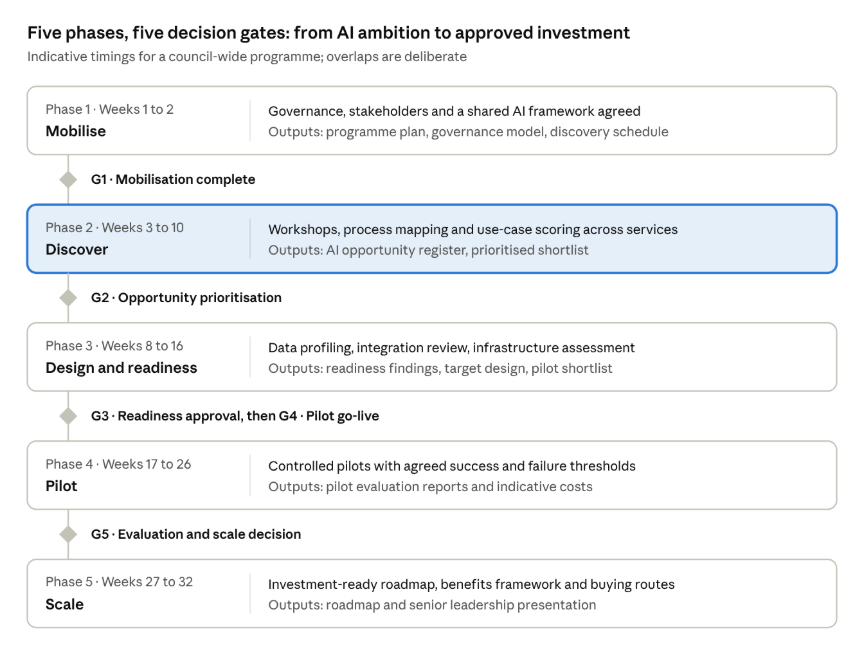
VE3 AI transformation methodology · 5 phases, 5 gates
Phases 2 and 3 deliberately overlap, so readiness work starts on the strongest opportunities while discovery finishes elsewhere. The timings shown are indicative for a council-wide programme; smaller scopes move faster.
What happens in each phase?
Phase 1: Mobilise
Purpose: set up the programme so every later decision is made quickly and on evidence.
We agree governance and decision rights, map stakeholders across services, ICT, data, finance, legal and HR, and establish a shared AI framework: opportunity categories, prioritisation criteria and risk tiers. We also request the baseline data each service will provide, so benefits can be measured later.
Outputs: programme plan, governance model, stakeholder map, shared AI framework, discovery schedule.
Gate G1, mobilisation complete: the programme board confirms governance, scope and the discovery plan.
Phase 2: Discover
Purpose: find where AI can genuinely add value, and rank the opportunities fairly.
We run structured workshops and interviews with service managers, frontline staff and corporate teams, map current processes and identify high-volume tasks, delays, rework and decision bottlenecks. Every candidate use case goes into a single AI opportunity register and is scored using VE3's six-factor prioritisation model: value, feasibility, risk, data maturity, implementation dependency and time-to-benefit.
Outputs: AI opportunity register, prioritisation matrix, agreed shortlist.
Gate G2, opportunity prioritisation: leaders agree which opportunities proceed to readiness assessment.
Read more: How councils identify where AI can deliver savings.
Phase 3: Design and readiness
Purpose: confirm that shortlisted opportunities can actually be delivered, and design how.
For each shortlisted use case, we assess data, integration, infrastructure, security and access, information governance and the operating model. Where key systems are due for renewal, we apply our layer, align or defer decision. We then produce a target-state design and recommend pilot candidates.
Outputs: data and technical readiness findings, remediation plan, target-state design, pilot candidates.
Gate G3, readiness approval: the board approves which pilots proceed and the remediation they depend on.
Read more: What is an AI technical readiness assessment?
Phase 4: Pilot
Purpose: prove, or disprove, the value of the strongest opportunities under controlled conditions.
Each pilot has a written hypothesis, success and failure thresholds, controls and an evaluation plan, all agreed before it starts. We build and configure in short agile cycles with users involved throughout, and measure against the baselines collected in Phase 1.
Outputs: working pilots, evaluation reports, indicative implementation costs.
Gate G4, pilot go-live: the service owner and governance leads confirm controls are in place before real use begins.
Gate G5, evaluation and scale decision: the board decides, on evidence, which pilots to scale, adjust or stop.
Phase 5: Scale
Purpose: give leaders everything they need to approve the next stage of investment.
We turn pilot evidence into an investment-ready roadmap: prioritised implementation plan, indicative costs and dependencies, governance and operating model, workforce and change plan, benefits tracking framework and procurement options for the next phase.
Outputs: investment-ready roadmap, benefits framework, transformation assessment, senior leadership presentation.
How is the programme governed?
Through three layers that match the speed of each decision:
Forum | Cadence | What it decides |
Executive or programme board | Monthly | Scope, risk, stage-gate decisions and benefits evidence |
Delivery steering group | Fortnightly | Milestones, dependencies and change requests |
Working groups | Weekly | Discovery, data readiness, pilot delivery, change and adoption |
The organisation keeps strategic ownership: an executive sponsor, service experts, ICT and data owners, governance and legal leads, and HR and organisational development. We provide the programme leadership, methodology, analysis, architecture and delivery capacity, and transfer knowledge throughout so capability stays in-house.
How is responsible AI built in?
From the first week, not as a final check. Every use case is classified by risk, and higher-impact uses need enhanced approval. Throughout the programme we apply:
privacy and data minimisation, with DPIA where needed;
fairness, bias and inclusion checks, aligned with equality impact assessment;
transparency and explainability, including whether a public algorithmic transparency record is needed;
human oversight, with named people accountable for every AI-supported decision.
For AI agents, we apply the VE3 Agent Lifecycle, so every agent has a defined role, an accountable manager and a clear route to retirement. Read more in managing AI agents like employees.
How are benefits measured?
By baselining before pilots start and reporting three types of benefit separately:
Cashable | Non-cashable | Enabling |
Reduced manual effort and handling time | Faster response times | Improved data readiness |
Less avoidable rework | Better service quality | Reusable integration components |
Lower demand on high-cost channels | Better data quality and visibility | Governance frameworks |
Better use of staff time | Stronger compliance | Workforce AI capability |
Every figure is recorded in a benefits register with its source and a confidence level, so savings reported to leaders can be traced and defended.