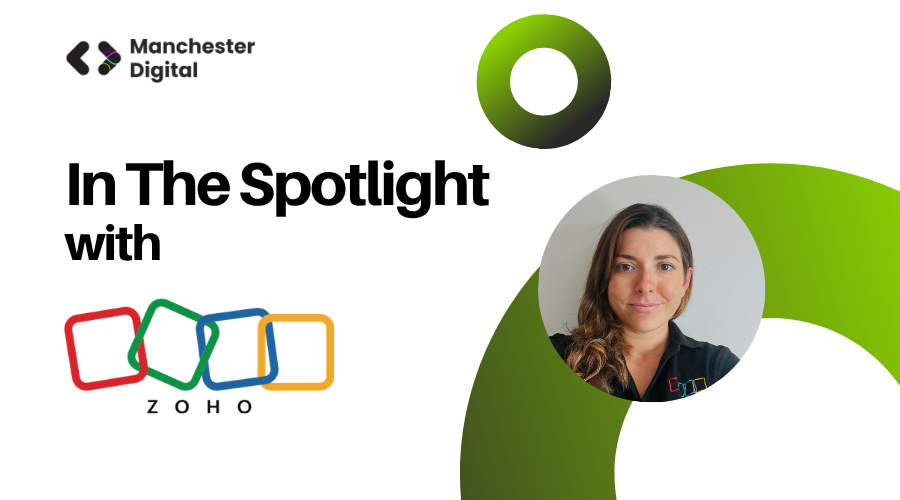
As ambitious SMEs look to grow revenues without dramatically growing headcount, the cracks in their operations and data quickly start to show. In this In the Spotlight feature, Chinia Waterman of Zoho shares the most common pain points she sees in scaling businesses – and the practical steps leaders can take now to tighten up their systems, clean their data, and build a tech stack that’s ready for the next stage of growth.
From your work with SMEs and scaling businesses, what are the most common pain points you see when it comes to growth and day-to-day operations?
Most SMEs don’t hit a growth ceiling because demand disappears, they hit it because the way they run the business stops working.
In the early stages, being fast, flexible, and slightly chaotic is often part of the reason they grow. Decisions happen quickly, people solve problems on the fly, and everyone
knows enough about everything to keep things moving. Y ou don’t need much process because the business is small enough for people to fill the gaps manually.
The challenge is that success creates complexity.
More customers means more onboarding, more service issues, more invoicing, more reporting, and more people involved in delivering the experience. Suddenly the same “we’ll just sort it” approach starts causing problems instead of solving them.
The most common pain points are usually visibility and consistency. Leaders can’t get a clear picture of sales performance, delivery teams are firefighting because information hasn’t been passed over properly, finance is chasing details that should already exist, and customer service is trying to solve problems without the full picture.
A good example is onboarding. Sales closes the deal and moves on, but delivery, finance, and support all need accurate information to do their jobs properly. If that handover relies on forwarded emails, sticky notes, or someone remembering what was agreed three weeks ago, things get missed. Customers notice that immediately.
Then add rising costs, hiring pressure, and tighter margins into the mix, and inefficiency becomes expensive very quickly.
A lot of businesses think they have a growth problem when really they have an operational one.
At what stage of growth do you typically see operational issues start to bite - where the ‘sticking things together manually’ approach stops working?
Usually around the point where growth stops feeling exciting and starts feeling slightly chaotic.
Often that happens when a business moves from founder-led operations into needing proper structure, somewhere around 20–50 people, or when multiple teams are involved in the customer journey rather than one person doing everything.
At that stage, the “we’ll sort it later” approach starts fighting back.
Leads get missed because nobody is quite sure who owns follow-up. Customers get asked for the same information twice because sales, delivery, and support are all working separately. Finance is using one set of numbers, sales another, and everyone believes their spreadsheet is the correct one.
You can usually spot it when leadership starts spending more time chasing updates than making decisions.
I’ve seen businesses where the MD’s Monday morning starts with asking five different people for five different reports just to understand what happened last week. That’s usually a sign the systems haven’t kept up with the business.
This is also where hiring more people doesn’t necessarily help. If the process is messy, more people often just means more complexity.
That’s why this stage matters so much. It’s the difference between scaling the business and just scaling the chaos.
Many businesses start with a patchwork of tools that don’t really talk to each other. What are the biggest risks of growing on that kind of fragmented tech stack?
The biggest risk is false confidence.
On paper, everything can look fine because every team has a tool that works for them. Sales has a CRM, finance has an accounts system, marketing has three platforms and a spreadsheet they trust more than all of them, and customer service is making miracles happen somewhere else entirely.
Everyone assumes the gaps are manageable because each department can still function.
The problem is the customer experiences the business as one company, not five separate teams.
When systems don’t talk to each other, the cracks show up in very ordinary but expensive ways. Customers get asked for the same information twice. Renewals get missed. Delivery teams don’t know what sales promised. Finance invoices the wrong thing. Reporting becomes an argument rather than a conversation.
I’ve seen businesses where support teams had no visibility of key customer commitments because that information lived in someone’s inbox rather than somewhere shared. The result wasn’t a dramatic system failure - it was a customer quietly losing confidence.
That’s the real cost. Not chaos, but friction.
It also makes growth more expensive because every new hire ends up learning workarounds instead of proper process. Instead of scaling operations, you scale inefficiency.
Most SMEs don’t need more software. They need fewer gaps between the software they already have.
That’s where connected platforms like Zoho make a difference - not because integration is glamorous (it absolutely isn’t), but because it removes the daily nonsense that slows good businesses down.
You’ve talked about the importance of ‘getting the foundations right’. What does a solid operational and data foundation look like for a scaling SME?
It means the business can run properly without relying on memory, heroics, or one person called Dave who somehow knows where everything is.
A lot of SMEs are held together by good people covering bad processes. Someone remembers the missing detail, someone manually fixes the report, someone stays late to sort the invoice issue. It works because people are capable, but it creates fragility. The minute someone leaves, goes on holiday, or the business grows faster than expected, the cracks show.
Good foundations start with ownership and process.
Everyone should know who is responsible for what - particularly around sales handover, onboarding, approvals, renewals, and customer issues. If three people think someone else is doing it, usually no one is.
It also means having processes that are consistent, not dependent on personality. A customer should have the same experience whether your best account manager is handling it or someone new joined last week.
Take onboarding as a simple example. Who owns the handover from sales to delivery? What information has to be captured before a deal is marked as closed?
What triggers finance to invoice? If those answers are vague, growth gets messy very quickly.
Then there’s data - which sounds dull until bad data starts costing you money.
It’s rarely dramatic. It’s duplicate customer records, inconsistent naming, missing fields, and reports that make no sense because half the team wrote “Manchester Digital Ltd”, someone else wrote “manchester digital limited”, and one optimist just put “MDLtd”.
It sounds small, but poor data creates poor reporting, which leads to poor decisions.
Taking time to clean up records, standardise fields, make key information mandatory, and agree what “good” looks like saves a huge amount of pain later - especially when reporting, forecasting, or AI enters the conversation.
Tools like Zoho DataPrep can help clean and structure that information, but the bigger win is building habits people actually stick to.
The goal isn’t complexity - it’s clarity.
That’s usually the difference between a business that scales and one that just gets busier.
For leaders who are juggling multiple hats and limited budgets, what are the first two or three practical steps they can take this quarter to become more operationally efficient?
First, find the repeat frustration.
Every business has one. The thing people complain about every single week but somehow still accept as normal. It might be quote approvals taking too long, customer onboarding being messy, reporting taking half a day, or invoices constantly being delayed.
Start there.
Trying to fix everything at once is usually a brilliant way to fix absolutely nothing.
One painful bottleneck solved properly creates far more value than ten half-finished improvement projects.
Second, look at where decisions rely too heavily on one person.
If the founder has to approve every quote, if only one person understands reporting, or if customer issues always land with the same manager, that’s a scaling problem waiting to happen.
Good operations reduce dependency, not increase it.
Third, challenge whether your systems are helping or just documenting the mess.
Before buying something new, ask whether the CRM, finance platform, or service desk you already have is actually being used properly. Sometimes the best efficiency project is simply turning on the automation you should have set up 18 months ago.
That might be lead assignment, follow-up reminders, invoice approvals, or customer onboarding workflows.
That’s often where Zoho tools like CRM, Flow, or Analytics help most - not through some huge transformation project, but by quietly removing repetitive admin and giving people better visibility.
Efficiency usually comes from simplification, not expansion.
How can SMEs prepare their data and systems now so they’re ready to make meaningful use of AI and automation in the next few years?
Most businesses jump straight to asking what AI they should buy, which is usually the wrong starting point.
The better question is: where are decisions currently weak, slow, or inconsistent?
That’s where AI becomes useful - not as a shiny separate project, but as something that improves judgement inside the business. It might be helping sales teams prioritise the right leads, flagging customer churn risks earlier, speeding up support responses, or spotting revenue leakage before it becomes a bigger problem.
But none of that works if the business doesn’t trust its own information.
If customer records are duplicated, if sales stages mean different things to different people, or if reporting changes depending on who pulled it, AI won’t fix that. It just helps you make bad decisions faster.
Preparation is really about governance.
What data matters most? Who owns it? How is it kept accurate? Who can see what?
And importantly, if AI is making recommendations, can someone understand why?
That explainability matters more than people realise, especially as businesses become more cautious about compliance, customer trust, and data privacy.
If AI recommends prioritising one customer over another, leaders need confidence in how that decision was reached. “The system said so” is not usually a strong board-level strategy.
That’s why embedded AI tends to work better than disconnected tools. In Zoho, for example, AI sits inside the CRM or service platform, working from live operational data with proper visibility and control.
The exciting bit comes later. The useful bit starts with structure.
Finally, what does ‘good’ look like? Can you share an example of a business that’ s set itself up well to scale - with the right systems, processes and customer journey in place - and what others can learn from it?
Good looks calm.
That sounds simple, but it’s usually the easiest way to spot a well-run business.
Things feel controlled rather than constantly reactive.
Leaders aren’t spending Monday morning chasing updates from five different people. Customers aren’t repeating the same information to three departments.
Teams know what happens next, and when something goes wrong, people can fix it quickly because the information is there.
A good example is Bryant Detnal, a UK manufacturer of specialist loupes for dentists, who moved to Zoho One, a connected suite of business applications covering sales, marketing, finance and more.
Their products are highly customised - each order can involve more than 1,500 specification choices and over 150 steps between enquiry and delivery, with input needed from design, manufacturing, engraving, dispatch and repair teams.
That kind of complexity can become chaos very quickly if the systems underneath aren't right.
Their approach was to become what they call an "automation first company". One of their best lines was "every time somebody has to manually change or move something is an opportunity for it to go wrong."
Instead of relying on emails, manual updates, or people remembering thing, they build connected workflows across CRM, forms, file management, and operations.
Order move automatically through stages, internal teams are updated in real time, and customers are kept informed without someone manually chasing every step.
They're now automating over 200,000 tasks a month, have grown fro 15 to 85 employees, and customer satisfaction has improved significantly, with more than 450 five-star reviews.
That's what good looks like.
A company where growth feels deliberate, not chaotic, because the foundations were fixed before the cracks became expensive.
That's usually the lesson - scale doesn't come from adding complexity. It comes from removing friction before it slows you down.
Thank you Chinia!
To find out more about Zoho, click here.