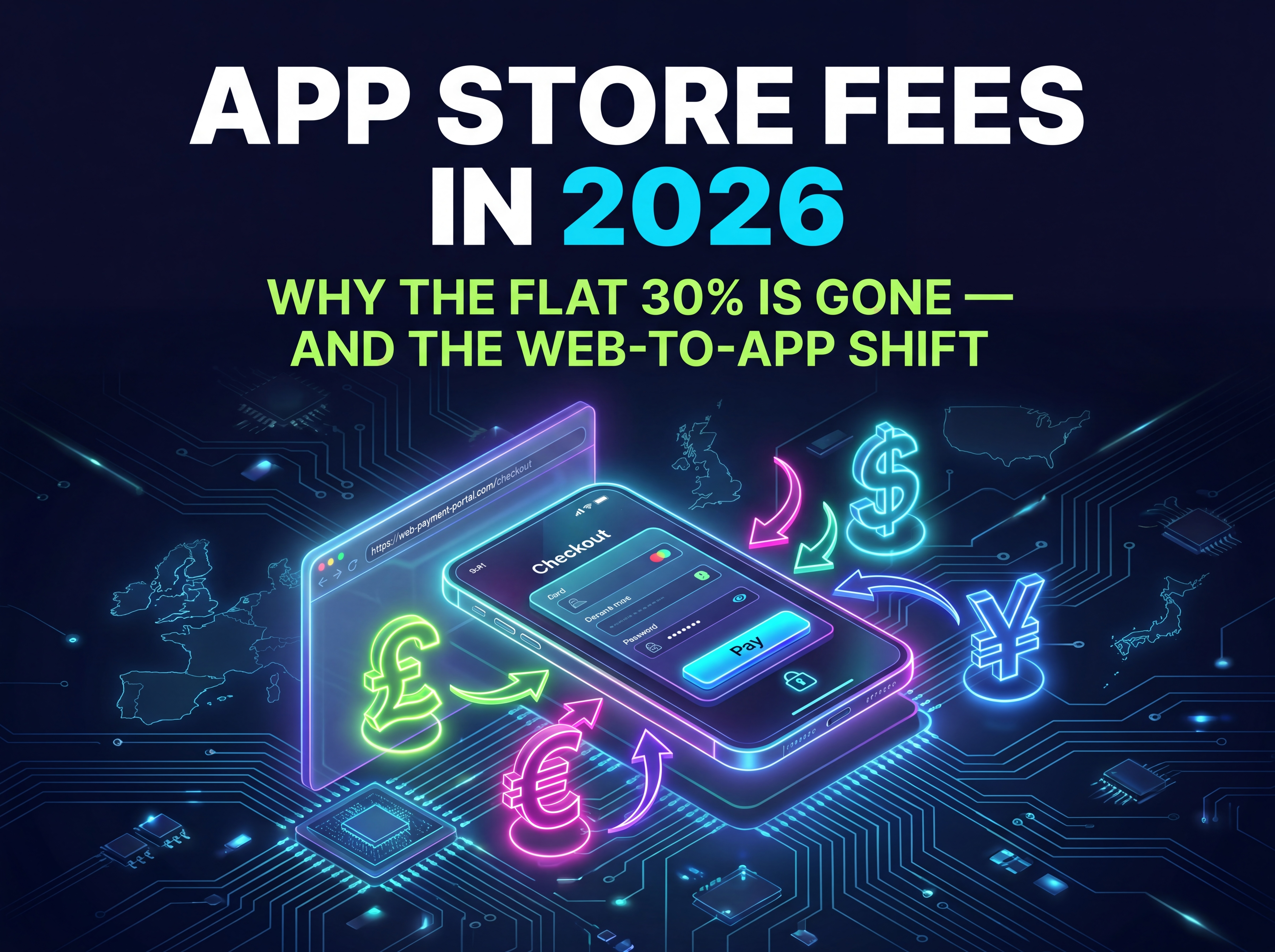
The £10 monthly subscription used to be a simple piece of arithmetic. Take £7 net, give £3 to Apple, plan the next year of headcount. That maths no longer holds.
As of January 2026, the same £10 sub generates a different margin in Berlin, Manchester, Tokyo, and Austin. The flat 30% commission is gone in Europe, partially gone in the US, weakening in the UK, and being replaced in Japan. For any Greater Manchester business running a subscription app, this is the year where the cost structure of your business model gets rewritten. The teams that figure this out first will compound a 15 to 25 percentage point margin advantage across the rest of the decade.
The 30% Cut Is Now a Stack of Smaller Fees
Apple's EU restructure under the Digital Markets Act replaced its flat commission with a modular fee model. There's now a Core Technology Commission of 5%, a Store Services Fee of either 5% (basic distribution only) or 13% (full App Store discovery), and an Initial Acquisition Fee of 2% on new users for their first six months.
Stay on the App Store and route payments externally, and you land at roughly 20%. Move to a third-party marketplace or Web Distribution, and you pay 5% plus your own payment processor (typically 2 to 5%). The drop from 30% to 7% is real money. On £200k MRR, that's £528,000 a year of contribution margin returned to the publisher.
The CMA Will Force the Same Conversation in the UK
The UK's Competition and Markets Authority designated Apple and Google with "Strategic Market Status" in late 2025 under the new Digital Markets Competition Regime. The CMA spent over six years on the underlying investigation. Steering measures (the formal mechanism for prohibiting anti-steering policies) are expected in the first half of 2026.
A UK developer is still paying 15% to 30% on the standard global commission today. Within 12 months, the same developer will have a legal right to direct UK users to alternative payment outside the app. The safe modelling assumption is a 15 to 25 percentage point cost reduction on UK revenue once the rules drop.
The question for any UK subscription business is whether the billing infrastructure is ready to use that on day one. In our experience, almost none are. Most UK app businesses we work with run a single subscription product through StoreKit or Google Play Billing, with no fallback web flow, no SCA-compliant card processor, and no test environment for non-IAP purchase events. Building that in three months under regulatory pressure is possible but expensive. Building it now, while the regulation is still pending, is cheaper.
The Death of the "Global LTV" Number
Until recently, a finance team could quote a single blended LTV for a subscription product. CAC divided by LTV gave you the only number that mattered. That number now means almost nothing.
The same £10 monthly subscription, sold to four users in four countries on the same day, generates four different net margins. Apple's commission depends on the user's location, the distribution path, whether they're in the first six months of acquisition, and which Apple services the publisher buys. Google Play has its own structure. Payment processor costs vary by region. Local taxation differs.
We've started calling this the "fragmented LTV problem" internally. It's the single biggest reason finance teams ask for a Fractional CTO engagement at the moment. The maths is harder than it used to be, and few in-house teams have built for it yet.
What This Means for Your Next Twelve Months
If you're running a subscription app, the decision tree is short.
Below £25k MRR: stay on App Store and Play Billing. The engineering investment in Web-to-App billing doesn't recover in less than a year.
£25k to £100k MRR: model it. Break-even sits somewhere in this range and depends on churn rate, payment processor, and your share of EU users.
Over £100k MRR: plan the migration if you haven't started. £100k MRR at 30% commission is £30k a month going to a platform you don't control. The same product at 8% blended cost is £8k. That's £264k a year of contribution margin, which buys an additional engineer or two and removes a structural risk from your business model.
The platform commission rate is now a function of where your users are, what services you buy from Apple or Google, and how willing you are to operate billing infrastructure yourself. There's no longer a single "App Store fee" you can plug into a spreadsheet. Teams that wait will spend 2027 retrofitting billing infrastructure under regulatory pressure rather than commercial choice.
Read the full analysis: App Store Fees in 2026: Apple's EU Stack and the Case for Web-to-App Billing
Modelling this for your own product? Our App Gameplan stress-tests monetisation strategy, regional fee exposure, and Web-to-App readiness in four weeks for a fixed £3,500 fee. Learn more about the App Gameplan
About Foresight Mobile
Foresight Mobile is a Manchester-based app development consultancy specialising in Flutter and cross-platform development. We've delivered subscription monetisation work for app businesses across the UK and EU, including several Web-to-App migrations completed in early 2026. As a RevenueCat Premier Partner, we help UK businesses implement billing architectures that survive regulatory change.