Most businesses talking about the AI skills gap are looking in the wrong direction.
The conversation is almost always about technical teams. Can developers use the tools? Are data scientists across the latest models? Do engineers understand prompt design? These are reasonable questions. But they miss the gap that is actually stalling AI progress in most businesses: the leadership and management layer.
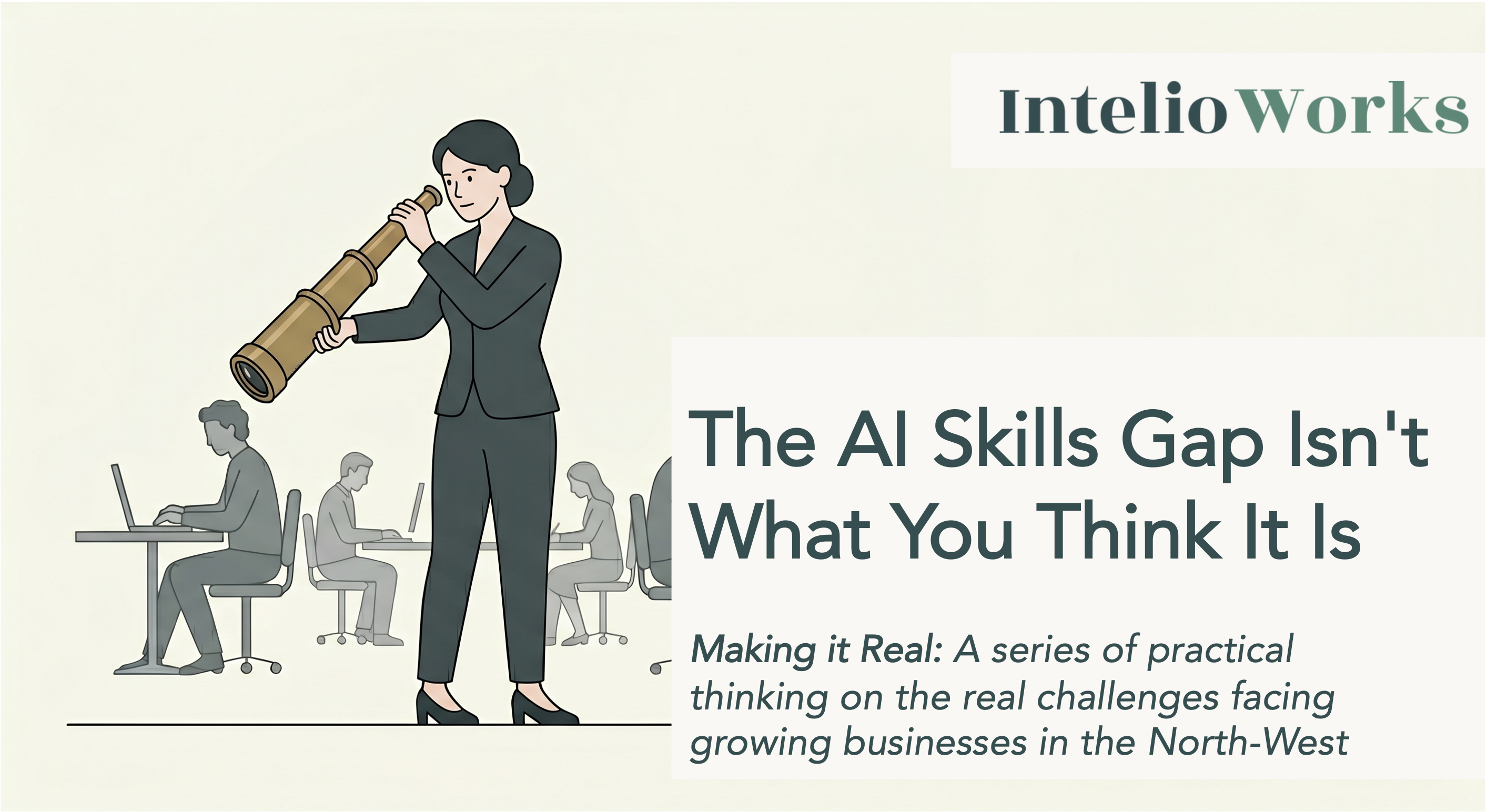
Making it Real: practical thinking on the real challenges facing growing businesses in the North West. This article is part of a series exploring the issues business leaders are navigating today, and the practical steps that drive results.
If the people setting priorities, commissioning work, approving spend, and evaluating results don't understand what they're looking at, the technical capability underneath them becomes very expensive and very hard to steer.
I was talking with the CEO of a media agency last week, they put it simply, 'We hired good people and bought good tools, and we still couldn't tell whether it was working.' That's a leadership problem, not a technology one.
AI literacy is not the same as technical literacy
This is the part most businesses get wrong. When they think about building AI literacy, they think about teaching people to use tools. Prompting courses. Copilot training. Workshops on what large language models can do.
That is not what leadership and management AI literacy looks like. AI literacy for a senior leader or a manager is the ability to:
- Define clearly what business problem AI should be solving, and what a successful outcome looks like
- Commission AI work with a brief that holds people accountable for results, not just activity
- Ask the right questions when a project is stalling or the results don't make sense
- Evaluate what you're being shown by vendors, by internal teams, by consultants; without being dependent on them for the answer
- Understand enough about how AI works to know when you're being oversold
- Visualise how work and roles could realistically be redesigned to capture the capacity and capability gains AI makes possible - and lead that conversation with confidence
- Know what governance and controls the business needs to put in place: who owns the data being fed into AI systems, how sensitive client or commercial information is protected, what the IP position is when outputs are AI-generated, and who is accountable when something goes wrong. These are not questions to delegate entirely to legal or IT. They are leadership questions that require an informed view at the top
- And perhaps most importantly: determine whether AI is actually the right answer to the problem in the first place. That judgment belongs with leadership, not with the people who have already been asked to deliver an AI solution
You will notice that most of these (all of them?) are simply good business practice for deploying any significant technology into an organisation. Clear problem definition. Accountable ownership. Informed leadership. Data governance. A realistic view of what the tool can and cannot do. None of this is new. What is new is that the pace and noise around AI, combined with a lack of tolerance from boards to zoom into the detail and reality of what delivery actually requires, is causing people to forget the fundamentals.
In the DSIT AI Labour Market Survey 2025 30% of respondents identified AI skills gaps as being non-technical, covering areas such as understanding AI concepts, governance and application rather than engineering or programming. Those are leadership and management gaps, hiding inside a conversation that is almost entirely focused on technical talent and skills.
Deloitte's 2026 State of AI in the Enterprise report, drawing on 3,235 senior leaders globally, identified the AI skills gap as the single biggest barrier to integration. Yet the primary organisational response seems to be education rather than role redesign or workflow change, suggesting most businesses are solving the easier version of the problem, not the right one.
What good actually looks like: six dimensions beyond just the technology
If you want to understand whether your organisation is genuinely ready to create value from AI - rather than just spend on it - then technology is only one dimension. There are five others, and my observation is that many businesses haven't honestly looked at them all.
Strategy clarity. Does AI have a defined role in how your business overall strategy and are you clear on how it creates commercial value, or is it a collection of unconnected experiments? Most organisations have the latter dressed up as the former.
Organisation design. Have roles, responsibilities and decision rights been updated to reflect how AI changes the work? Or has AI been bolted on to structures that were designed for a different way of working?
Work design. Have workflows and operating rhythms actually been redesigned around what AI makes possible? Does how work is costed, evaluated or procured by clients change? A tool sitting alongside an unchanged process rarely creates value.
Talent and capability. Do your people (not just your technical team, but your managers and leaders) have the skills, the mandate, and the psychological safety to work differently? This is where the leadership AI literacy gap does its damage.
Leadership and governance. Is there clear ownership of AI outcomes at the right level? Is there a way to measure progress that goes beyond activity and spend? Is someone accountable for value, not just delivery?
Culture readiness. Underpinning it all, do people trust the tools enough to use them, trust each other enough to experiment, and trust leadership enough to be honest when something isn't working? Do you have a culture connected to your commercial outcomes?
Most organisations, if they are honest, score well on the technology and poorly on everything else. That is where the gap lives in reality.
What one session could actually change
The practical suggestion here is not a multi-month, long and expensive programme. But to start with a single focused session with your senior leadership and management team, built around those six dimensions - creating a plan that builds this muscle internally giving you the capability and capacity to acclerate value creation.
Not to make everyone an 'AI expert' but rather to get clear on where the real gaps are, have an honest conversation about what that costs the business, and agree what needs to change before the next significant AI investment is made.
That session typically surfaces three things: the strategy is less clear than people assumed, the accountability is thinner than anyone would admit, and the culture dimension has never been properly addressed. None of those are technology problems. All of them are fixable with the right converation and plan.
What Actually Works: How Intelio Works Can Help
This is one of the core areas where I am working with leadership teams in service and knowledge businesses. Specifically:
- AI Readiness Radar: working with your leadership team to assess & map honestly across the six dimensions above, identify the real gaps, and prioritise what to address
- Leadership and management development: building the AI literacy your leaders and managers need to commission, govern and evaluate AI work effectively
- Operating model design: helping businesses redesign the structures, workflows and ways of working that determine whether AI investment creates value or accumulates cost
- Interim Transformation Support: working alongside leadership teams through the messy middle of AI-related change, where strategy meets reality
If your business is spending on AI and not yet confident you're getting the value you expected, the conversation worth having is not with your technology team. It's with your leadership team.