This guide covers everything you need to know: what a fractional CMO actually does, how much they cost, where to find the best ones, and how our agency used one to scale from a small SEO shop to a full-service growth team.
What Is a Fractional CMO?
A fractional CMO is a senior marketing executive who works with your company on a part-time or contract basis instead of as a full-time employee. They bring the same strategic leadership, experience, and decision-making authority as a traditional Chief Marketing Officer, but at a fraction of the cost and commitment.
The "fractional" model has exploded in popularity over the past three years. According to recent industry data, demand for fractional CMOs grew by over 60% between 2023 and 2025, driven by companies that need executive-level marketing leadership but cannot justify the £150,000–£250,000+ annual salary that a full-time CMO commands.
The concept is simple: instead of hiring one company's full-time CMO, an experienced marketing executive splits their time across two to four companies, typically dedicating 10–20 hours per week to each client. You get the strategic brain without the full-time overhead.
What Does a Fractional CMO Actually Do?
This is where a lot of businesses get confused. A fractional CMO is not a freelancer who runs your Facebook ads. They are a strategic leader who sits at the executive level and is responsible for the direction of your entire marketing operation. Their responsibilities typically include:
- Marketing strategy development: Building the overarching plan that connects your business goals to specific marketing channels, campaigns, and KPIs
- Team leadership and hiring: Managing your existing marketing team, identifying skill gaps, and hiring or outsourcing the right specialists to fill them
- Budget allocation: Deciding where to invest your marketing spend for maximum return, and cutting what isn't working
- Channel strategy: Determining whether your company should invest in paid acquisition, organic search, content, email, social, partnerships, or a combination — and in what order
- Vendor and agency management: Evaluating, hiring, and holding accountable any external agencies or contractors your company works with
- Performance reporting: Building dashboards, setting targets, and reporting to the CEO or board on marketing performance
- Brand positioning: Refining your messaging, positioning, and go-to-market strategy to differentiate from competitors
In short, a fractional CMO does everything a full-time CMO does. They just do it in fewer hours per week, for fewer months (or years), and at a lower total cost.
How We Used a Fractional CMO to Scale Keever SEO
Before we get into the how-to, it's worth sharing our own experience because it illustrates exactly why this model works — and the pitfalls to avoid.
At Keever SEO, we started as a lean SEO consultancy. We were good at what we did — technical audits, link building, content strategy — but we had no overarching marketing leadership guiding our own growth. We were the classic case of the cobbler's children having no shoes. Our client work was thriving, but our own brand, our lead generation, and our ability to scale the team were all suffering because nobody was owning the marketing strategy at a senior level.
We knew we needed CMO-level thinking, but hiring a full-time CMO at £150,000+ per year made no sense for our size. So we explored the fractional route.
After evaluating several options — independent consultants on LinkedIn, referrals from our network, and a couple of talent platforms — we ended up going through MarketerHire, a curated platform that specialises in matching businesses with pre-vetted marketing talent. The experience was eye-opening.
What Made the Difference
Within 48 hours of our initial scoping call, MarketerHire matched us with a fractional CMO who had direct experience scaling digital agencies. That specificity mattered. We had previously spoken with two independent fractional CMOs who had impressive CVs but had never worked inside an agency environment. They didn't understand our margins, our client acquisition model, or the unique challenge of marketing a company that sells marketing.
Our matched CMO immediately got to work on three things that transformed our trajectory:
- Repositioning our brand: We shifted from "Keever SEO" as a narrow technical SEO shop to a growth-focused agency that could handle the full marketing stack. This opened up an entirely new tier of clients.
- Building a scalable team model: Instead of hiring full-time employees for every discipline, our fractional CMO helped us build a hybrid team using a mix of full-time core staff and vetted freelance specialists for specific channels. This kept our overhead lean while expanding our capabilities dramatically.
- Creating a repeatable lead generation engine: We went from relying entirely on referrals to having a systematic inbound pipeline built on content, paid search, and strategic partnerships.
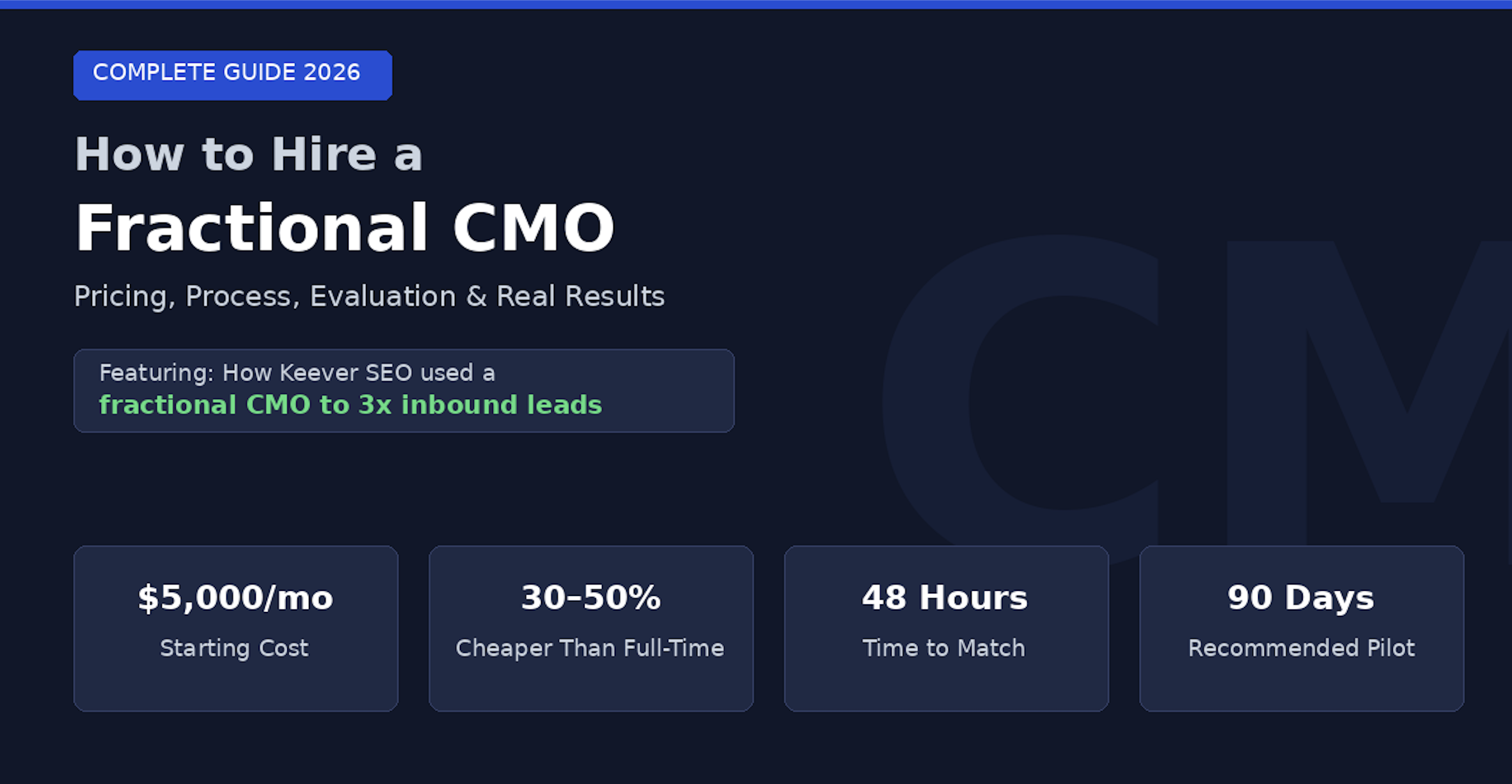
The result? Within six months, we had tripled our inbound lead volume, expanded into three new service lines, and built a team structure that could scale without breaking. The fractional CMO engagement cost us a fraction of what a full-time hire would have, and the ROI was clear within the first 90 days.
That experience is why we are so confident recommending the fractional CMO model to the right companies — and why we are specific about where to find the right talent.
How Much Does a Fractional CMO Cost in 2026?
Pricing is the most common question, and the answer varies more than most guides admit. Here is an honest breakdown of what you can expect to pay in 2026, based on real market data:
Hourly Rate Model
- Junior fractional CMO (5–10 years experience): $150–$250 per hour
- Mid-level fractional CMO (10–15 years): $250–$400 per hour
- Senior fractional CMO (15+ years, enterprise experience): $400–$600+ per hour
Monthly Retainer Model (Most Common)
- Part-time engagement (10–15 hours/week): $5,000–$10,000 per month
- Standard engagement (15–25 hours/week): $10,000–$15,000 per month
- Near full-time engagement (25–35 hours/week): $15,000–$25,000 per month
Platform-Based Pricing
Talent platforms like MarketerHire offer subscription-based pricing that simplifies the process: their plans start at $5,000/month for part-time specialist access (including fractional CMO roles), $10,000/month for full-time engagement, and $15,000/month for senior executive leadership. There are no placement fees, no deposits, and no contracts — you can cancel month to month. You can check out the MarketerHire Review to learn more.
How Does Fractional CMO Cost Compare to Full-Time?
Here is the comparison that makes the fractional model click for most business owners:
- Full-time CMO salary (US): $180,000–$300,000+ per year
- Add benefits, bonuses, equity: Total cost reaches $250,000–$400,000+ per year
- Annual cost of a fractional CMO: $60,000–$180,000 per year (depending on hours)
That means a fractional CMO typically costs 30–50% of what a full-time hire costs, with no long-term commitment, no benefits overhead, and the ability to scale hours up or down as your needs change. For growth-stage companies and SMBs, the maths is compelling.
When Should You Hire a Fractional CMO?
Not every company needs a fractional CMO. Here are the situations where the investment makes the most sense:
You Should Hire a Fractional CMO If:
- You are spending on marketing but not seeing results. If you have a budget, a team (or agencies), and campaigns running — but growth is flat or declining — you likely have an execution problem driven by a strategy gap. A fractional CMO provides the senior leadership to diagnose and fix it.
- You have passed product-market fit but lack marketing leadership. Companies between $1M–$20M in annual revenue often hit a ceiling because the founder is still making all marketing decisions. A fractional CMO takes that off your plate with someone who has done it before.
- You are preparing to raise funding or go to market with a new product. Investors want to see a credible marketing strategy. A fractional CMO can build and present that strategy faster than you can recruit a full-time hire.
- You need to hire and build a marketing team. One of the highest-value things a fractional CMO does is define the roles you need, write the job descriptions, and either hire the team or source the right freelance specialists. This was exactly our experience at Keever SEO — our fractional CMO designed the team structure that let us scale.
- Your marketing budget is between $5,000 and $50,000 per month. Below $5,000/month, you typically cannot afford fractional CMO rates alongside execution costs. Above $50,000/month, you may benefit from a full-time CMO. The sweet spot for fractional is in between.
You Should NOT Hire a Fractional CMO If:
- You need someone to execute, not strategise. If your problem is that nobody is writing emails, running ads, or building landing pages, you need a specialist or a marketing manager — not a CMO.
- Your total marketing budget is under $5,000/month. At this level, a fractional CMO's fees would consume your entire budget with nothing left for execution.
- You are not willing to act on strategic recommendations. A fractional CMO will tell you things you may not want to hear — kill this campaign, restructure this team, invest in this channel. If you are not prepared to act on that guidance, you are wasting money.
- You are pre-product-market fit. Before you have a product that people want, marketing leadership is premature. Focus on product development and customer discovery first.
Where to Find a Fractional CMO in 2026
There are several channels for sourcing fractional CMO talent, each with distinct advantages and drawbacks:
1. Curated Talent Platforms (Recommended)
Platforms like MarketerHire pre-vet their talent pool and use a concierge matching model. You describe your needs to a dedicated Growth Manager, and they match you with a fractional CMO within 48 hours. This is the approach we used at Keever SEO, and it worked exceptionally well because the matching intelligence eliminated the guesswork.
MarketerHire accepts only the top 5% of applicants through a multi-stage vetting process, and their network is trusted by companies like Netflix, Lyft, Coinbase, and Forbes. The major advantage is speed and quality assurance — the major drawback is the $5,000/month minimum, which prices out very early-stage companies.
2. Your Professional Network
Referrals remain one of the best channels for finding fractional CMOs. Ask founders, CEOs, and marketing leaders in your network who they have worked with. The advantage is high trust; the disadvantage is a limited pool and no structured vetting beyond the referral itself.
3. LinkedIn
Searching "fractional CMO" on LinkedIn yields thousands of results. The talent is there, but the signal-to-noise ratio is low. You will spend significant time screening profiles, checking references, and evaluating fit. There is no guarantee that someone presenting themselves as a fractional CMO on LinkedIn has the experience their profile suggests.
4. Fractional CMO Agencies
Companies like Chief Outsiders, CMOx, and Authentic Brand operate agency models where they employ or contract multiple fractional CMOs and match them to clients. These can work well, but they typically charge a premium for the agency layer, and you may have less control over who you are matched with.
5. Open Freelance Marketplaces (Upwork, Toptal)
Upwork offers the widest pool and lowest starting prices, but vetting is entirely your responsibility. Toptal has a rigorous acceptance process (top 3% of applicants) and covers marketing alongside tech, design, and finance — but requires a $500 deposit and $79/month subscription to even begin searching.
Our Recommendation
Based on our direct experience, a curated platform is the best starting point for most companies. The matching intelligence, vetting rigour, and speed-to-hire eliminate the biggest risks in the process. If budget is a constraint, start with your professional network. If you need the widest possible pool and have time to screen, LinkedIn and Upwork are viable options.
How to Evaluate a Fractional CMO: The 7-Point Framework
Whether you source candidates through a platform, your network, or LinkedIn, here is the framework we recommend for evaluating fractional CMO candidates:
1. Industry-Relevant Experience
A fractional CMO who scaled a DTC e-commerce brand is not automatically the right fit for a B2B SaaS company. Ask specifically about experience in your industry, your business model, and your stage of growth. At Keever SEO, the biggest difference between the independent consultants we interviewed and our eventual MarketerHire match was direct agency experience.
2. Strategic vs. Tactical Orientation
Ask candidates to walk you through a recent engagement. If they spend most of the time talking about ad campaigns and email sequences, they are likely a tactician, not a strategist. A true fractional CMO should talk about market positioning, competitive analysis, team structure, budget allocation, and growth levers — not just channel execution.
3. Track Record of Measurable Results
Ask for specific numbers. Revenue growth, lead volume increases, customer acquisition cost improvements, conversion rate lifts. Vague claims like "I helped grow the company significantly" are not sufficient. You want specifics: "I reduced CAC by 35% over six months while increasing lead volume by 2x."
4. Team Building Capability
One of the most valuable things a fractional CMO does is build and manage your marketing team. Ask about their approach to hiring, their experience managing freelancers and agencies, and how they structure teams for companies at your stage.
5. Communication Style and Cadence
How often will they report to you? What does their weekly or bi-weekly update look like? A good fractional CMO should be proactive with communication, not waiting for you to ask for status updates. Discuss expectations around availability, response times, and meeting cadence upfront.
6. Cultural Fit
Even on a fractional basis, this person will be making decisions that affect your team, your brand, and your growth trajectory. Personality and working style matter. Do they listen well? Do they push back constructively? Do they communicate in a way that works for your team?
7. Clear Engagement Structure
Before signing anything, confirm: hours per week, deliverables expected, reporting cadence, contract term (month-to-month is ideal), and exit terms. The best fractional CMO engagements have clear boundaries and expectations from day one.
The Hiring Process: Step by Step
Here is the exact process we recommend for hiring a fractional CMO in 2026:
Step 1: Define Your Needs (1–2 Days)
Before you talk to anyone, answer these questions: What specific marketing challenges are you trying to solve? What does success look like in 90 days? What is your monthly marketing budget (separate from the CMO cost)? Do you have an existing team, or does the CMO need to build one? What channels are you currently investing in?
Step 2: Source Candidates (1–7 Days)
Using the channels described above. If you use a curated platform like MarketerHire, this step takes 48 hours or less. If you are sourcing through LinkedIn or your network, budget a full week.
Step 3: Initial Screening Call (30 Minutes)
Use the 7-point evaluation framework above. Focus on industry relevance, strategic orientation, and communication style. You should be able to eliminate poor fits in a single call.
Step 4: Deep-Dive Strategy Session (60 Minutes)
With your top candidate, do a working session. Present your current marketing situation and ask them to outline — on the spot — what they would prioritise in the first 30 days. This tests both their strategic thinking and their ability to process new information quickly.
Step 5: Reference Check
Talk to at least two previous clients. Ask specifically: Did they deliver measurable results? Were they proactive or did you have to manage them? Would you hire them again? If you sourced through a vetted platform, the reference checking is partially done for you — but it is still worth doing your own due diligence.
Step 6: Start with a 90-Day Pilot
Do not commit to a 12-month contract upfront. The best fractional CMO engagements start with a defined 90-day pilot with clear deliverables and success metrics. At the end of 90 days, both sides evaluate whether the engagement should continue, expand, or end.
Fractional CMO for Startups: Special Considerations
Startups have unique needs when it comes to fractional marketing leadership. Here is what to consider if you are a founder evaluating this model:
- Stage matters more than size. A pre-seed startup with no product-market fit should not hire a fractional CMO. A Series A startup with a working product and early traction absolutely should. The inflection point is when you have something to market and a budget to market it with.
- Look for startup-specific experience. A fractional CMO who spent 20 years at Fortune 500 companies may struggle with the speed, scrappiness, and resource constraints of a startup environment. Prioritise candidates who have worked at or with startups at your stage.
- The first 30 days should produce a strategy document. In a startup context, your fractional CMO should deliver a written marketing strategy within the first month that covers: target audience definition, channel prioritisation, budget allocation, hiring plan, and 90-day OKRs.
- Budget realistically. If your total marketing budget is $10,000/month, spending $5,000 of it on a fractional CMO leaves only $5,000 for execution. That can work if the CMO's strategy dramatically improves how the remaining $5,000 is spent, but it's tight. Ideally, the CMO cost should be no more than 30–40% of your total marketing investment.
Fractional CMO for SaaS Companies
SaaS companies represent the single largest category of fractional CMO clients. Here is why the model is particularly well-suited to SaaS:
- SaaS growth is marketing-driven. Unlike product-led or sales-led businesses, most SaaS companies rely heavily on demand generation, content marketing, and paid acquisition. A fractional CMO with SaaS experience understands the metrics that matter: MRR, CAC, LTV, churn, and payback period.
- The team structure for SaaS marketing is well-defined. A SaaS fractional CMO knows exactly which roles to hire first (typically content + demand gen), which tools to implement (HubSpot, Klaviyo, SEMrush, etc.), and which channels produce the fastest ROI at each revenue stage.
- SaaS companies scale in predictable stages. The marketing playbook for a SaaS company at $500K ARR is different from one at $5M ARR, which is different from $20M ARR. A fractional CMO with SaaS experience has seen these stages before and can accelerate your progression through them.
If you are a SaaS company looking for a fractional CMO, platforms that specialise in marketing talent — like MarketerHire — tend to have deeper benches of SaaS-experienced CMOs than generalist platforms.
Red Flags to Watch For
Not all fractional CMOs deliver on their promises. Here are the warning signs we have seen — both from our own hiring experience and from talking to dozens of other companies:
- "I do everything." A fractional CMO who claims expertise across every channel and every industry is likely a generalist who is excellent at none of them. The best fractional CMOs have deep expertise in specific areas and are honest about where they need to bring in specialists.
- No measurable results from previous engagements. If a candidate cannot cite specific metrics they influenced, that is a serious red flag. Either they did not track results or the results were not impressive enough to share.
- Resistance to a 90-day pilot. A confident fractional CMO welcomes a pilot because they know they will prove their value. Candidates who push for long-term contracts upfront may be more concerned about guaranteed income than delivering results.
- No interest in your existing data. A good fractional CMO should be asking about your current analytics, your CRM data, your customer acquisition costs, and your historical campaign performance before the engagement even starts. If they are not curious about your data, they are not going to make data-driven decisions.
- They want to execute, not lead. If a fractional CMO is eager to get into the weeds of running campaigns rather than building strategy and managing execution through specialists, they may be a marketing manager in CMO clothing.
Key Takeaways
Hiring a fractional CMO is one of the highest-leverage decisions a growing company can make. Here is what matters most:
- A fractional CMO costs 30–50% of a full-time hire with no long-term commitment and the flexibility to scale up or down as needed.
- The best time to hire is when you have product-market fit, a marketing budget of at least $5,000/month, and no senior marketing leadership. That was exactly our situation at Keever SEO, and the fractional CMO engagement transformed our growth trajectory.
- Where you source matters. Curated platforms with rigorous vetting processes produce the best matches fastest. Our experience with MarketerHire — matched in 48 hours, live in a week, measurable results in 90 days — is consistent with what we hear from other companies using the platform.
- Start with a 90-day pilot. Define clear deliverables, set measurable goals, and evaluate honestly at the end of the pilot period.
- Use the 7-point evaluation framework to compare candidates on industry relevance, strategic thinking, measurable results, team-building ability, communication, cultural fit, and engagement structure.
If you are ready to explore the fractional CMO model, book a free scoping call with MarketerHire. It is the same platform we used at Keever SEO to find our fractional CMO — trusted by Netflix, Coinbase, Forbes, and thousands of other companies. No deposit, no commitment, and most companies are matched within 48 hours.
Frequently Asked Questions
What is a fractional CMO?
A fractional CMO is a senior marketing executive who works with your company on a part-time or contract basis. They provide the same strategic leadership as a full-time Chief Marketing Officer — including marketing strategy, team management, budget allocation, and growth planning — at a fraction of the cost and without a long-term employment commitment.
How much does a fractional CMO cost?
Fractional CMO costs vary by experience and engagement model. Hourly rates range from $150–$600+ per hour. Monthly retainers typically run $5,000–$25,000 per month depending on hours and seniority. Curated platforms like MarketerHire offer subscription plans starting at $5,000/month with no placement fees or contracts.
How is a fractional CMO different from a marketing consultant?
A marketing consultant typically delivers a strategy document or set of recommendations and then leaves. A fractional CMO is an embedded member of your leadership team who not only builds the strategy but owns the execution, manages the team, allocates the budget, and is accountable for results over months or quarters.
How many hours per week does a fractional CMO work?
Most fractional CMO engagements range from 10 to 25 hours per week, depending on the scope of the role and the company's needs. Part-time engagements (10–15 hours) are common for companies that need strategic direction, while near full-time engagements (20–25 hours) are typical for companies in rapid growth phases.
How long does a fractional CMO engagement last?
The average engagement lasts 6 to 12 months. We recommend starting with a 90-day pilot to evaluate fit and results before committing to a longer-term arrangement. Some companies maintain fractional CMO relationships for years, while others use them as a bridge until they are ready to hire full-time.
Can a fractional CMO build and manage a marketing team?
Yes, and this is one of the highest-value services they provide. A fractional CMO can define the roles your company needs, write job descriptions, interview candidates, onboard new hires, and manage both in-house staff and freelance specialists. This was a major part of our fractional CMO's impact at Keever SEO.
Is a fractional CMO worth it for a startup?
For startups that have achieved product-market fit and have a marketing budget of at least $10,000/month (so that CMO costs don't consume the entire budget), a fractional CMO can be transformative. For pre-product-market-fit startups with minimal budgets, it is usually premature.
Where can I hire a fractional CMO?
The main channels are: curated talent platforms like MarketerHire (fastest, pre-vetted), your professional network (high trust, limited pool), LinkedIn (large pool, time-intensive screening), fractional CMO agencies (premium cost, managed matching), and open freelance marketplaces like Upwork or Toptal (widest range, variable quality).