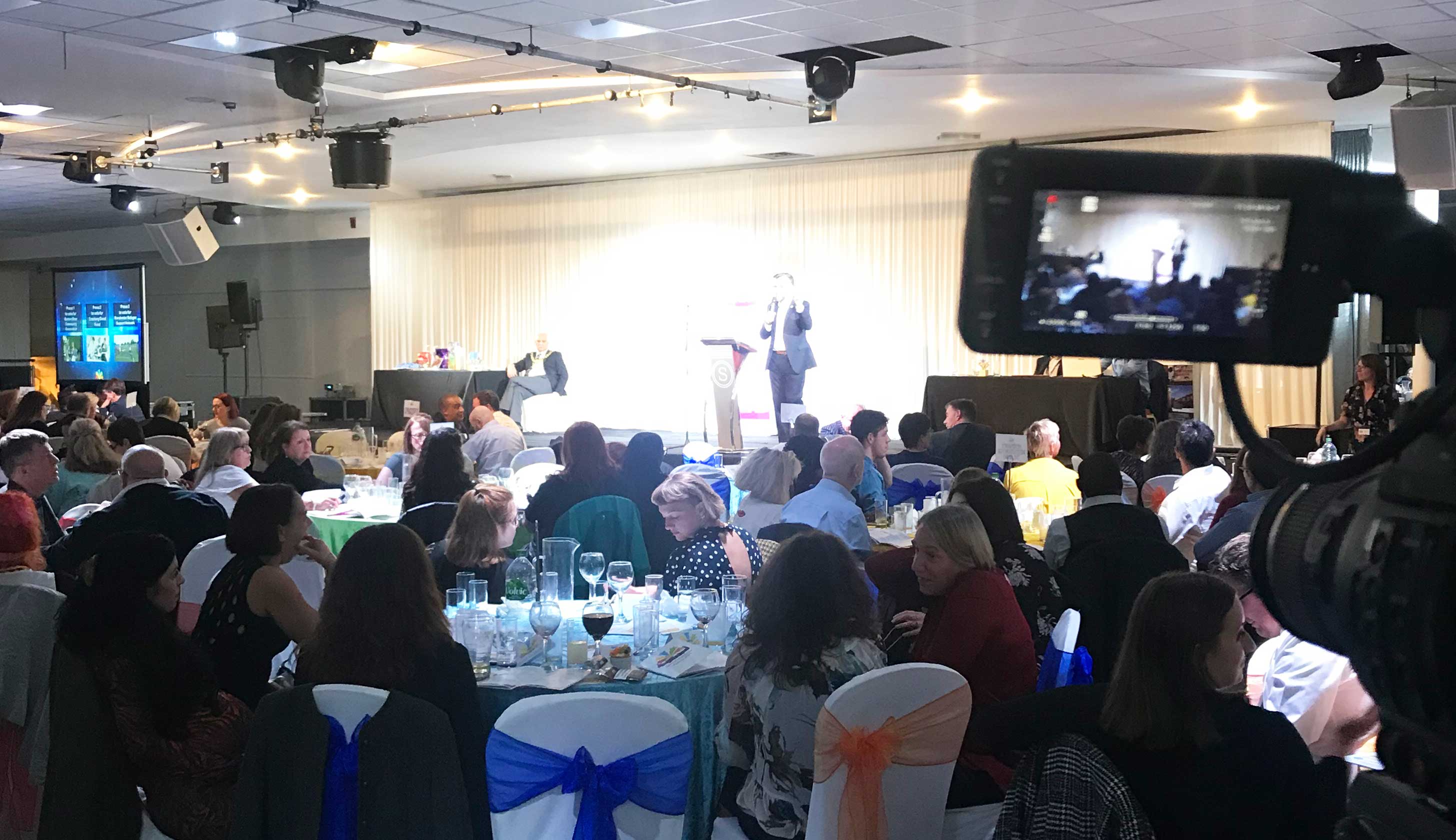
Manchester Digital welcomed members back together for the 2025 Member Conference on 5th December as we examined the topic “Built to Last.”
The event brought together a diverse mix of local tech and digital businesses from across the community, with the aim of celebrating resilience, long-term thinking and sustainable growth -even in uncertain times. The afternoon’s line-up offered a rich mix of technical insight, leadership thinking and practical business strategy.
Thanks go to our sponsors The PMC, Traversally and Bruntwood SciTech for making the event possible.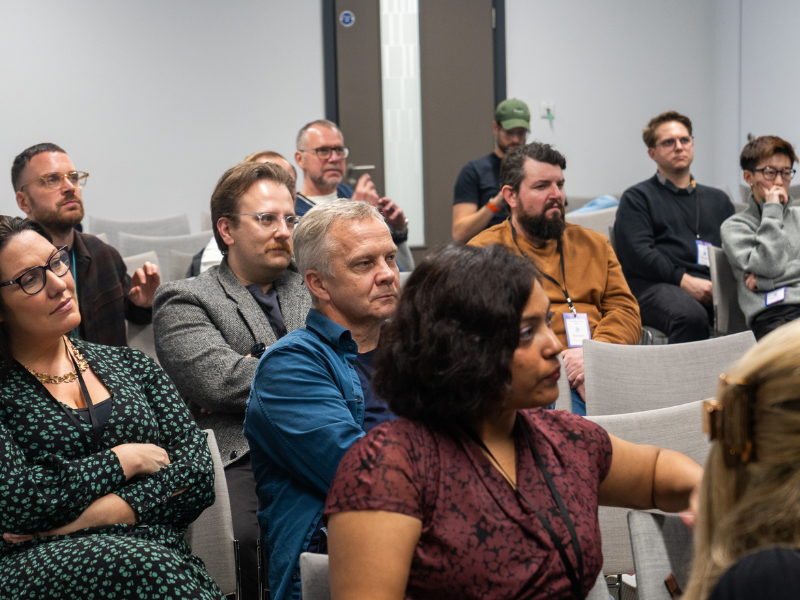
Here’s our round up of the day’s talks and panel sessions:
The durability of the Arm CPU architecture across decades
Laura Moore, Staff Information Developer, Arm
Laura Moore kicked things off in Studio One with a deep dive into why the Arm CPU architecture has proven so resilient and far-reaching. She laid out how Arm’s role is to design CPU, GPU, media, ISP and system IP - not fabricate devices -licensing these blueprints to partners (such as Samsung, Nvidia, Google, Amazon) who build them into chips. With roughly 99% of smartphones using Arm CPUs, the reach is enormous - from everyday gadgets to cloud servers, cars, smart devices, and even industrial and space-grade applications.
She emphasised three “pillars of durability”: engineering longevity (designs built to stay relevant across decades), ecosystem longevity (a stable foundation that encourages long-term investment by partners), and cultural longevity (a sustainable engineering mindset over hype or trend-chasing). This architectural philosophy - grounded in simplicity, clarity and energy-efficient design - allows Arm’s technology to scale from tiny, battery-powered devices to high-performance, power-hungry systems. The talk also connected this back to Manchester’s own computing heritage: reminding attendees that Manchester has been at the forefront since the earliest days of stored-program computers, and that the region’s engineering values continue to shape global technology through firms like Arm.
Thriving Through Uncertainty – a working session for digital leaders
Rob Sugden, Managing Director, Morson Edge & Emma Grant, Head of Programmes, Manchester Digital
In a more interactive and introspective session, digital leaders from across the membership came together to reflect on the year ahead. The workshop asked participants to map out the pressures currently facing their businesses - from economic uncertainty to shifting market demands - but also to pinpoint where real opportunities for growth and innovation lie.
The ideas and shared experiences from this session will feed directly into the next Manchester Digital “Sector Insights Report,” helping shape a collective view of where the region’s digital economy is heading.
The Death of the Marketing Team: Why AI, Economic Pressure, and Fractional Talent Are Forging a New Model
Carl Phillips, Managing Director, The PMC
Carl Phillips took a challenging look at how marketing - as a function and as a team - is being reshaped. He argued that economic pressures (tightened budgets, shifting industry dynamics) combined with rapid technological change and the rise of AI are pushing companies away from traditional, full-time marketing teams and toward more flexible, fractional-expert models.
He outlined the shortcomings of conventional marketing hierarchies, which are built for stability and safety, but slow and often out of step with rapid business change. In contrast, fractional or specialist-led teams (often embedded directly in agile workflows) allow companies to stay lean while accessing high skill levels when needed. This “team of teams” approach, borrowed from network-centric organisational thinking, can offer adaptability without sacrificing quality -especially useful now that data-driven marketing and nimble execution matter more than ever.
Building something that lasts when technology is moving at the speed of light
Nicola van Gelder, COO, Powdr
Nicola van Gelder shared the story of Powdr’s journey: from a SaaS-only product offering aimed at SME fundraising, to a hybrid model combining software with bespoke consultancy services. The shift was triggered by the recognition that customers’ expectations - shaped by AI, accessible tools, and rising demand for quality - had changed dramatically. What once felt like “delighters” (e.g. automated transcription) are increasingly becoming standard expectations when technology evolves quickly.
Confronted with that reality, Powdr pivoted: instead of competing on low-cost software alone, they embraced a service-oriented approach. The result: a tenfold increase in value and far stronger customer relationships. Nicola underlined that building something enduring in fast-moving industries requires not only technical agility, but a strong team culture, shared vision, and a willingness to adapt - even if it means deconstructing original assumptions about what your “product” actually is.
AI – Artificial Intelligence or Augmented Intelligence
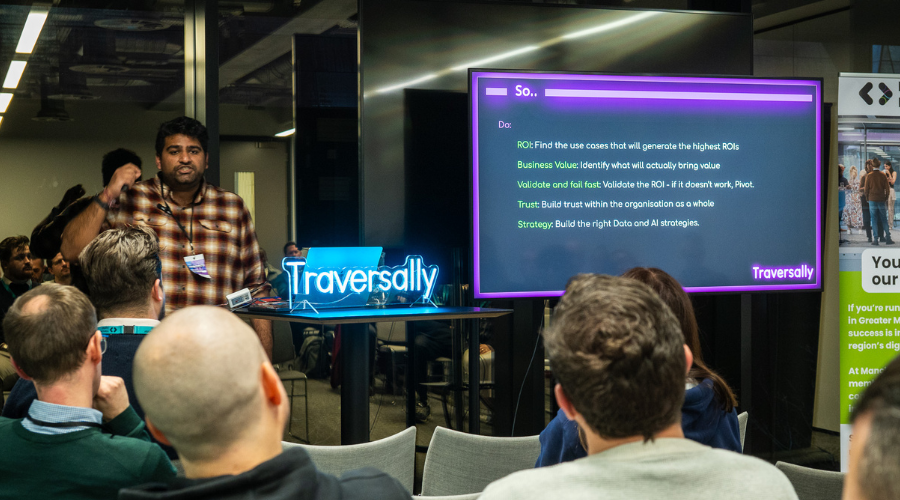
Dr Phininder Balaghan, Co-Founder, Traversally
Phininder Balaghan challenged the audience to reframe “AI” as “Augmented Intelligence,” an enabler for human work rather than a wholesale replacement. Citing high-profile failures where companies replaced people with AI only to reinstate human roles (for instance with service agents or content production), he argued that people remain critical to success.
He noted that although many organisations are experimenting with AI, only a tiny fraction of solutions make it through to long-term production. A common pitfall is treating AI tools as magic bullets rather than components of a broader strategic transformation. Instead, companies must treat AI deployment as a holistic change - involving data readiness, legal and ethical frameworks, infrastructure decisions, and training - not just a quick plug-in.
His advice: identify genuine ROI-driven use cases, validate rapidly, fail fast, but build trust - not hype. AI can succeed as a force multiplier, but only when paired with clear strategy, realistic expectations, and human-centred design.
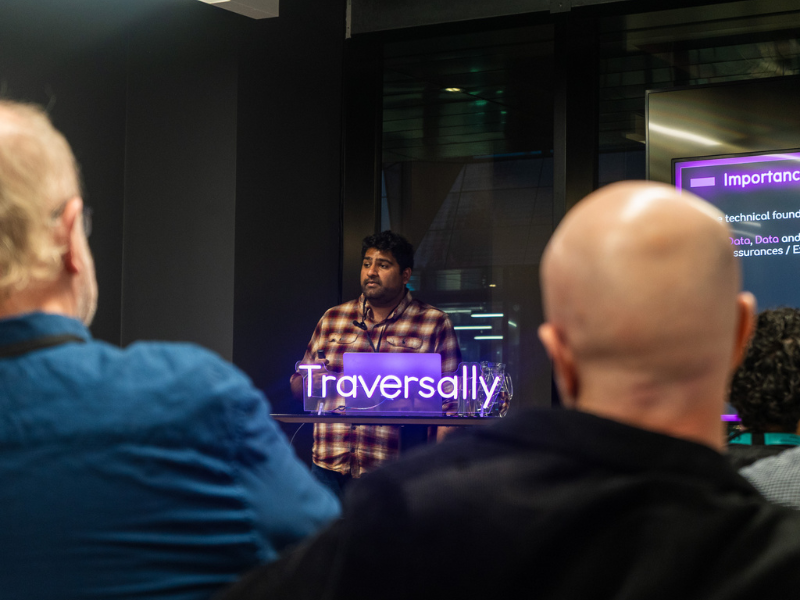 Dr. Phininder Balaghan, Traversally
The power of data and analytics: how digital marketers can thrive in an omnichannel media world
Ailish McDonnell, Head of PR & Communications, BuyMedia
Ailish McDonnell demonstrated how data-driven, omnichannel marketing isn’t just a luxury, it’s quickly becoming a necessity, especially for SMEs. BuyMedia’s AI-powered advertising platform helps companies plan, buy, manage and measure advertising across multiple channels, enabling smarter, evidence-based campaigns instead of guesswork.
She shared evidence that omnichannel campaigns can deliver significantly higher purchase rates and ROI compared to single-channel efforts. She also highlighted how many businesses struggle with disjointed systems: separate tools for sales, marketing and finance; manual planning; lack of accountability or clarity around performance.
Ailish argued that the solution lies in integrated processes: from customer segmentation and predictive insights, through to seamless execution and holistic reporting. For marketers - and the businesses they serve - adopting data-led decision-making is increasingly the difference between growth and stagnation.
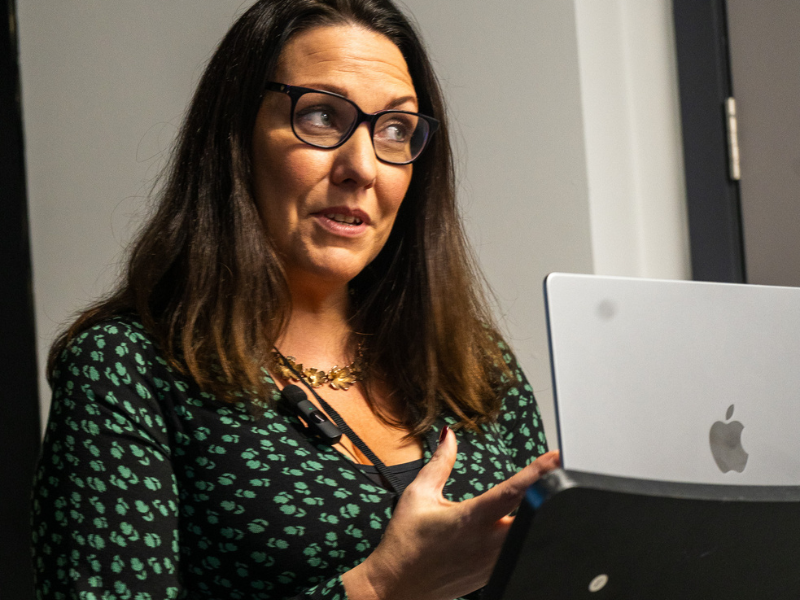 Ailish McDonnell, BuyMedia
The Punk and the Process: Building Resilient Quality
Rob Lunt, Director of Quality Engineering, Planit
Rob Lunt delivered a high-energy, no-nonsense examination of the industry’s growing quality crisis, arguing that software development has drifted into a culture where speed trumps robustness - and the consequences are mounting.
Across 2023–24, 64% of projects failed, contributing to an estimated £335 billion in wasted spend from a total £500 billion invested in IT. Rob set out the root causes: reduced emphasis on architecture and planning, shrinking testing roles, and a “tech bro” mentality that treats production defects as inevitable clean-up rather than preventable failures.
He contrasted today’s backlog-driven, reactive approach with the more resilient mindset needed to prevent issues at source. High-profile security incidents, such as the M&S breach, highlight how reputations can be damaged when organisations push ahead without embedding quality. What’s needed, he argued, is a cultural shift from gatekeeping (“computer says no”) to shared ownership, collaboration and proactive quality engineering.
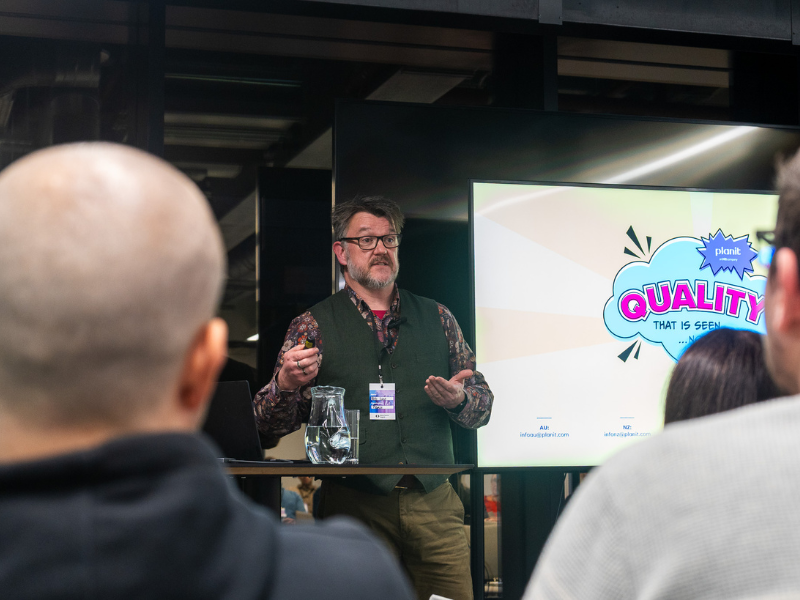 Rob Lunt, Planit
Kevin versus John – How sticking with a carrot made Aldi the Kings of Christmas
Jamie Peate, Head of Effectiveness, McCann Manchester
In a lighter but no less insightful session, Jamie Peate took the audience through the evolution of Aldi’s iconic “Kevin the Carrot” campaigns, and what long-term consistency - rather than novelty - can achieve. Originally created in 2016 to help Aldi compete over the Christmas period, Kevin transformed the brand’s seasonal image by turning ordinary moments into festive, emotionally resonant narratives.
Crucially, what began as a “cheap and cheerful” idea evolved into a beloved tradition: a consistent creative team, recurring characters, and a simple but effective philosophy of “make everyday feel special.” Over time, Kevin campaigns outperformed traditional Christmas adverts from rivals, boosting awareness and converting festive sentiment into sales.
Jamie left the audience with the broader takeaway that marketing success doesn’t always come from chasing the next big idea. Sometimes steady repetition, craft quality and brand fluency deliver far more value than chasing novelty.
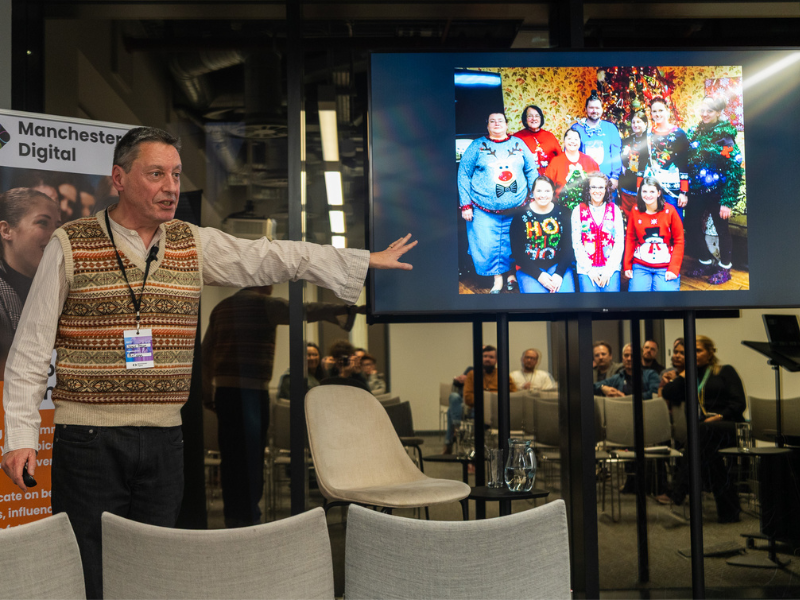 Jamie Peate, McCann Manchester
General Meeting and Closing
Ghislaine West & Shaun Fensom, Manchester Digital
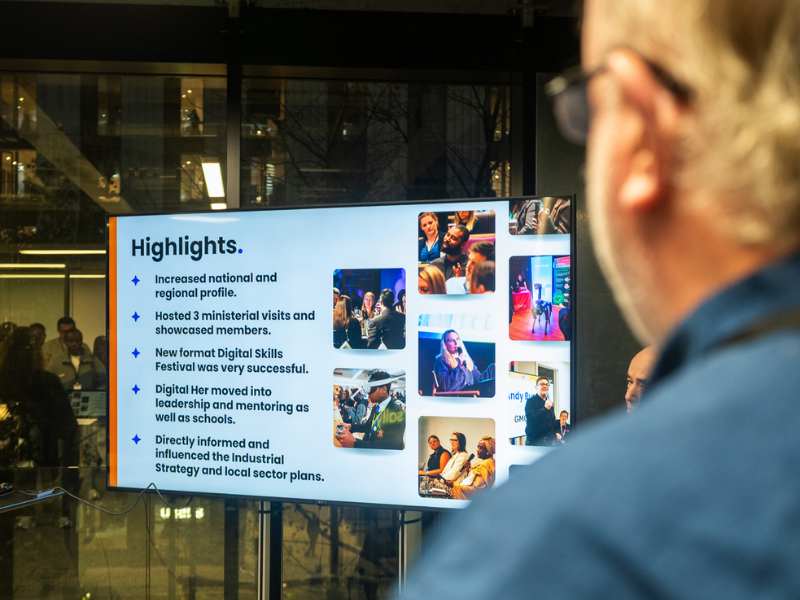
The day closed with a general meeting led by Ghislaine West and Shaun Fensom, giving a transparent account of Manchester Digital’s impact and activities over the past year. They also introduced updates to the board, outlined organisational priorities for the coming period, and reaffirmed their commitment to fostering community, collaboration and growth across the region.
This final session served as a reminder that beyond the talks and ideas, the heart of the conference - and Manchester Digital itself - remains the people: the companies, leaders and practitioners who make up this unique regional tech ecosystem.