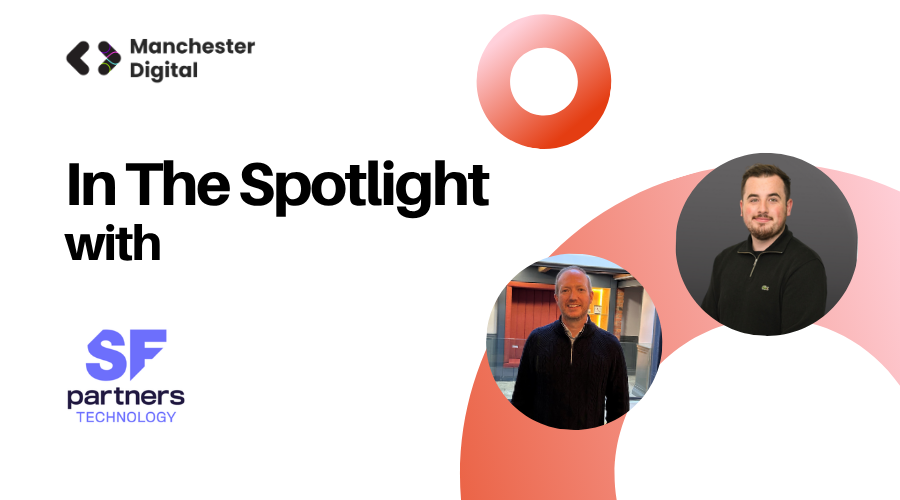
At Manchester Digital, we regularly shine a light on our members to understand more about their roles and their work within Greater Manchester’s digital and technology community. This week, we’re speaking with Russell Livesey, Divisional Director, and Tommy Parkes, Recruitment Consultant at SF Technology Partners.
How would you describe the current recruitment market across technology and leadership roles?
Russell:
The market definitely feels more positive than it did this time last year. Since the start of 2026, we’ve seen a noticeable increase in senior technology and transformation hiring across the North West. Businesses are investing again, particularly around large scale transformation programmes, operational efficiency and AI related initiatives.
That said, clients are being incredibly selective. They know exactly what they want and they’re not rushing decisions. Businesses want leaders who can genuinely move the needle commercially, not just manage technology functions.
We’re also seeing a significant rise in interim and fractional hiring. A lot of organisations still need experienced CTO or CIO level leadership, but they may not yet be ready to commit to a permanent executive hire while the market remains uncertain.
Tommy:
In data, AI and analytics, the market has become far more specialised over the last few years. Businesses increasingly want tailored systems and solutions that fit their exact environment rather than generic approaches.
What many organisations are crying out for are technically credible leaders who can guide them through AI adoption and automation properly, without wasting time or money going down the wrong route.
The businesses seeing the best results are usually the ones bringing in people who understand both the technology and the commercial reality of the sector they operate in.
What are the biggest changes you’ve seen over the past 12-18 months, and what’s driving them?
Russell:
The biggest shift has probably been supply and demand. There are far more candidates actively looking for opportunities than there are roles available, particularly at middle management level.
At the same time, AI generated applications and LinkedIn Easy Apply have changed the market completely. Businesses are getting flooded with applications, which ironically means a lot of genuinely strong candidates are getting overlooked.
There’s also much more scrutiny around hiring decisions internally. Businesses want to understand the return on investment behind every hire and they’re generally unwilling to compromise on quality.
Tommy:
I think the online nature of recruitment has made it harder for talented people to stand out. You can apply for hundreds of jobs within minutes now, which creates huge volumes but not necessarily quality.
Because of that, trusted networks and personal relationships have become more important than ever. That’s where specialist recruiters still add value because we’re not just posting adverts, we’re actively engaging with people in our market every day.
We’re also seeing businesses place much more value on sector experience. Quite often, companies would rather hire someone who understands their industry and commercial environment over somebody who is purely technically strong on paper.
As your business has evolved, how have you adapted your approach to building and maintaining client relationships?
Russell:
We’ve become much more focused on being an extension of our clients’ network rather than simply a supplier.
That means spending more time face to face, visiting offices, understanding businesses properly and staying close to clients even when they’re not actively hiring.
We’re also heavily involved in the wider North West technology community through leadership events, Manchester Digital and discussions around AI, cyber and transformation. Clients want insight and honest conversations, not just CVs.
Tommy:
The human side of recruitment is becoming more important again. People value proper conversations and genuine relationships in what’s become a very noisy market.
We spend a lot of time building networks locally across Manchester and the wider North West because ultimately those trusted relationships are what create opportunities for both clients and candidates.
You talk about “deep relationship building” - what does that look like in practice, and how does it benefit clients?
Russell:
We’re very focused on what we do well, which is technology leadership, transformation and specialist technology hiring.
Because we stay close to our market, we’re able to move quickly and introduce high quality people who are genuinely relevant rather than sending large volumes of CVs.
A lot of our work is relationship led and referral driven, particularly across private equity backed businesses, transformation programmes and specialist areas like AI, cyber, software engineering and project delivery.
Tommy:
For me, deep relationships come from genuinely understanding your market and consistently adding value over time.
That doesn’t always mean filling a role immediately. Sometimes it’s sharing insight, helping someone avoid a bad hire or simply pointing people in the right direction.
The benefit of that long term approach is trust. Clients and candidates know we understand their world properly.
What are organisations really looking for in senior technology leaders today?
Russell:
Modern CIOs and CTOs are expected to solve business problems, not just manage technology.
The strongest leaders today are commercially minded, operationally aware and able to communicate effectively at board level. They need to understand how technology drives growth, efficiency and competitive advantage.
There’s also a huge focus on leadership style. Businesses want people who can lead transformation, bring teams with them and make confident decisions in complex environments.
Increasingly, we’re seeing technology leaders viewed as future CEOs because technology now sits right at the centre of business strategy.
There’s growing demand for fractional and permanent CTOs - what’s behind that shift?
Russell:
Fractional leadership has become really popular because businesses can access very experienced technology leaders without committing to a full time executive hire straight away.
A lot of these leaders have broad transformation experience across multiple sectors, so they can come into a business, stabilise things quickly and help shape long term strategy.
It’s also a sensible option during periods of uncertainty because businesses can stay flexible while still getting senior level expertise.
AI is changing how candidates are assessed - how are you seeing it impact the recruitment process?
Tommy:
AI has changed candidate behaviour massively. People can now tailor CVs instantly and apply for huge numbers of jobs very quickly, which has increased application volumes dramatically.
The challenge is that it becomes harder for genuinely strong candidates to stand out and harder for businesses to identify quality through volume alone.
That’s why networking, human interaction and industry relationships still matter so much, especially at senior level.
I also think candidates need to focus more on commercial outcomes in applications rather than just listing technical skills. Businesses want to understand impact.
What skills are becoming essential for tech candidates, and where are you seeing gaps?
Russell:
There’s no shortage of technical candidates competing for opportunities. The people standing out are usually the ones with strong communication skills, commercial awareness and emotional intelligence.
Businesses want people who understand why technology matters commercially, whether that’s around AI, ERP, CRM or automation.
The biggest gap is often around people staying current. AI now appears on almost every technology job brief we work on in some form.
Tommy:
In data and AI especially, soft skills have become hugely important.
The ability to work across teams, communicate with non technical stakeholders and understand business needs is often more valuable than being purely tool focused.
Technical skills can be developed relatively quickly nowadays. What’s much harder to teach is curiosity, communication and commercial thinking.
You’ve focused on building a community for senior leaders — why is that so important right now?
Russell:
One thing I realised quite early in my career is that senior technology leadership can be quite isolating.
CIOs and CTOs are often under huge pressure to deliver transformation, manage risk and make difficult decisions, so having a trusted peer network is incredibly valuable.
That’s why we’re passionate about bringing leaders together across Manchester and the wider North West technology community. The conversations and relationships that come from those events often last for years.
Looking ahead, what trends do you think will shape the recruitment and technology landscape over the next 1–2 years?
Russell:
AI isn’t going away. The investment levels are too significant and businesses are only just starting to understand the wider opportunities it creates.
From a recruitment perspective though, I actually think the market will become more relationship driven again. Businesses are overwhelmed by applications and candidates are frustrated by impersonal processes.
The value will increasingly come from trusted networks, specialist knowledge and quality over quantity.
Tommy:
I think we’ll see much more mature conversations around AI over the next couple of years.
Right now many businesses are still figuring out data quality, governance and where AI genuinely fits into their operations. As that matures, we’ll see more tailored solutions, stronger internal capability and much clearer commercial use cases emerge.
The businesses investing properly now will put themselves in a really strong position over the next few years.
Thank you Russell and Tommy!
To find out more about SF Technology, click here.