AI Is Changing How Enterprise Programs Operate
As enterprises scale AI initiatives, the real differentiator is no longer technology alone, but governance that can convert innovation into measurable business outcomes. Organisations are investing heavily in AI, but the ability to translate that investment into value depends on how effectively decisions are aligned, executed, and sustained at speed.
Yet while innovation moves fast, governance structures often remain rooted in oversight models designed for slower delivery environments.
I have seen this play out repeatedly. When organizations apply legacy frameworks to fast-moving digital programs, governance challenges don't just slow things down, they quietly compound.
One experience stays with me. In a large government digital transformation I led, a multi-agency citizen services platform was moving significantly faster than the governance supporting it. Multiple vendors were building integrations to meet aggressive national digitalization targets, but the cross-agency model around decision rights, data ownership, and change approvals hadn't kept pace. Several consequential decisions were being made at delivery level, without consistent architectural oversight.
Rather than responding with heavier controls, we introduced lightweight but structured governance: an executive board empowered for rapid decisions, clear ownership across agencies, and fast-track change controls for urgent features. The program regained alignment, not because we added bureaucracy, but because governance evolved alongside delivery.
That lesson has stayed with me: governance cannot follow delivery. It must move with it, adaptive enough to maintain speed, yet structured enough to protect strategic alignment.
Traditional Governance Frameworks Are Being Tested
Most enterprise governance models were built for predictable project lifecycles, phase gates, structured reporting, centralised decision-making. These worked when technology programs moved over months or years.
Today, delivery cycles operate weekly or daily. Governance boards still meeting monthly cannot keep pace. That structural mismatch delays critical decisions and creates friction between delivery teams and executive oversight.
AI-enabled initiatives make this gap even more visible. They also introduce new dimensions of risk, including model trust, decision accountability, and explainability, which traditional governance frameworks are not designed to address. They involve rapid experimentation, evolving requirements, and cross-functional dependencies that rarely fit neatly within traditional checkpoints. The result is a familiar tension: how do you maintain oversight without becoming the thing that slows innovation down?
Governance Should Enable Value, Not Slow Innovation
Strong governance is consistently misunderstood as a control mechanism. Its most important function is actually alignment, keeping technology initiatives connected to enterprise strategy while giving teams the clarity to move with confidence.
When governance becomes overly procedural, innovation stalls. When it's too loose, initiatives lose strategic direction. The challenge is designing frameworks that maintain visibility without creating drag.
Good governance isn't about adding checkpoints. It's about enabling clarity. Teams should know what they can decide independently, what needs escalation, and how their work connects to outcomes. When governance is designed that way, it reduces friction rather than creating it.
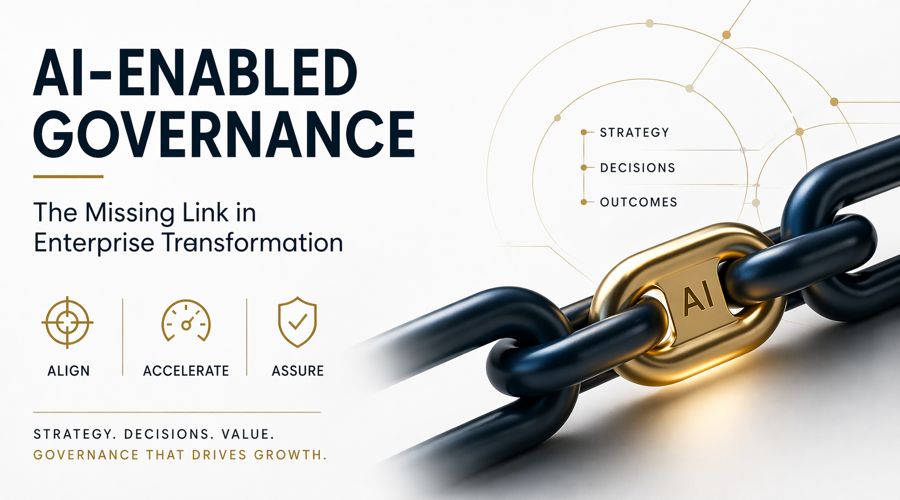
At its best, governance delivers three things: direction, transparency, and decision velocity. It keeps programs aligned to enterprise priorities while giving delivery teams the autonomy to move.
In one enterprise SaaS program I was governing, every risk was logged and every dependency documented, yet nothing moved. The steering committee was being asked to resolve decisions that should have been pre-aligned before the meeting. We changed the approach: aligning decision owners in advance, removing ambiguity before the forum. Approval turnaround improved by over 40% within weeks. The insight was simple, governance should prepare decisions, not just review them.
Rethinking Governance for the AI Era
As organisations scale AI-driven initiatives, governance must evolve accordingly. Three areas deserve focus:
- Strategic alignment: Governance must connect every initiative directly to enterprise objectives. AI without strategic anchor drifts into technical novelty without business impact.
- Decision velocity: Governance forums should accelerate decisions, not delay them. Pre-aligned pathways, clear escalation thresholds, and empowered owners are non-negotiable.
- Cross-functional accountability: AI initiatives span technology, operations, risk, and business teams. Governance must define ownership across all of them, not just the delivery layer.
CIOs should focus less on adding new committees and more on creating clear decision pathways and fast escalation mechanisms. Governance works best when it is designed as an enabler of progress, not an audit trail for it.
Final Thoughts
The organisations succeeding with AI are not those with the most controls. They are those with governance that keeps strategy, delivery, and decision-making tightly connected, and that adapts as fast as the program it supports.
When governance is treated as a strategic capability rather than a compliance exercise, it stops being overhead. It becomes the mechanism through which organisations convert AI investment into measurable enterprise growth.
That is not a technology problem. It is a leadership discipline.
By
M. Qasim Bhatti