Enterprise product implementations rarely fail because of technology.
In several large-scale implementations, I’ve seen products technically go live on time, yet take months to achieve meaningful user adoption due to delayed decisions and misaligned stakeholders.
They struggle when adoption lags, decisions slow down, and alignment weakens across business and delivery teams.
Having worked across banking, public sector, and enterprise SaaS environments in the Middle East and UK, one pattern consistently stands out:
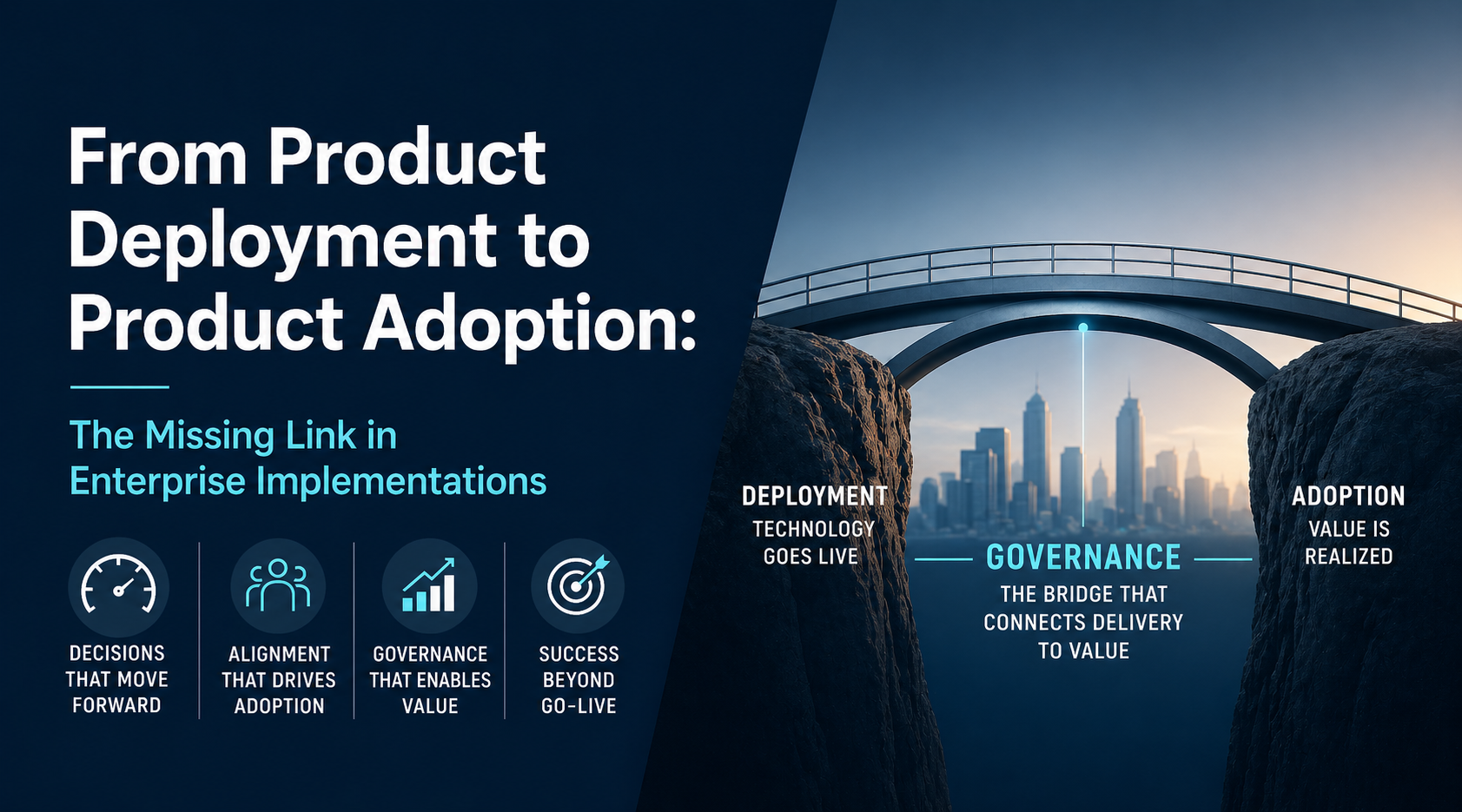
The success of a product is not defined at deployment; it is defined at adoption.
And the bridge between the two is not just delivery capability.
It is programme governance, designed as an enabler of product value.
The Reality of Modern Product Implementations
Today’s enterprise products, whether CRM platforms, digital HR solutions, or AI-enabled applications, are no longer “install and go” systems.
They are:
- Deeply Integrated into Business Processes
- Dependent On Cross-Functional Alignment
- Sensitive To Organisational Readiness
- And Increasingly Driven by Data And AI
This shifts implementation from a technical rollout to a business transformation exercise.
Yet many organisations still treat implementation as:
- A Milestone-Driven Delivery Effort
- Focused On Timelines, Scope, And Cost
- With Governance Centred on Status Reporting
This is where the gap begins.
Why Deployment Alone Doesn’t Deliver Value
A product can go live successfully, and still fail to deliver value.
Common patterns include:
- Features delivered but not fully utilised
- Business teams not aligned on process changes
- Delayed decisions impacting configuration and rollout
- Adoption varying significantly across departments
These are not delivery failures.
They are adoption and decision failures.
And they require a different lens, one that extends beyond traditional project controls.
Reframing Governance in Product Implementations
In high-performing programmes, governance is not positioned as control.
It is positioned as a decision and alignment engine.
Effective governance in product implementation focuses on:
1. Decision Velocity
The speed at which critical business and product decisions are made.
Delays in decisions, whether on requirements, configurations, or process changes, directly impact timelines, rework, and user confidence.
High-performing programmes actively track and improve decision latency.
2. Business Alignment Signals
Beyond status reports, leading programmes monitor:
- stakeholder readiness
- cross-functional alignment
- dependency risks
- and adoption readiness indicators
This shifts governance from reporting “what happened” to sensing “what may impact outcomes.”
3. First-Time-Right Delivery
In complex product implementations, rework is one of the biggest hidden costs.
Leading teams focus on improving:
- clarity of requirements
- validation cycles
- and business engagement
A strong benchmark many programmes aim for is:
85%+ deliverables accepted on first submission
This is not just a delivery metric, it reflects governance maturity.
4. Adoption-Focused Milestones
Traditional milestones end at build completion, testing sign-off, go-live
Modern implementations extend this to:
- user adoption
- process stabilisation
- and value realisation
Because the real success begins after go-live.
The Role of AI in Modern Product Governance
As enterprise products become more data-driven, governance is also evolving.
AI is beginning to support:
- early identification of delivery risks
- pattern recognition across programme data
- proactive insights on dependencies and delays
But the real shift is not just in tools.
It is in mindset: From dashboards → to decision signals
Where governance helps leaders act earlier, not just report later.
Product Implementation as a Growth Driver
When implemented effectively, enterprise products do more than digitise processes.
They:
- improve operational efficiency
- enhance customer experience
- enable better decision-making
- and unlock new growth opportunities
But this only happens when:
- business and technology move in alignment
- decisions are timely
- and adoption is actively driven
This is where governance plays a critical role, not as oversight, but as a strategic enabler of value.
A Practical Shift for Organisations
For organisations implementing enterprise products today, a few shifts can make a significant difference:
Treat implementation as a business transformation, not just a technical rollout
Design governance around decisions and adoption, not just reporting
Measure success beyond go-live, focus on usage and value realisation
Strengthen collaboration between business, product, and delivery teams
These are not complex changes.
But they require intent.
Closing Thought
Enterprise product implementations will continue to grow in complexity as organisations embrace digital transformation and AI-enabled platforms.
The differentiator will not be who deploys faster.
It will be who adopts better and realises value sooner.
And that journey is shaped not just by delivery teams, but by how effectively governance enables decisions, alignment, and outcomes.
If you’re navigating complex product implementations or enterprise transformations, I always welcome a conversation on governance, adoption, and value realisation.
M. Qasim Bhatti, PgMP®, PMP®
Programme & Portfolio Governance Leader | Author of From Governance to Growth
Enabling enterprise SaaS transformations through AI-enabled governance, product adoption, and value realisation.