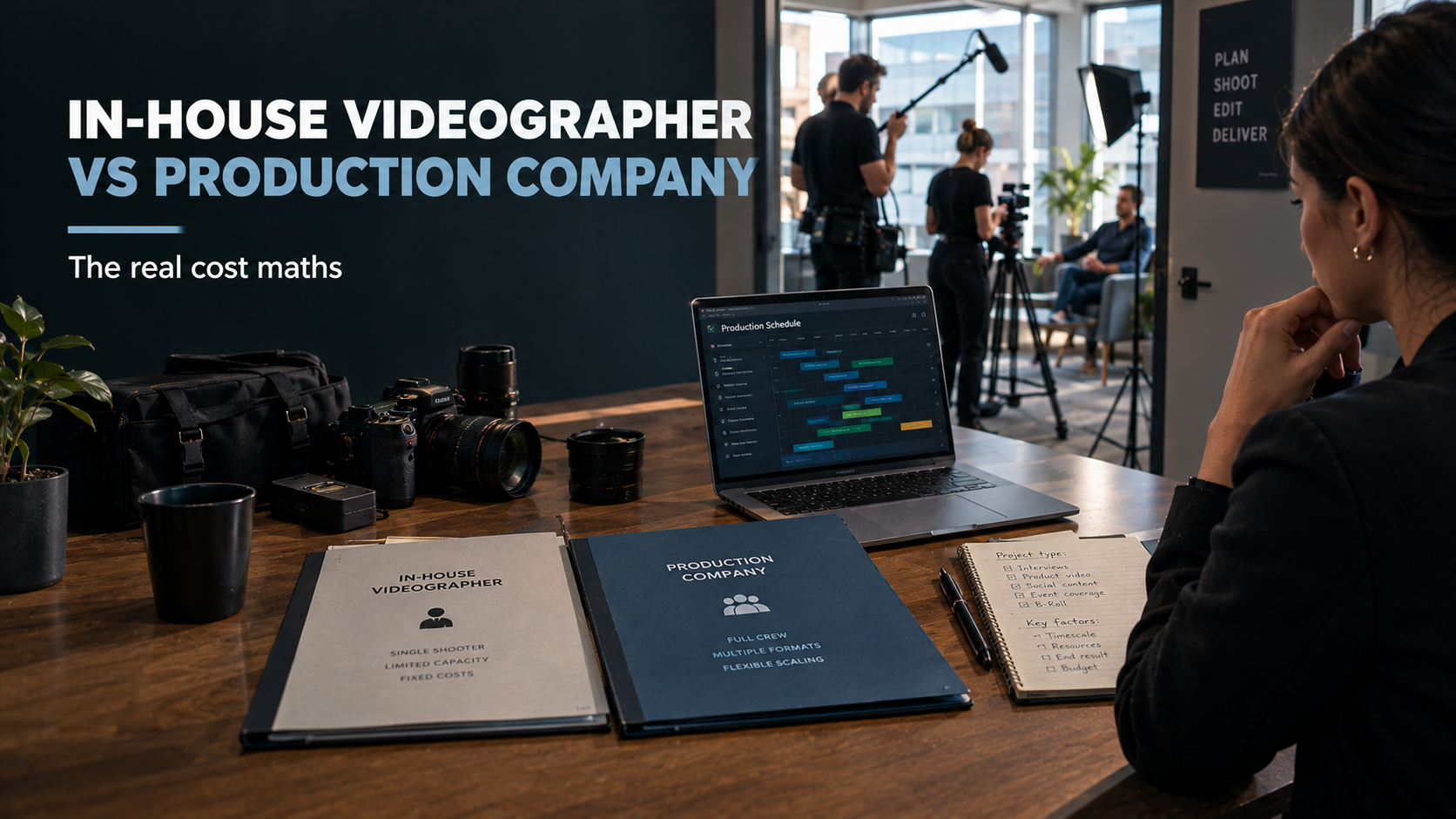
Instead of paying a production company for every project, you bring the capability inside. The camera is always available, the employee learns the business, and marketing can request videos whenever they are needed.
On paper, it sounds straightforward.
But the comparison often starts and ends with salary. Once you factor in equipment, software, employment costs, editing capacity and the volume of finished content actually produced, the numbers can look very different.
For a business in the North West considering its options in 2026, an in-house videographer might cost £45,000–£60,000 a year once the wider costs are included. That investment can make sense when filming is a near-daily requirement. For businesses with more occasional or campaign-based needs, an external production company or monthly retainer may offer better value.
The question is not simply which option is cheaper. It is which model gives your business the right production capacity, quality and consistency for the money.
What Does an In-House Videographer Really Cost?
Let's start with the employment model.
A capable shooter-editor in the North West might command a salary of around £28,000–£40,000, depending on experience, responsibilities and technical skills. But salary is only one part of the cost.
Salary: £28,000–£40,000 a year
This is the most visible expense, and usually the figure businesses use when comparing an employee with an external supplier.
However, an annual salary buys working time, not a guaranteed number of finished videos. The employee will also attend meetings, plan shoots, manage requests, organise files, make revisions and deal with other responsibilities assigned to the role.
The amount of time available for actual production will therefore vary.
Equipment: £10,000–£20,000 upfront
A professional setup can include cameras, lenses, lighting, audio equipment, tripods, storage and supporting accessories.
The investment depends on the type of content the business produces. A company creating simple internal updates will have different requirements from one producing polished customer testimonials, product films or campaign content.
Equipment also needs maintenance and eventual replacement. The initial purchase is not necessarily the final equipment cost over several years.
Software and storage: £1,000–£2,000 a year
Editing software, cloud services, file storage, backup systems and other production tools can add to the annual expense.
These costs may be relatively modest individually, but they are part of maintaining a reliable production operation.
Employment overheads and management time
Employer National Insurance contributions, pension contributions, recruitment, holiday cover and management time all affect the total cost of employing someone.
The business must also consider what happens when the videographer is unavailable, leaves the company or needs specialist support beyond their own capabilities.
The realistic annual picture
Taken together, these expenses can put the total cost of an in-house setup in the region of £45,000–£60,000 a year, depending on salary, equipment purchases, employment arrangements and how the business accounts for its kit.
This is an indicative planning range, not a universal market rate. Equipment bought upfront should also be treated differently from recurring annual expenditure when comparing costs over multiple years.
The important point is that an in-house videographer is not simply a salary on the payroll. It is an ongoing commitment to maintaining video production capability inside the business.
And that investment still buys you one person's capacity.
What Does the Same Budget Buy From a Production Company?
Now consider the external model.
Instead of employing a permanent videographer, the business commissions a production company for specific projects or agrees a regular monthly arrangement.
An annual budget of £45,000–£60,000 could fund a substantial programme of external production. Depending on the agreed scope, it might support regular filming days, a production crew, editing, motion graphics and a planned collection of finished assets.
A smaller retainer of approximately £1,500–£3,000 per month could provide a more manageable way to maintain a consistent flow of content.
These figures are illustrative planning ranges, not guaranteed packages. The number of filming days, crew members and finished assets must be agreed with the supplier. A retainer at the lower end will not necessarily provide the same output as a larger production programme.
The advantage is that the business can buy the capacity it needs without maintaining every element of the production operation itself.
Access to different specialists
One person may be an excellent camera operator and editor, but professional production can involve several distinct skills.
Depending on the project, a production company may provide access to camera operators, sound specialists, editors, motion graphics designers, producers and other creative professionals.
That can be particularly valuable for customer-facing campaigns, complex interviews, brand films and projects where production quality matters.
Rather than expecting one employee to handle every technical and creative requirement, the business can assemble the right team for each brief.
Capacity that can flex
A business may need several videos in one month and very little filming the next. A product launch or major campaign can require more capacity than an ordinary month.
External production makes it possible to scale the scope of a project up or down, subject to availability and the agreed budget.
It also avoids making every production decision around the equipment and skills already available internally.
A clearer production brief
Working with an external supplier encourages the business to define the objective, deliverables, schedule and approval process before production begins.
A well-structured brief helps establish what the company is paying for and what the finished work should achieve.
However, outsourcing does not automatically guarantee better value. Poorly planned projects, excessive revisions and unclear deliverables can still drive up costs. The comparison must be based on what each option actually delivers.
The Hidden Cost of an In-House Videographer
There is another challenge that rarely appears in the original recruitment calculation: the role can gradually become the company's everything-visual person.
The videographer is hired to produce strategic marketing content. Then someone requests new headshots. Another department needs a screen recording. The managing director wants conference slides updated. An internal event needs filming, followed by a request to edit footage from the Christmas party.
Each request may be reasonable on its own. The problem is the cumulative effect.
Internal requests often arrive from people the employee works with every day, so they can be difficult to decline. Over time, the work that justified the hire can be crowded out by smaller, immediate tasks.
The business still pays the same salary, but less of the employee's time is spent producing the marketing content that was supposed to deliver value.
This is a capacity and management problem, not necessarily a performance problem. Without clear priorities, protected production time and an agreed process for accepting requests, even a talented videographer can struggle to maintain a consistent output.
External production has its own coordination requirements, but a defined brief and agreed deliverables can make the scope of work easier to manage.
When Does Hiring In-House Make Sense?
There are situations where an in-house videographer is the better investment.
You need filming most days
Content-led businesses, media companies and organisations running large-scale social media operations may have enough daily work to justify a permanent employee.
If there is a steady flow of filming requests and the business can keep the role productively occupied, internal capacity can make practical sense.
Speed matters more than production complexity
Some businesses need quick-turnaround footage for internal communications, daily social updates or rapidly changing campaigns.
Having someone on-site can reduce scheduling friction and make it easier to capture spontaneous moments.
That is especially useful when content needs to be created and published within hours rather than planned around a production schedule.
You can protect the role's priorities
An in-house videographer is more likely to deliver value when the business has a clear content plan, realistic expectations and a manager who protects production time.
Without that structure, the employee can become an internal AV service rather than a dedicated contributor to the marketing strategy.
Before hiring, establish what the person will produce, how success will be measured and which requests fall outside the role.
When Does an External Production Company Make More Sense?
External production is often a stronger option when the business needs planned, high-quality content rather than a permanent filming presence.
You need consistency, not daily availability
If the company needs regular monthly content, customer testimonials, recruitment films or campaign assets, a production schedule or retainer may provide the right level of support.
The business can plan production around its marketing calendar rather than carrying a full-time salary during quieter periods.
The work is customer-facing
Brand films, product launches, investor communications and major campaigns can benefit from a team with the right specialist skills and equipment.
An external supplier can bring additional creative input and technical expertise when the brief demands it.
You want to scale without a permanent employment commitment
A production company can offer access to different levels of support according to the project.
This can be useful for businesses whose content requirements change throughout the year, although availability and pricing still need to be agreed in advance.
The trade-off is that external teams require booking, briefing and coordination. If a business needs somebody ready to film at a moment's notice every day, an external model may not provide the same convenience as an employee on-site.
The Hybrid Model: Combine Internal Speed With External Expertise

The decision does not have to be all or nothing.
For some businesses, the most practical solution is a junior in-house content creator or videographer for everyday requirements, supported by a production company for larger projects and planned content days.
The internal person might capture quick updates, record simple interviews, produce straightforward social clips and respond to immediate requests.
The external team could handle campaign production, customer case studies, more demanding shoots, advanced editing and a coordinated batch of content for the coming weeks.
This gives the business an internal point of contact without expecting one employee to cover every specialist production requirement.
It also creates a clearer division of responsibilities. Everyday content can be handled quickly, while more complex work receives the planning, crew and post-production support it needs.
The model only works if responsibilities and budgets are defined. Otherwise, the business risks paying for overlapping services or leaving important tasks without a clear owner.
How to Compare the Costs Properly
Before choosing an in-house videographer, an external production company or a hybrid approach, compare the total cost with the expected output.
Start with the following questions:
What is the total annual cost? Include salary, employer costs, equipment, software, storage, recruitment and management time where relevant.
How many usable assets will be delivered? Distinguish between raw footage, edited videos, different versions of the same video and genuinely separate content pieces.
What level of production quality is required? A quick internal update and a major customer-facing campaign do not require identical resources.
How much internal time will the work consume? Briefing, approvals, feedback and distribution all require input from the business.
What happens when demand changes? Consider quiet periods, major launches, staff absence and specialist requirements.
Who is responsible for distribution? Creating a video is only one part of getting it in front of the right audience.
You can then calculate an indicative cost per finished asset by dividing the relevant annual spend by the number of usable deliverables.
For example, if an external programme costs £48,000 and produces 240 distinct finished assets over a year, the average production cost is £200 per asset. That is an illustration of the calculation, not a prediction of what every supplier or programme will deliver.
The figure should also be interpreted carefully. A short social clip is not equivalent to a complex brand film, and production cost alone does not reveal whether the content generates leads or supports sales.
The most useful comparison combines cost, output, quality, turnaround time and commercial purpose.
The Verdict: Which Option Delivers Better Value?
An in-house videographer can be a sound investment when the business has enough regular filming work, values immediate availability and can protect the role from competing internal requests.
A production company or retainer can be more practical when content requirements are planned around campaigns, quality needs vary by project, and the business wants access to a wider range of production skills without maintaining all of them internally.
For some organisations, a hybrid arrangement will provide the best balance.
The key is to avoid comparing a salary with a production quote as though they represent the same thing. One buys an employee's time and requires the business to provide equipment, direction and ongoing management. The other buys an agreed service and set of deliverables, with the scope and costs defined by the supplier.
At Title Productions, we approach video production as part of a wider content strategy, helping businesses consider how filming days, editing and multiple content formats can work together. You can explore our video production work to understand the range of projects a production team can support.
If you are weighing up an in-house hire against external production, start by identifying how much content you genuinely need, how often you need it and what level of quality each project requires. Then compare the full cost of each model against those requirements.
Contact Title Productions to discuss a production approach that fits your content requirements and budget.