Only 13% of CIOs say their organisation has realised significant or transformational value from AI so far. That is the headline from Gartner's latest survey of more than 2,000 CIOs and technology executives, published on 19 October 2026 (Gartner).
It lands at an awkward moment. AI funding is rising, and 58% of CIOs in the same survey said they face increased pressure to deliver cost improvement from AI. Boards are asking a simple question: where is the return?
The encouraging part is that the gap is not about access to better technology. The organisations getting value are doing a few things differently, and none of them depend on sector or size.
Key takeaways
Most organisations are not yet seeing significant value from AI, despite rising investment.
Gartner's leading group of CIOs is more likely to set stopping rules for AI at two points: pilots and production.
Gartner also calls on CIOs to govern AI economics across the whole lifecycle, not just approve the initial purchase.
Value comes from redesigning work around clear outcomes, on solid data, with governance that enables rather than blocks.
What did Gartner find?
Gartner surveyed 2,002 CIOs and technology executives between May and July 2026. Alongside the 13% figure, it identified a group it calls "vanguards": CIOs who are delivering better business outcomes and whose CEOs also see high value from AI. Two findings stand out:
Vanguards set stopping rules. They are more likely to establish rules for stopping AI initiatives at two points in the lifecycle: at the pilot stage and in production.
AI economics need stewardship. With funding shifting towards generative and agentic AI, Gartner says CIOs need to govern AI economics across the full lifecycle, rather than simply approving an initial technology purchase.
Other recent research points the same way. An IBM Institute for Business Value study in June 2026 found that two-thirds of surveyed CIOs and CTOs are held accountable for AI systems they do not fully control, and 59% cited security and compliance concerns as top barriers to scaling AI agents (IBM).
Why are most organisations not seeing value from AI?
In our experience, four patterns explain most of the gap:
Tools before problems. AI is bought and then searched for a use, so it ends up spread thinly across tasks that don't move business outcomes.
Pilots that never end. Experiments continue without success or failure criteria, consuming budget and attention without producing a decision.
Costs that creep. Usage-based charges, integration and support grow quietly after the initial business case, eroding the return.
Unchanged work. AI is added on top of existing processes rather than used to redesign them. As Deloitte's research on agentic AI put it, the shift is less about adding more agents and more about changing how work happens (CIO Dive).
What do AI leaders do differently?
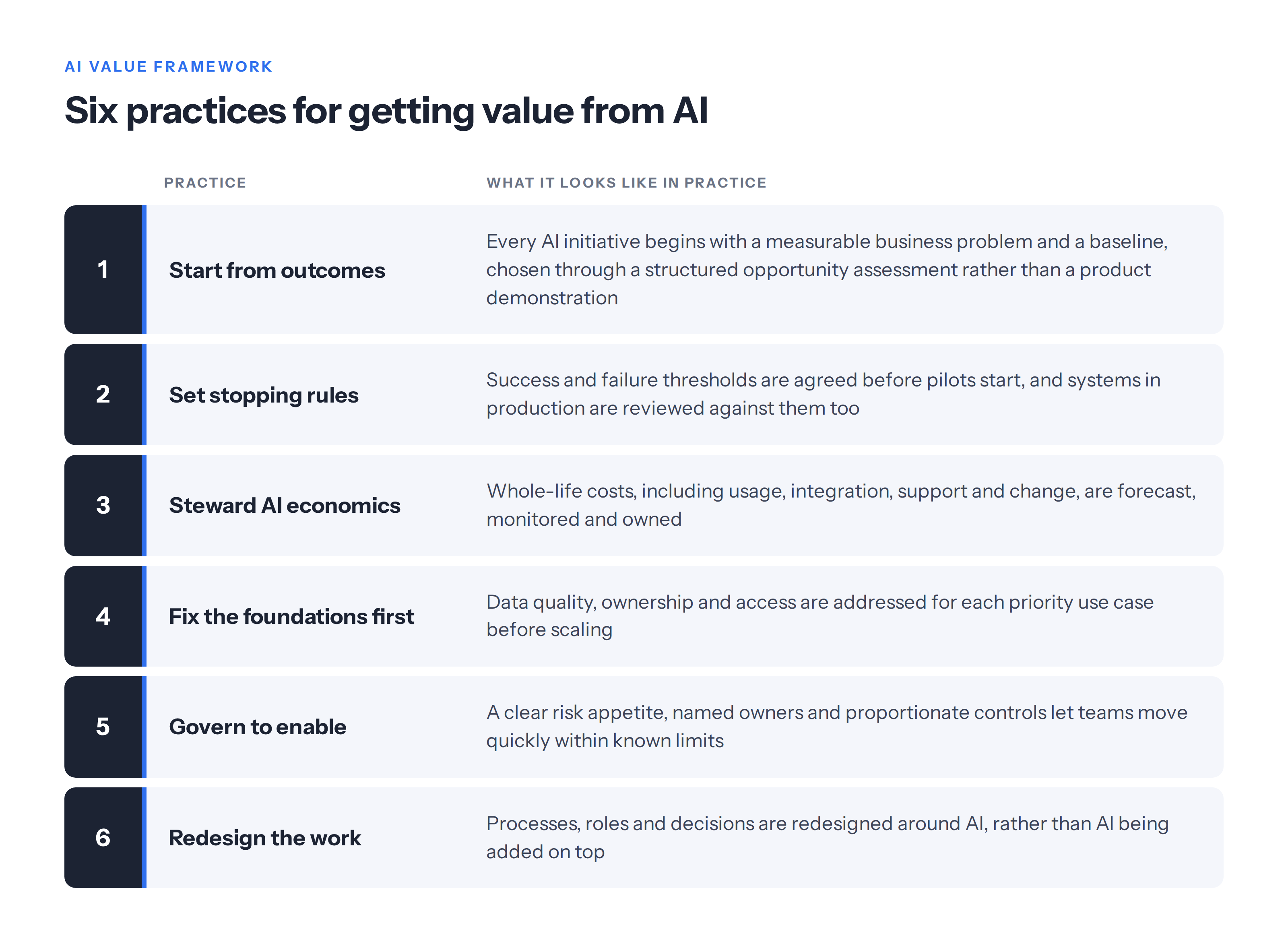
Drawing on Gartner's findings and our own delivery experience, six practices separate organisations that get value from AI from those still waiting for it:
Why do stopping rules matter so much?
Because the biggest drain on AI value is not failure, it is indecision. Pilots that run indefinitely and production systems that are never reviewed absorb budget, licences and staff time without producing a decision.
Stopping rules fix that at two moments:
At the pilot stage, a firm end date, a baseline and agreed success and failure thresholds mean every pilot ends in a decision: scale, adjust or stop. Our guide to moving from AI pilot to scale sets out how to design pilots this way.
In production, regular reviews against value, cost and risk thresholds mean that systems which stop earning their keep are retired, freeing capacity for better opportunities.
Stopping on evidence is a success, not a failure. It is how leaders keep their AI portfolio focused on what works.
What is AI economic stewardship?
It is the discipline of managing AI costs and returns across the whole lifecycle, from business case to retirement. Gartner frames it as a core CIO responsibility. In practice, it means:
Costing the whole lifecycle in the business case, not just licences. Our guide to building an AI business case lists the cost categories most often missed.
Monitoring usage-based costs as adoption grows, with thresholds that trigger review.
Tracking benefits against baselines, with named owners in the business, not the technology team.
Reallocating spend from initiatives that stall to those that deliver.
For agentic AI, this matters even more. Agents can run continuously and call other tools and models, so costs can rise quickly and unpredictably without active oversight.
How can organisations close the AI value gap in the next 90 days?
Start with what you already have:
List every AI initiative and system in pilot or production, with its owner, cost and the outcome it is meant to deliver.
Apply stopping rules retrospectively. For each one, agree what success looks like and by when. Stop or pause anything that cannot answer the question.
Pick two or three priority outcomes and concentrate investment there, with baselines and benefits owners in place.
Put AI costs on a dashboard that finance and technology leaders review together each month.
This is not glamorous work, but it is where value comes from.
How does VE3 help?
Our AI value review takes stock of your AI portfolio, applies stopping rules and economic stewardship to what is already running, and focuses investment on the outcomes most likely to pay back. It draws on our five-phase AI transformation methodology, which builds decision gates, baselines and benefits tracking into every stage, across sectors from healthcare and utilities to education and the public sector.
Conclusion
The AI value gap is real, but it isn't a technology problem. The organisations getting value start from outcomes, stop what isn't working, manage AI economics over the whole lifecycle, fix their data, govern to enable and redesign how work is done. Any organisation can adopt those habits, and the sooner it does, the sooner AI investment starts to show up in results.
Book an AI value review. Find out which of your AI initiatives are earning their keep, and where to focus next.