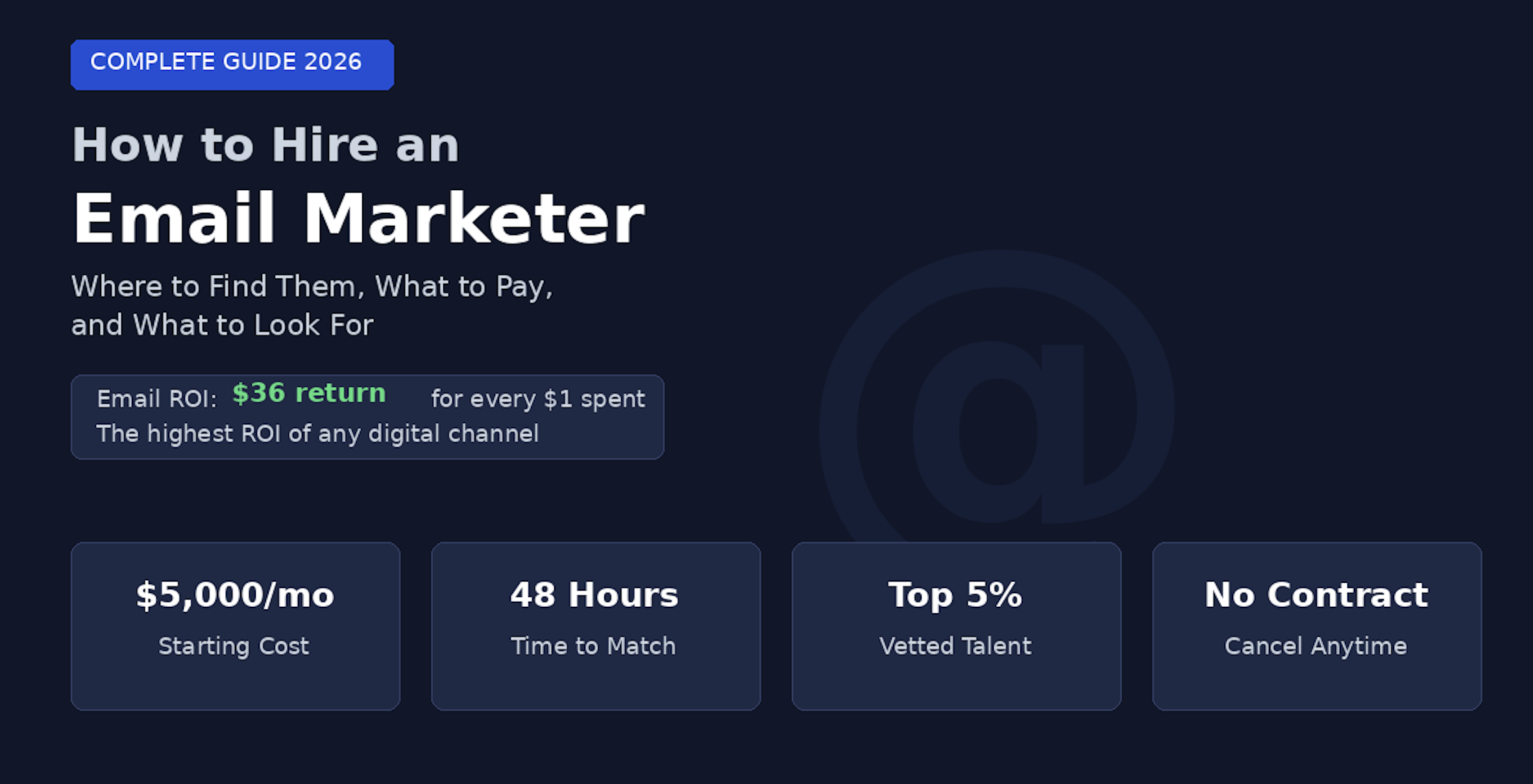
This guide covers everything you need to know about hiring an email marketer in 2026: what skills to look for, where to find them, how much they cost, and how to avoid the most common hiring mistakes.
Why Hiring the Right Email Marketer Matters More Than Ever
Email marketing in 2026 is not what it was five years ago. The bar for what constitutes effective email marketing has risen dramatically, driven by three major shifts:
Privacy changes have reshaped the landscape. Apple's Mail Privacy Protection, Google's sender requirements introduced in 2024, and evolving GDPR enforcement have made list hygiene, deliverability management, and authentication protocols (SPF, DKIM, DMARC) non-negotiable skills. An email marketer who doesn't understand these isn't just underperforming — they're actively risking your sender reputation.
Automation has become the standard. Businesses are no longer competing on whether they have email automation in place. They're competing on the sophistication of their flows — welcome sequences, abandoned cart recovery, post-purchase nurture, win-back campaigns, and cross-sell logic. The difference between a basic three-email welcome sequence and a behaviour-triggered multi-branch flow can be hundreds of thousands in annual revenue.
Subscribers expect personalisation. Generic batch-and-blast emails are increasingly ignored. The marketers who drive results in 2026 are building dynamic segments, using predictive analytics, and creating content that adapts based on purchase history, engagement patterns, and lifecycle stage.
All of this means that hiring the wrong email marketer — someone who can write decent copy but doesn't understand deliverability, automation architecture, or data segmentation — will leave significant revenue on the table. The right hire, on the other hand, can transform email from a cost centre into your most profitable channel.
Quick Tip: Find the top 5% email marketers fast with MarketerHire. Keever SEO has used them to source some of our best talent to date.
What Does an Email Marketer Actually Do?
Before you start hiring, it helps to understand the full scope of what a modern email marketer is responsible for. The role has expanded well beyond "writing and sending emails."
Core Responsibilities
- Strategy development: Building the overarching email programme strategy that ties to business goals — revenue targets, retention metrics, and customer lifetime value
- Automation architecture: Designing and building automated email flows including welcome series, abandoned cart, post-purchase, win-back, browse abandonment, and re-engagement sequences
- Campaign creation: Planning, writing, designing, and sending one-off campaigns including product launches, promotions, newsletters, and seasonal communications
- List management and segmentation: Building dynamic segments based on purchase behaviour, engagement history, demographics, and lifecycle stage. Maintaining list hygiene through regular cleaning and suppression management
- Deliverability management: Monitoring sender reputation, authentication records (SPF, DKIM, DMARC), inbox placement rates, and blacklist status. Troubleshooting deliverability issues before they impact revenue
- A/B testing and optimisation: Running systematic tests on subject lines, send times, content structure, CTAs, and personalisation elements to continuously improve performance
- Reporting and analytics: Building dashboards that track open rates, click rates, conversion rates, revenue per email, list growth, and unsubscribe trends. Translating data into actionable insights
- Platform management: Operating your email service provider (Klaviyo, HubSpot, Mailchimp, ActiveCampaign, Braze, Iterable, etc.) including template builds, integration management, and data syncing
The Three Types of Email Marketers
Not all email marketers are the same. Understanding the distinctions helps you hire the right person for your specific needs:
The Strategist: Focuses on the big picture — programme architecture, channel integration, team management, and revenue strategy. Best for companies that already have execution capability but lack senior direction. Often operates as a fractional or consulting engagement.
The Operator: Handles both strategy and execution — building flows, writing campaigns, managing the ESP, running tests, and reporting on results. This is the most common type of email marketer hire and what most growing companies need. They are hands-on and deliver end-to-end.
The Specialist: Focuses deeply on one aspect of email marketing — typically deliverability, automation engineering, or copywriting. Best for companies with mature email programmes that need targeted expertise in a specific area.
For most companies hiring their first or second email marketer, the Operator profile is the right fit. They can build and run your programme without requiring a larger team to support them.
Skills to Look For When Hiring an Email Marketer
This is where hiring decisions go wrong most often. Companies focus too heavily on copywriting ability and not enough on the technical and strategic skills that actually drive email revenue. Here's the complete skill stack to evaluate:
Must-Have Skills
- ESP proficiency: Deep expertise in at least one major email platform — Klaviyo is dominant in e-commerce, HubSpot in B2B SaaS, Mailchimp for SMBs, and Braze or Iterable for enterprise. The candidate should know your platform or be able to transition quickly.
- Automation design: Ability to map, build, and optimise multi-step automated flows with conditional logic, time delays, and behavioural triggers. Ask to see examples of flows they've built.
- Segmentation and data: Experience creating dynamic segments based on purchase behaviour, engagement scoring, and lifecycle stage. This skill separates email marketers who drive revenue from those who just send emails.
- Deliverability fundamentals: Understanding of SPF, DKIM, DMARC, warm-up protocols, list hygiene best practices, and inbox placement monitoring. If a candidate doesn't know what these acronyms mean, they're not ready for a senior email role.
- Copywriting: Ability to write compelling subject lines, preview text, and email body copy that drives opens and clicks. This matters, but it's one skill among many — not the only one.
- Analytics and reporting: Ability to track, interpret, and act on email performance data. The candidate should be able to explain what metrics they track, how they identify problems, and how they prioritise optimisation efforts.
Nice-to-Have Skills
- HTML/CSS for email: Not all email marketers need to code, but those who can build and troubleshoot email templates without a designer save significant time and cost
- SMS and push integration: Email increasingly sits alongside SMS (Attentive, Postscript) and push notifications as part of a unified lifecycle marketing strategy
- E-commerce platform knowledge: For DTC brands, experience with Shopify, WooCommerce, or BigCommerce integrations with the ESP is valuable
- CRM integration experience: For B2B companies, understanding how email connects to Salesforce, HubSpot CRM, or Pipedrive is important for lead nurturing and sales alignment
How Much Does It Cost to Hire an Email Marketer in 2026?
Costs vary significantly based on experience level, engagement type, and where you source the talent:
Full-Time In-House
- Junior email marketer (1–3 years): $50,000–$70,000/year ($4,200–$5,800/month before benefits)
- Mid-level email marketer (3–6 years): $70,000–$100,000/year ($5,800–$8,300/month)
- Senior email marketer / Head of Lifecycle (6+ years): $100,000–$140,000/year ($8,300–$11,700/month)
- Add 25–35% for benefits, payroll taxes, and overhead
Freelance / Contract
- Upwork / open marketplace: $25–$100/hour depending on experience and geography
- Independent consultant: $100–$250/hour for senior specialists
- Curated platform (e.g., MarketerHire): $5,000–$10,000/month for a pre-vetted email marketing specialist on a subscription model with no contracts
Agency
- Email marketing agency retainer: $2,000–$10,000/month depending on scope (campaign volume, automation builds, strategy involvement)
Which Model Is Right for You?
The right model depends on your stage and needs:
- Full-time hire makes sense if email is a core revenue channel generating $50,000+ per month and you need dedicated, always-on attention
- Freelance / curated platform makes sense if you need senior expertise but don't have enough work (or budget) for a full-time role. This is the sweet spot for most growth-stage companies
- Agency makes sense if you want a full team (strategist + designer + developer) handling your email programme end-to-end and you're comfortable with less direct control
Where to Find Email Marketing Talent in 2026
Here are the best channels for sourcing email marketers, ranked by quality and speed:
1. Curated Talent Platforms (Best for Speed + Quality)
MarketerHire is our top recommendation for hiring an email marketer quickly. The platform pre-vets all talent (accepting only the top 5% of applicants) and uses a concierge matching model: you describe your needs to a dedicated Growth Manager, and they match you with a specialist within 48 hours.
Email and lifecycle marketing is one of MarketerHire's core specialisations. Their network includes Klaviyo, HubSpot, and Mailchimp experts who have built and scaled email programmes for companies ranging from early-stage DTC brands to enterprises like Netflix, Coinbase, and Forbes.
Pricing starts at $5,000/month with no contracts, no deposits, and a free rematch guarantee if the first match isn't the right fit. For companies that need a senior email operator fast — without spending weeks screening profiles — it's the most efficient path available.
2. Your Professional Network
Ask other marketing leaders and founders who they've used for email. Referrals produce high-trust hires, but the pool is limited and there's no structured vetting beyond the referrer's personal experience. Good as a supplementary channel, not a primary one.
3. LinkedIn
Searching "email marketer" or "lifecycle marketer" on LinkedIn surfaces thousands of candidates. The talent is there, but the signal-to-noise ratio is poor. You'll need to invest significant time in profile screening, portfolio reviews, and preliminary calls. Best if you're not in a rush and want maximum control over the selection process.
4. Upwork and Fiverr
The widest talent pools and lowest starting prices in the market. Upwork freelancers range from $25–$100/hour for email work. The tradeoff: vetting is completely your responsibility, quality varies dramatically, and you may interview 10+ candidates before finding the right fit. Fiverr is better for one-off email template designs or single campaign builds rather than ongoing engagement.
5. Specialised Email Agencies
Agencies like InboxArmy, Flowium, and Rejoiner specialise in email and lifecycle marketing. They provide full-team coverage (strategy + design + development) but at a premium. Monthly retainers typically start at $3,000–$5,000 and scale up quickly. Best for companies that want hands-off management of their email programme.
6. ESP Partner Directories
Klaviyo, HubSpot, Mailchimp, and other ESPs maintain directories of certified partners and freelancers. These directories provide a platform-specific quality signal (the freelancer has completed certification in your exact tool), but the pool is smaller and pricing isn't always transparent.
The Hiring Process: Step by Step
Step 1: Define the Role (Before You Talk to Anyone)
Answer these questions first:
- What ESP do you use (or plan to use)?
- What's the current state of your email programme — starting from scratch, or optimising an existing one?
- Do you need strategy, execution, or both?
- What does success look like in 90 days? (e.g., "automated flows generating 30% of email revenue" or "email list growing by 5,000 subscribers/month")
- What's your total budget for email marketing including both the marketer's cost and any tool/ad spend?
Step 2: Source Candidates (1–7 Days)
If speed matters, start with a curated platform like MarketerHire — you'll have a pre-vetted email marketer matched within 48 hours. If you're casting a wider net, run LinkedIn outreach and Upwork postings simultaneously.
Step 3: Portfolio and Case Study Review
Ask every candidate for specific examples of:
- Automated flows they've built (with screenshots of the flow architecture)
- Campaign performance metrics they've achieved (open rates, click rates, revenue per email)
- A/B tests they've run and what they learned
- A deliverability issue they diagnosed and fixed
Any email marketer worth hiring should be able to provide concrete examples with real numbers. Vague descriptions like "I improved email performance" without supporting data are a red flag.
Step 4: Technical Screening (30 Minutes)
Ask these questions to assess technical depth:
- "Walk me through how you'd set up a welcome sequence from scratch for our business. What would the flow look like?"
- "Our open rates have dropped 20% over the last quarter. Walk me through your diagnostic process."
- "Explain SPF, DKIM, and DMARC. Why do they matter?"
- "How do you approach list segmentation for a [your business type] with [your list size] subscribers?"
- "What metrics do you track weekly, and how do you decide what to optimise first?"
A strong candidate should answer all five with specificity and confidence. If they struggle with the deliverability or segmentation questions, they're likely an email copywriter rather than a full-stack email marketer.
Step 5: Paid Test Project (Optional but Recommended)
For freelance and contract hires, consider a short paid test project — such as auditing your current email programme and delivering a prioritised list of recommendations. This reveals how they think, how they communicate, and whether their recommendations are genuinely actionable. Budget $500–$1,000 for a quality audit.
Step 6: Start with a 90-Day Engagement
Avoid long-term contracts upfront. Set clear deliverables and success metrics for the first 90 days, then evaluate. If you hire through a platform like MarketerHire, you're already on a month-to-month subscription with no termination fees — the flexibility is built in.
Email Marketer Hiring Mistakes to Avoid
After working with email marketers across multiple engagements — and seeing other companies make costly errors — here are the biggest mistakes to watch for:
Mistake 1: Hiring a Copywriter When You Need an Operator
Great email copy matters, but it's only one piece of the puzzle. If your email programme needs automation builds, deliverability fixes, segmentation strategy, and platform management, a copywriter alone won't solve the problem. Hire for the full skill stack first; copywriting can be supplemented later.
Mistake 2: Ignoring Deliverability Expertise
You can write the best emails in the world, but if they're landing in spam folders, none of it matters. Deliverability is the most undervalued email marketing skill, and it's the one that most separates senior email marketers from junior ones. Always ask about deliverability experience during the interview.
Mistake 3: Not Defining Success Metrics Upfront
If you don't agree on what success looks like before the engagement starts, you'll spend months in ambiguity. Define specific KPIs: revenue attributed to email, automation revenue as a percentage of total email revenue, list growth rate, and deliverability metrics. Review them bi-weekly.
Mistake 4: Hiring Based on Price Alone
A $30/hour Upwork email marketer might seem like a bargain compared to a $5,000/month MarketerHire subscription. But if the cheaper hire doesn't understand deliverability, builds basic automations that leave revenue on the table, or damages your sender reputation through poor list management, the "savings" become the most expensive decision you make all year.
Mistake 5: Not Giving Them Access to Data
An email marketer can only be as good as the data they have access to. Give them full access to your ESP, your analytics platform, your e-commerce or CRM data, and your customer feedback. The more they understand about your customers, the better their segmentation, personalisation, and strategy will be.
What to Expect in the First 90 Days
Here's a realistic timeline for what a strong email marketer should deliver after being hired:
Days 1–14: Audit and Strategy
- Complete audit of your current email programme (or assessment of what needs to be built from scratch)
- Deliverability health check (authentication, sender reputation, list quality)
- Competitive analysis of how peers and competitors use email
- 90-day email strategy document with prioritised initiatives and projected impact
Days 15–45: Foundation Building
- Core automated flows designed and launched (welcome series, abandoned cart, post-purchase at minimum)
- Segmentation framework built and applied to your list
- Email templates designed and tested across devices and email clients
- Reporting dashboard created with weekly review cadence established
Days 46–90: Optimisation and Scaling
- A/B testing programme running on subject lines, content, send times, and segmentation
- Advanced flows launched (browse abandonment, win-back, cross-sell, VIP)
- Revenue attribution reporting showing email's contribution to total revenue
- First monthly performance review with data-backed recommendations for month 4 and beyond
If your email marketer hasn't delivered a strategy document in the first two weeks and launched core automations by week six, the engagement may not be the right fit.
Key Takeaways
- Email remains the highest-ROI digital channel at $36 return per $1 spent, but capturing that return requires a skilled operator — not just someone who can write a subject line.
- Hire for the full skill stack: automation, segmentation, deliverability, analytics, and copywriting. Technical depth matters as much as creative ability.
- The fastest path to a quality hire is a curated platform. MarketerHire matches you with a pre-vetted email marketing specialist within 48 hours, on a month-to-month basis starting at $5,000/month — trusted by Netflix, Coinbase, and Forbes.
- Start with a 90-day pilot with clear deliverables: programme audit by week 2, core automations live by week 6, and optimisation results by week 12.
- Don't hire on price alone. A cheap hire who damages your sender reputation or builds underperforming automations costs far more in lost revenue than a premium hire who gets it right the first time.
If you're ready to hire an email marketer, book a free scoping call with MarketerHire. Their Growth Managers understand the difference between a campaign writer and a full-stack lifecycle marketer — and they'll match you with the right specialist for your specific needs. No deposit, no contracts, and most companies are matched within 48 hours.
Frequently Asked Questions
How much does it cost to hire an email marketer?
Full-time email marketers cost $50,000–$140,000/year depending on experience level, plus 25–35% for benefits and overhead. Freelance rates range from $25–$250/hour. Curated platforms like MarketerHire offer pre-vetted email specialists on a subscription model starting at $5,000/month with no contracts.
What skills should an email marketer have?
The core skill stack includes: ESP proficiency (Klaviyo, HubSpot, Mailchimp, etc.), automation design and build capability, list segmentation and data management, deliverability knowledge (SPF, DKIM, DMARC), copywriting, A/B testing methodology, and analytics and reporting. Senior email marketers should be competent across all of these areas.
Where is the best place to hire an email marketer?
For speed and quality, curated talent platforms like MarketerHire offer pre-vetted email marketing specialists matched within 48 hours. For budget flexibility, Upwork provides the widest freelancer pool. For full-service management, specialised email agencies like InboxArmy or Flowium handle strategy through execution. LinkedIn and your professional network are also viable for sourcing candidates.
Should I hire a freelance email marketer or a full-time employee?
If email generates over $50,000/month in revenue and requires daily attention, a full-time hire is justified. For most growth-stage companies, a freelance or contract email marketer provides senior expertise at a lower cost with more flexibility. Curated platforms give you the quality of a full-time hire with the flexibility of a contractor.
What's the difference between an email marketer and an email copywriter?
An email copywriter writes the content of emails — subject lines, body copy, and CTAs. An email marketer handles the entire programme: strategy, automation architecture, segmentation, deliverability, analytics, and copywriting. Most companies need a full email marketer, not just a copywriter, especially when building or scaling a programme.
How long does it take to hire an email marketer?
Traditional hiring through job boards takes 3–6 weeks on average. Curated platforms like MarketerHire can match you with a pre-vetted email specialist within 48 hours. LinkedIn and Upwork sourcing typically takes 1–3 weeks including screening and interviews.
What should I look for in an email marketer's portfolio?
Ask for screenshots of automated flows they've built, specific campaign metrics (open rates, click rates, revenue per email), examples of A/B tests and results, and at least one example of a deliverability issue they diagnosed and resolved. Concrete numbers beat vague descriptions every time.