A non-technical founder can now build a working app prototype over a weekend. I've watched it happen. They describe what they want to Lovable or Bolt, iterate a few times, and end up with something that runs on a phone. In 2023 that would have taken a contractor a fortnight. The change is real, and for anyone testing an idea it's one of the best things to happen to early-stage product work in years.
Then the prototype succeeds, real users arrive, and the questions get harder. This is the moment most of our enquiries now start with: "We built it in Bubble / Lovable / FlutterFlow, it's working, and now we're stuck." If you run a startup or a product team in Greater Manchester, the odds are good that either you or someone in your network is sitting exactly there right now.
The wave is real, and so is the catch
The adoption numbers are not hype. In Y Combinator's Winter 2025 batch, a quarter of startups had codebases that were 95% or more AI-generated. GitHub says roughly 46% of all new code is now written by AI, and Gartner expects that to pass 60% before the end of 2026. The tools genuinely build software.
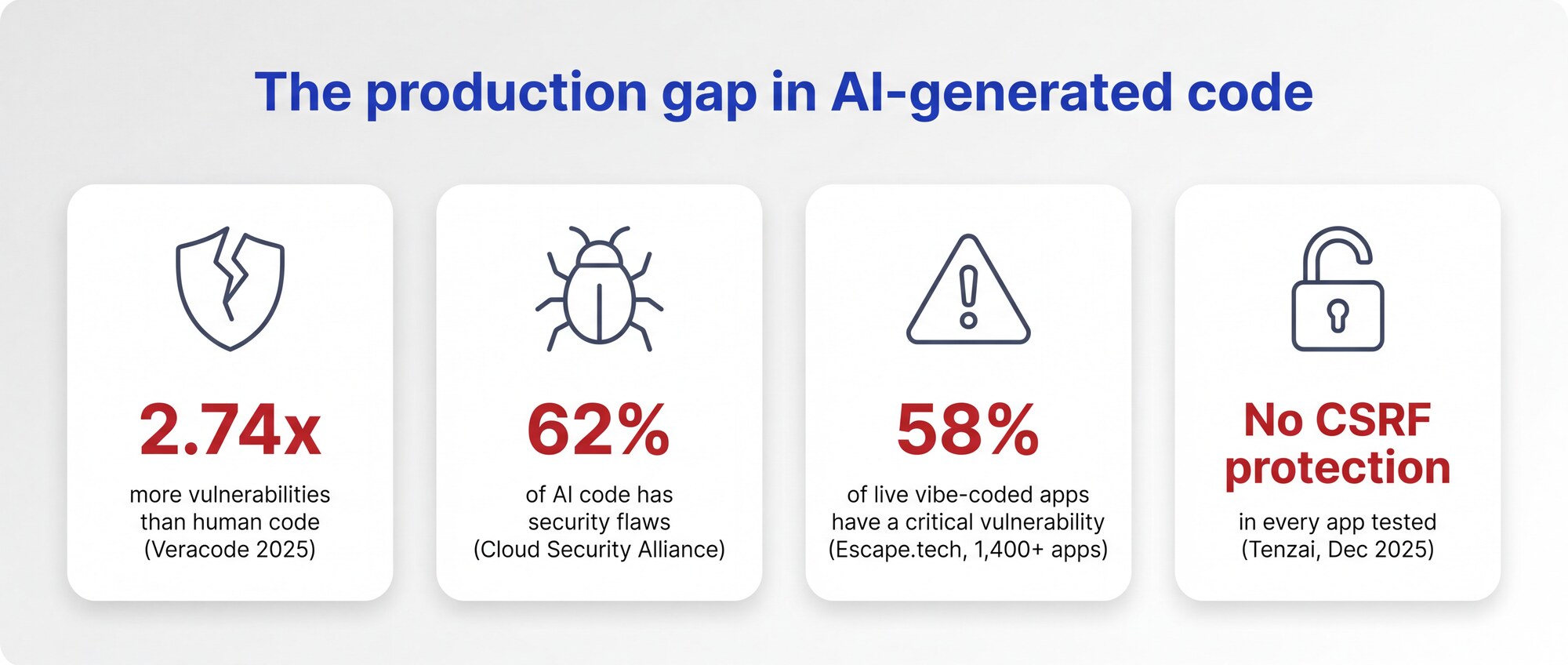
What they don't build, on their own, is software that's safe to ship. Veracode's 2025 GenAI Code Security Report tested more than 100 models and found that AI-generated code carries 2.74 times more vulnerabilities than human-written code. The security firm Escape.tech scanned over 1,400 live vibe-coded applications and found 58% had at least one critical vulnerability, with hundreds of exposed secrets between them. The model optimises for "does the demo work", not "what happens when someone hostile pokes at the login endpoint".
Three walls every founder hits
When a vibe-coded MVP starts to grow, the same three problems turn up.
The App Store. Apple's Guideline 4.2 (Minimum Functionality) exists specifically to keep repackaged websites out. A Lovable or Bolt build wrapped in Capacitor is detectable in seconds, and reviewers test for native gestures, real screen transitions, push notifications and offline handling. Wrap a web app in a native shell and it gets rejected on the first attempt.
Hardware and scale. WebView apps can't reliably deliver background push or background location, can't reach Bluetooth peripherals or the biometric enclave without native bridge code, and chew through memory on older Android phones. None of this shows up in the demo. All of it shows up the week real users arrive.
Lock-in. Bubble exports no source code, so outgrowing it means a rebuild. Lovable and Bolt produce real code, but it's web code (React, Vite, Tailwind) that needs rebuilding against native components.
The answer isn't "AI or humans"
The framing that's wrong in 2026 is the old "AI versus human developers" debate. It was never a contest. You use AI to get going and a team to make it last. The teams that win treat the vibe-coded MVP and the production app as two chapters of the same story.
The expensive mistake we see most often is paying for a quick native wrapper as a stopgap, then paying again three to six months later for the rebuild that was always coming. Industry estimates put a full rebuild at $50,000 to $250,000, and UK agency quotes for the same project can range from £5,000 to £60,000 depending on scope. That spread tells you the decision matters more than the build.
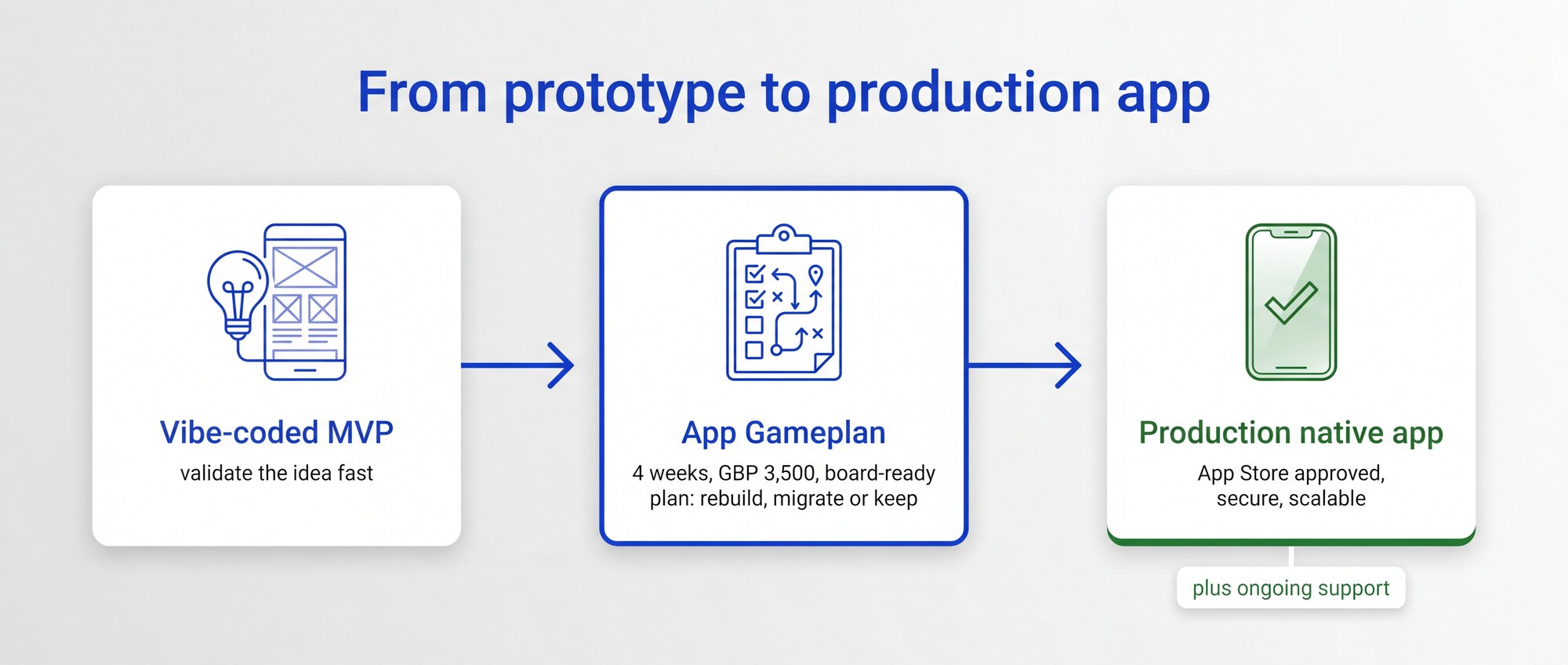
What's salvageable depends entirely on what you built on. FlutterFlow exports real Flutter and Dart, so a specialist team can refactor and extend it; the salvage rate is high. Lovable and Bolt apps keep their business logic, API code and Supabase or Firebase setup, with the UI rebuilt in React Native. Bubble apps usually keep their database and workflows behind a fresh native frontend. The only way to know which path is right is to look before you build, which is exactly what our App Gameplan is for: four weeks, a fixed £3,500, and a board-ready plan that says what to rebuild, what to keep, what it'll cost, and how long it'll take.
If your prototype is working and you're weighing up what "going native" actually takes, we've written the full breakdown, including what carries over from each platform and why the App Store wall exists: AI-Generated Apps vs Production Apps. And when you're ready to make the move, that's our Vibe Code to Production service.
AI gets you a brilliant first draft. A team of humans turns it into something you'd stake your company on. Use both, in that order.