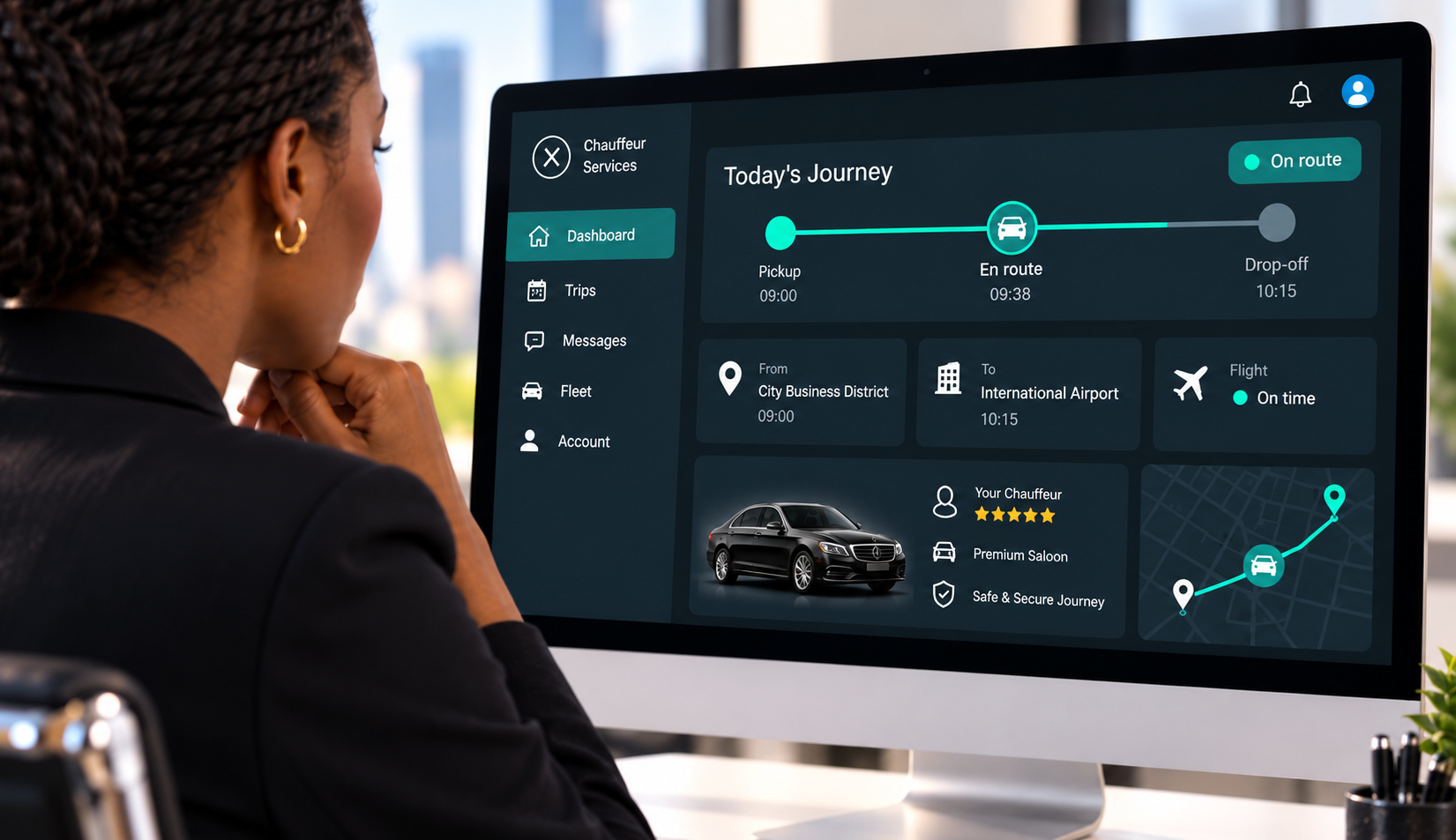
When most people think about a chauffeur service, technology probably isn't the first thing that comes to mind. The visible part of the service is still very traditional: a professional chauffeur, a well-presented vehicle and a passenger who needs to get somewhere.
Behind that journey, however, the industry has changed considerably.
Online booking, secure payments, automated communications, live flight information, location technology and privacy-focused communication systems can now sit behind what should ultimately feel like a very simple experience for the passenger.
At Get Chauffeur Service®, we began adopting many of these technologies nearly five years ago, at a time when they were still far from commonplace among smaller chauffeur operators.
The objective wasn't to make chauffeur travel more technical. It was the opposite: to use technology to remove friction from the experience.
From an enquiry to a confirmed journey
One of the most obvious changes has been the way a journey is booked and managed.
Traditionally, chauffeur bookings could involve numerous telephone calls and emails, with addresses, flight numbers, passenger details and timings being passed backwards and forwards.
Digital booking systems have made much of this considerably more structured.
A quotation can be produced online, journey information recorded electronically and a confirmation issued to the client detailing what has actually been booked.
This is particularly useful when the person booking the vehicle isn't the person travelling.
An executive assistant in London, for example, might be arranging transportation for a CEO flying into Manchester. They need confidence that the airport collection, hotel, subsequent meetings and passenger information have all been recorded correctly without having to repeatedly telephone the operator.
For us, technology is increasingly about providing that visibility while keeping the human service behind it.
Payments have changed too
The way clients expect to pay for professional services has also evolved.
Secure online payment platforms mean a client no longer needs to provide card information over the telephone simply to arrange a vehicle. Corporate and private clients can make payments electronically, while APIs allow different technology platforms to communicate behind the scenes.
The passenger doesn't necessarily know — or need to know — what is happening technically.
They simply see a smoother process.
That is arguably when business technology works best: when the complexity happens in the background and the customer experience becomes simpler as a result.
Communication without exchanging personal numbers
One of the technologies our clients have responded particularly well to is number masking.
There is an obvious requirement for a chauffeur and passenger to communicate. A chauffeur might need to say they have arrived, while the passenger may need to explain that they are leaving a meeting slightly later than expected or help identify exactly where they are waiting.
Historically, the obvious solution was simply to give both parties each other's mobile telephone numbers.
We no longer need to do that.
Using communications technology provided through Twilio, our passengers and chauffeurs can communicate by SMS or voice call without either needing access to the other's personal telephone number.
The conversation works normally, but the personal contact details behind it remain masked.
While digital booking and automated communications have become more widespread, number masking remains much less common within the chauffeur industry. It is a feature we adopted nearly five years ago and continue to use today.
For an everyday journey that is convenient. At CEO, board, high-net-worth or other senior executive level, it becomes considerably more important.
An executive assistant arranging transport doesn't necessarily want a senior colleague's private mobile number being distributed every time a chauffeur is booked. Equally, there is little reason a passenger should need to retain a chauffeur's personal mobile number after a journey has finished.
Technology allows the necessary communication to take place without unnecessarily exchanging that personal information.
Keeping the booker informed
The passenger isn't always the only person who needs information.
This is something that can easily be overlooked in business travel.
A PA, travel manager or executive assistant who has arranged a journey may simply want to know that everything is progressing as expected.
Automated email and SMS status notifications can provide that reassurance.
When the chauffeur is en route or has arrived, relevant journey updates can be communicated without the booker having to telephone the passenger or chauffeur to ask what is happening.
It is a relatively small technological change, but operationally it removes a surprising amount of unnecessary communication.
Instead of somebody chasing information, the information comes to them.
Working with the flight rather than the timetable
Airport transportation is another area where access to live information has changed the way chauffeur services operate.
A flight might be scheduled to arrive at Manchester Airport at 14:10, but the actual landing time may be earlier or considerably later.
Simply working from the arrival time entered when the journey was booked isn't enough.
Flight tracking allows the operation to react to the actual progress of the aircraft. That means changes to arrival times can be considered before the passenger has even landed.
Again, the technology itself isn't what the passenger is buying.
The passenger simply wants the chauffeur operation to know that their flight is late without them having to send a message from the aircraft explaining it.
That distinction is important. Technology should eliminate work for the customer rather than create more of it.
Pinpointing exactly where a journey starts, stops and ends
Navigation technology has transformed driving, but a postcode or conventional street address doesn't always tell a chauffeur exactly where a passenger needs to be collected, where they need to stop during a journey or precisely where they need to be dropped off.
Large private properties, rural locations, event venues, business parks, estates, temporary meeting points and sites with multiple entrances can all create situations where a standard postal address is not precise enough.
This is where services such as what3words can be particularly useful.
A passenger or booker can provide a precise location for the start of a journey, an intermediate stop or the final destination rather than relying entirely on a postcode or broad street address.
For a chauffeur, this can remove uncertainty around the final few metres of a collection, stop or drop-off. For the passenger, particularly at an unfamiliar location, it can make the difference between arriving somewhere nearby and arriving exactly where they need to be.
It is another example of relatively simple technology solving a very practical operational problem.
Technology shouldn't replace the human part
There is an interesting contradiction in all of this.
The more technology we have introduced into our operation, the more important the human element has become.
A system can tell us that an aircraft has landed. It cannot decide how much time a particular international passenger is likely to require before reaching arrivals.
Software can record an itinerary. It cannot understand that a meeting has overrun and that the rest of the day's timings now need to be reconsidered.
Navigation can calculate a route. An experienced chauffeur still has to make decisions based on traffic, road closures, the passenger's priorities and what is actually happening around them.
And automated messages can provide information, but there are still occasions when somebody simply needs to pick up the telephone and deal with a problem.
For us, technology has never been about removing people from the service.
It is about giving those people better information and removing repetitive processes so they can concentrate on the passenger.
A traditional industry becoming digitally connected
The chauffeur industry will always have a physical service at its centre. Ultimately, a vehicle and chauffeur still have to turn up at the right place, at the right time and complete the journey properly.
No app, API or automated notification changes that.
What technology can change is everything surrounding the journey.
It can make booking easier, payments more secure, information more accessible, communication more private and operations more responsive.
When we began adopting these systems nearly five years ago, many were still relatively uncommon within smaller chauffeur operations. Since then, what has been most noticeable is how quickly clients have come to value the convenience and visibility they provide.
Not because they particularly want to think about the technology.
Quite the opposite.
They value it because, when everything works as intended, there is less for them to think about.
For a business built around getting people from one place to another reliably, that may be the most useful technology of all.
About the author
Imran Latif is the founder of Get Chauffeur Service®, a Manchester-based professional chauffeur company providing executive ground transportation across Manchester and the UK.